What 206 bones actually means
The number is right, it just isn’t the number of individual names you would have to learn, and that changes how you might go about learning them. Here is the whole accounting, bone by bone.
In short: 206 bones, 80 in the axial skeleton and 126 in the appendicular. The Bone Room teaches 48 individual names, which cover 84 bones, and introduces the other 122 through numbered or grouped sets.
01 · The count
Where the 206 come from.
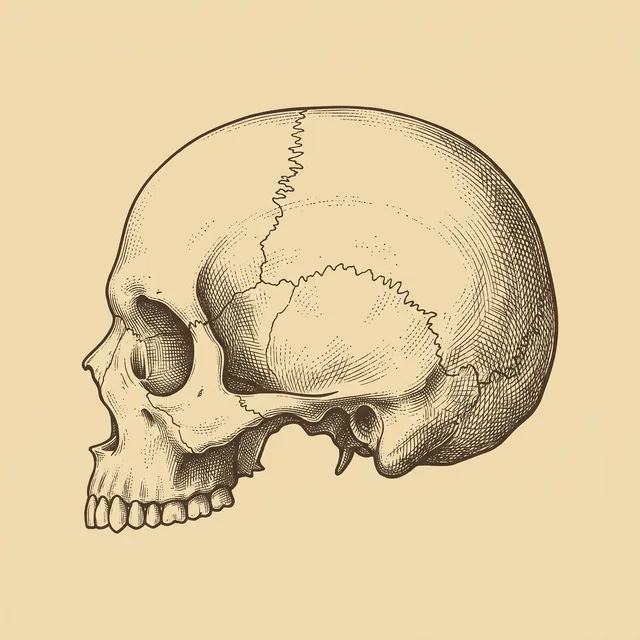
An adult skeleton has 206 bones, and anatomists split them down the middle. Eighty of them make up the axial skeleton, which is the skull, the spine and the rib cage, and the other 126 make up the appendicular skeleton, which is your arms and legs and the girdles that hang them off the trunk.
Babies have more, because a lot of bones start out in pieces and fuse as you grow, and some adults keep a spare or two. But 206 is the standard count, and it is the one The Bone Room works to.
Counts follow OpenStax, Anatomy and Physiology 2e, section 7.1, Divisions of the Skeletal System.
02 · The names
The Bone Room teaches 48 individual names.
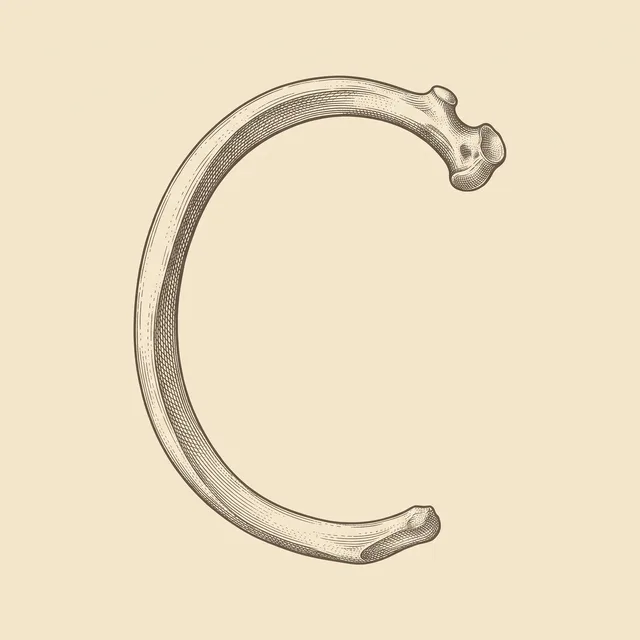
In The Bone Room’s curriculum, 48 bones are taught by their own individual names, and because most of them come as a left and a right, those 48 names cover 84 bones.
The other 122 bones are introduced through numbered or grouped sets, which is also how anatomy usually refers to them. The 24 ribs are numbered one to 12 on each side. The 22 vertebrae of the neck and back go by their region and a number, so a doctor says C3 or T7, and only atlas and axis at the very top carry names of their own. The 20 long bones in your palms and the soles of your feet are numbered too, and so are the 56 phalanges in your fingers and toes, which the lab teaches by row.
The wrist and the ankle are the surprise in the other direction. Each of the 8 bones in a wrist and the 7 bones in an ankle has its own name, and so does each of the 8 bones of the braincase. Those are the ones people are usually delighted to find out about.
03 · The ledger
All 206, accounted for.
This is the full list, generated from the same records the app teaches from, so if the curriculum ever changes this page changes with it.
| Entry | Case file | How it is named | Bones |
|---|---|---|---|
| clavicle | The Arm & Shoulder | named | 2 |
| scapula | The Arm & Shoulder | named | 2 |
| humerus | The Arm & Shoulder | named | 2 |
| radius | The Arm & Shoulder | named | 2 |
| ulna | The Arm & Shoulder | named | 2 |
| femur | The Leg | named | 2 |
| patella | The Leg | named | 2 |
| tibia | The Leg | named | 2 |
| fibula | The Leg | named | 2 |
| sternum | The Chest | named | 1 |
| sacrum | The Spine & Pelvis | named | 1 |
| coccyx | The Spine & Pelvis | named | 1 |
| hip bone | The Spine & Pelvis | named | 2 |
| mandible | The Head & Throat | named | 1 |
| maxilla | The Head & Throat | named | 2 |
| hyoid | The Head & Throat | named | 1 |
| zygomatic bone | The Facial Bones | named | 2 |
| nasal bone | The Facial Bones | named | 2 |
| lacrimal bone | The Facial Bones | named | 2 |
| palatine bone | The Facial Bones | named | 2 |
| inferior nasal concha | The Facial Bones | named | 2 |
| vomer | The Facial Bones | named | 1 |
| malleus | The Auditory Ossicles | named | 2 |
| incus | The Auditory Ossicles | named | 2 |
| stapes | The Auditory Ossicles | named | 2 |
| carpals | The Hand | 16 named bones inside | 16 |
| tarsals | The Foot | 14 named bones inside | 14 |
| cranium | The Head & Throat | 8 named bones inside | 8 |
| rib | The Chest | counted, in two classes | 24 |
| phalanges | The Hand | counted, in three classes | 28 |
| phalanges | The Foot | counted, in three classes | 28 |
| cervical vertebrae | The Spine & Pelvis | counted, atlas and axis named | 7 |
| thoracic vertebrae | The Spine & Pelvis | counted | 12 |
| lumbar vertebrae | The Spine & Pelvis | counted | 5 |
| metacarpals | The Hand | counted | 10 |
| metatarsals | The Foot | counted | 10 |
| Total | 206 |
04 · The 48
The 48 individual names, with what people usually call them.
- claviclecollarbone
- scapulashoulder blade
- humerusupper arm bone
- radiusforearm bone (thumb side)
- ulnaforearm bone (pinky side)
- femurthigh bone
- patellakneecap
- tibiashinbone
- fibulacalf bone
- sternumbreastbone
- sacrumbase of the spine
- coccyxtailbone
- hip bonepelvis (each side)
- talusankle bone
- calcaneusheel bone
- mandiblelower jawbone
- maxillaupper jaw
- hyoidthroat bone
- zygomatic bonecheekbone
- nasal bonebridge of the nose
- lacrimal bonetear bone
- palatine boneback of the roof of the mouth
- inferior nasal conchascroll bone of the nose
- vomernose divider
- malleushammer
- incusanvil
- stapesstirrup
- frontal boneforehead bone
- parietal bonetop of the head
- temporal bonetemple bone
- occipital boneback of the head
- sphenoid bonebutterfly bone
- ethmoid bonesieve bone
- atlas
- axis
- navicular boneboat-shaped foot bone
- cuboid bonecube-shaped foot bone
- medial cuneiforminner wedge bone
- intermediate cuneiformmiddle wedge bone
- lateral cuneiformouter wedge bone
- scaphoidboat-shaped wrist bone
- lunatemoon-shaped wrist bone
- triquetrumthree-cornered wrist bone
- pisiformpea-shaped wrist bone
- trapeziumthumb-saddle wrist bone
- trapezoidsmall table-shaped wrist bone
- capitatehead-shaped wrist bone
- hamatehooked wrist bone
05 · In the lab
What The Bone Room does with this.
The lab teaches the 48 individual names, and it teaches the counted sets as what they are, so you learn the ribs as the ribs and the finger bones as the phalanges rather than memorizing a name for each. That comes to 67 case entries across 15 case files, and between them they account for every one of the 206.
The same table sits inside the app, so you can always see what has been covered. Here is how an examination works, if you want the rest of the system.
| Coverage | Entries | Bones |
|---|---|---|
| Named individually | 48 | 84 |
| Groups fully broken down (carpals, tarsals, cranium) | 3 | counted above |
| Named by class or row | 11 | 80 |
| Named by region and count | 5 | 42 |
| Total | 67 | 206 |
Start learningBegin with four bones. It’s free, and you don’t need an account.