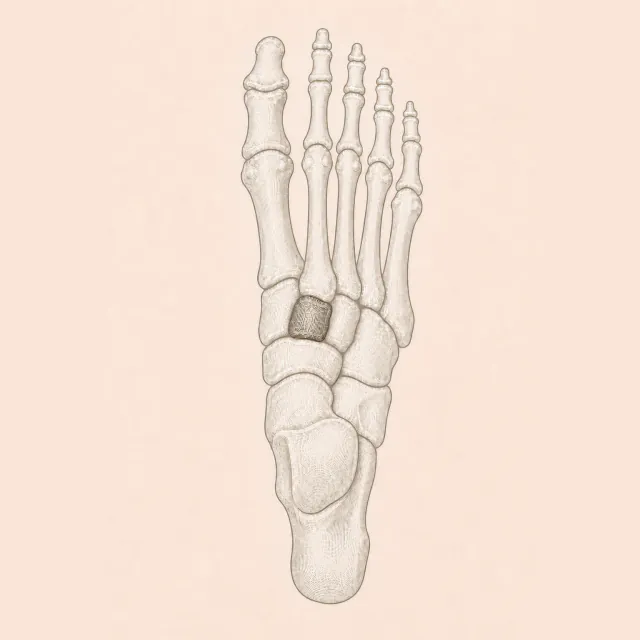
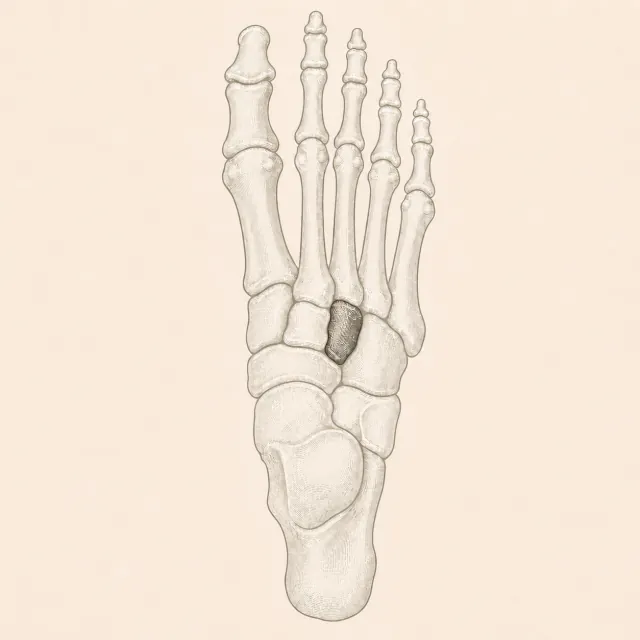
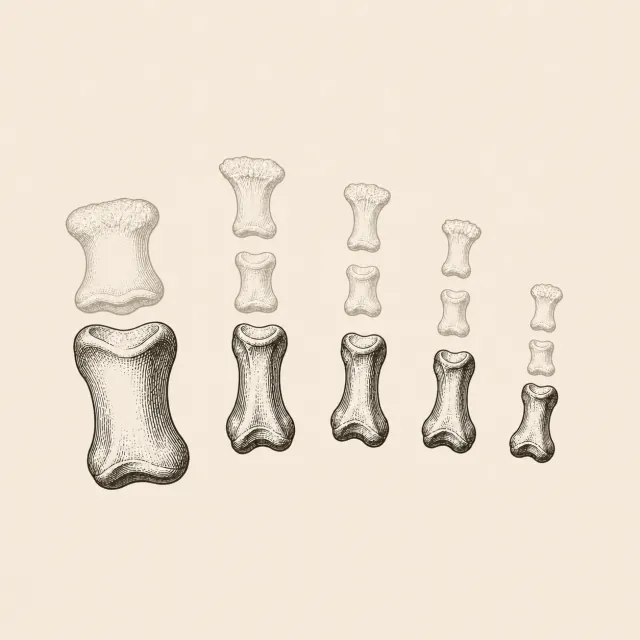
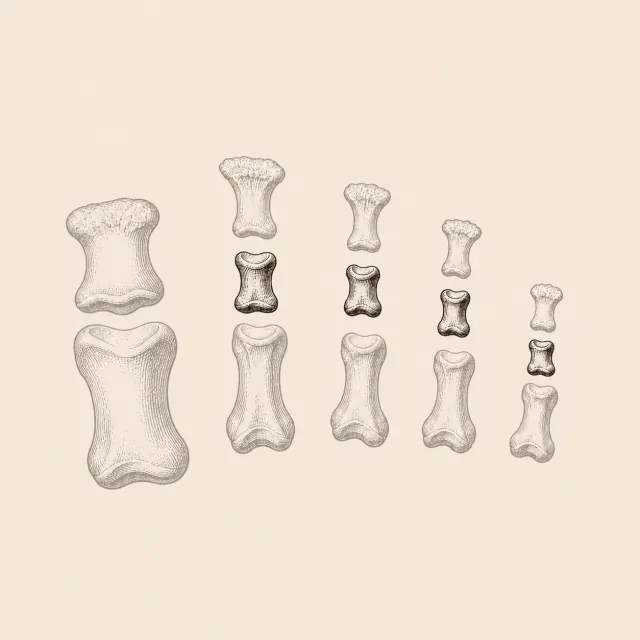
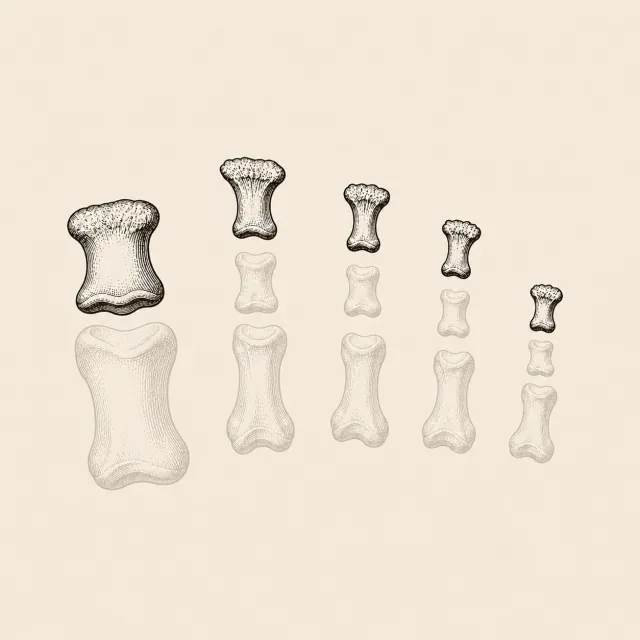
The standard count is 26 bones in each foot: seven tarsals, five metatarsals, and 14 phalanges. The big toe has two phalanges while each of the other toes has three, which is how the last group reaches 14.
You may also see 28. Two small sesamoid bones are usually tucked beneath the head of the first metatarsal, near the base of the big toe, and some accounts add them to the familiar 26. They can vary from person to person, so The Bone Room follows the standard skeleton count and treats them as extra rather than quietly changing the total.
This page has 13 entries for the 26 bones in one foot. Some entries name a family, such as the tarsals or phalanges, and others open that family up so you can meet the talus, calcaneus, navicular, cuboid, and three cuneiforms one at a time. Across both feet, the standard count contributes 52 of the body's 206. It is a crowded little structure, which makes sense when you consider how it takes your weight while bending enough to carry you over the ground.
This is how the lab asks. A bone you name today comes back a week later to be named again, and that is how it stays known.
Identify the specimen
The group of chunky bones forming the ankle and rear half of the foot.
14 (7 per foot)
tarsals
“ankle bones”
In the body14 (7 per foot)
DescriptionThe group of chunky bones forming the ankle and rear half of the foot.
Field noteSeven per foot. Two of them are famous enough to get their own case entries: the talus and the calcaneus.
Identify the specimen
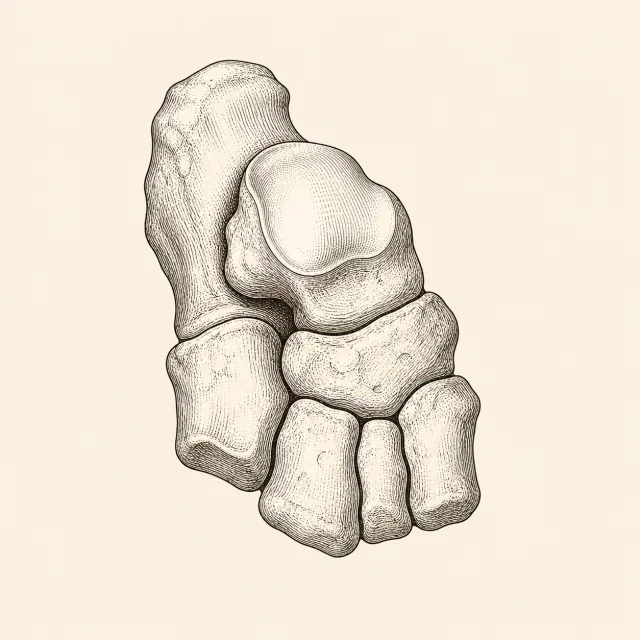
The tarsal bone sitting on top of the foot, where the shinbone lands.
2 (one per foot)
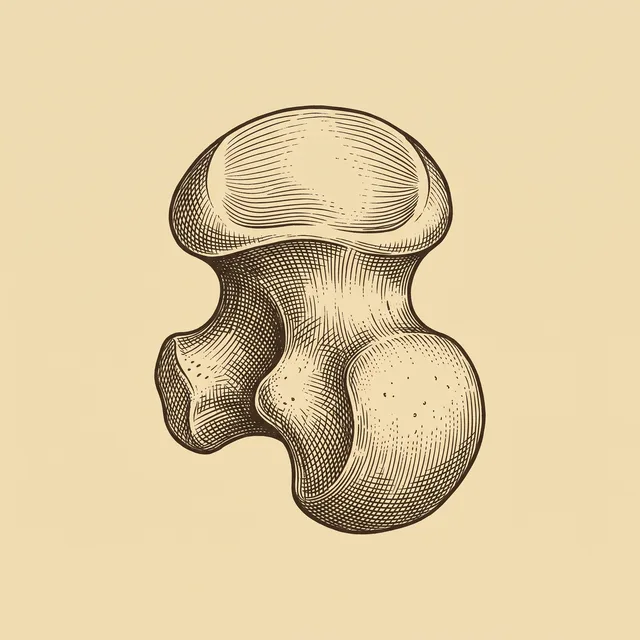
talus
plural: tali
“ankle bone”
In the body2 (one per foot)
DescriptionThe tarsal bone sitting on top of the foot, where the shinbone lands.
Field noteYour entire body weight passes through it with every step, yet not a single muscle attaches to it. It’s held purely by ligaments and its neighbors.
Identify the specimen
The large bone forming the heel.
2 (one per foot)
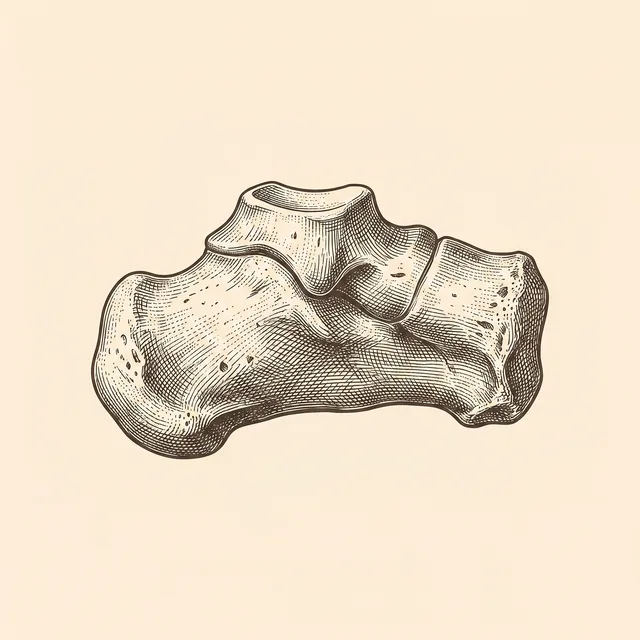
calcaneus
plural: calcanei
“heel bone”
In the body2 (one per foot)
DescriptionThe large bone forming the heel.
Field noteThe largest bone of the foot, and the anchor of the Achilles tendon: the strongest tendon in the body pulling on the sturdiest tarsal.
Identify the specimen
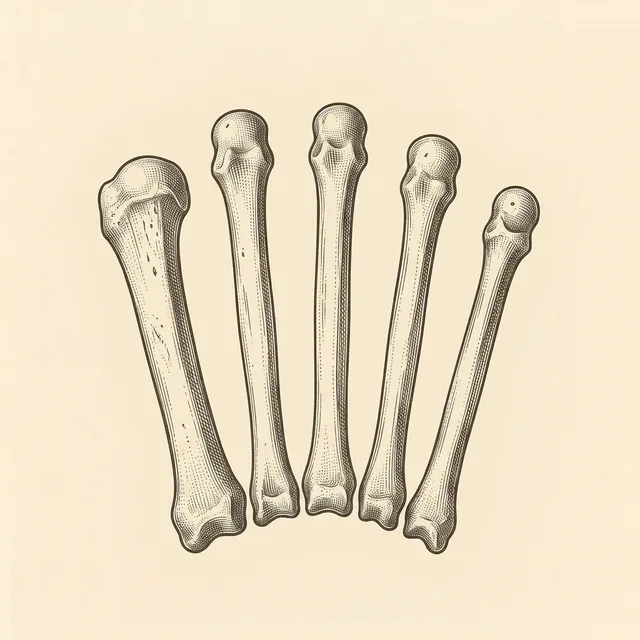
The five long bones spanning the sole, between the ankle bones and the toes.
10 (5 per foot)
metatarsals
“long bones of the foot”
In the body10 (5 per foot)
DescriptionThe five long bones spanning the sole, between the ankle bones and the toes.
Field noteMarathon runners know them well: hairline "stress fractures" here were first described in soldiers and named march fractures.
Identify the specimen
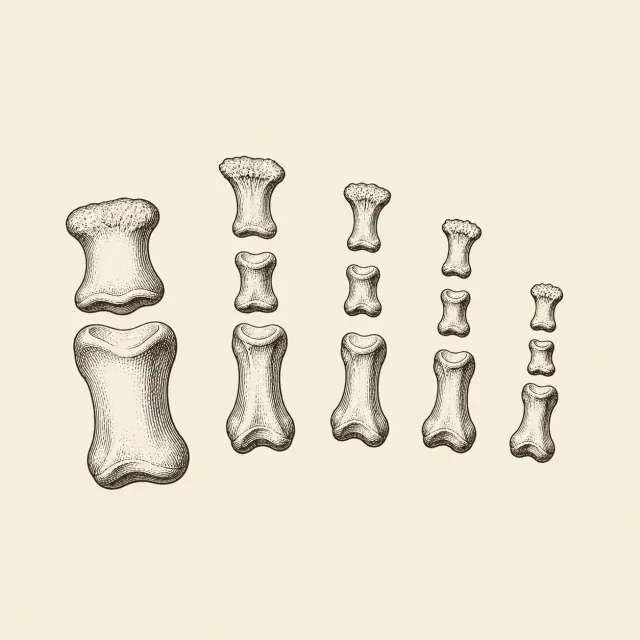
The small bones inside the toes.
28 (14 per foot)
phalanges
“toe bones”
In the body28 (14 per foot)
DescriptionThe small bones inside the toes.
Field noteSame plan as the hand: three per toe, two for the big toe. Fourteen per foot, and every one of them finds the furniture in the dark.
02 · Questions
The questions people ask about these bones.
How many bones are in the foot?
Twenty-six in the standard count: seven tarsals, five metatarsals, and 14 toe phalanges. Two sesamoids are also usually present beneath the first metatarsal, which is why some diagrams show 28. OpenStax, Bones of the Lower Limb and StatPearls, Foot Bones
The talus meets the tibia and fibula to form the ankle joint, then passes body weight down toward the calcaneus. About 60 percent of its surface is covered in cartilage, and it has no muscular or tendinous attachments. StatPearls, Foot Bones
What holds up the arch of the foot?
The foot has longitudinal arches running from heel to toe and a transverse arch running across it. Ligaments bind the neighboring bones together, and muscle contractions help support the arches when the foot is bearing weight. OpenStax, Bones of the Lower Limb
DescriptionThe group of chunky bones forming the ankle and rear half of the foot.
Field noteSeven per foot. Two of them are famous enough to get their own case entries: the talus and the calcaneus.
On record
Each foot has seven tarsals: two in the hindfoot and five in the midfoot. StatPearls
The talus and calcaneus form the hindfoot; the navicular, cuboid, and three cuneiforms form the midfoot. StatPearls
talus
plural: tali
“ankle bone”
talus2 (one per foot)
In the body2 (one per foot)
DescriptionThe tarsal bone sitting on top of the foot, where the shinbone lands.
Field noteYour entire body weight passes through it with every step, yet not a single muscle attaches to it. It’s held purely by ligaments and its neighbors.
On record
No muscle attaches directly to the talus, even though it transfers forces between the leg and foot. StatPearls
Around 60 percent of the talus is covered with smooth joint cartilage, leaving relatively little exposed surface for blood vessels. StatPearls
calcaneus
plural: calcanei
“heel bone”
calcaneus2 (one per foot)
In the body2 (one per foot)
DescriptionThe large bone forming the heel.
Field noteThe largest bone of the foot, and the anchor of the Achilles tendon: the strongest tendon in the body pulling on the sturdiest tarsal.
On record
The calcaneus is the largest tarsal and transfers much of the body’s weight from the leg to the ground. StatPearls
The Achilles tendon attaches to the calcaneus, turning calf-muscle force into the push that lifts the heel. StatPearls
metatarsals
“long bones of the foot”
metatarsals10 (5 per foot)
In the body10 (5 per foot)
DescriptionThe five long bones spanning the sole, between the ankle bones and the toes.
Field noteMarathon runners know them well: hairline "stress fractures" here were first described in soldiers and named march fractures.
On record
Metatarsals are numbered one to five from the big-toe side toward the little toe. StatPearls
The base of the second metatarsal locks into the midfoot like a keystone, helping stabilize the Lisfranc joint. StatPearls
phalanges
“toe bones”
phalanges28 (14 per foot)
In the body28 (14 per foot)
DescriptionThe small bones inside the toes.
Field noteSame plan as the hand: three per toe, two for the big toe. Fourteen per foot, and every one of them finds the furniture in the dark.
On record
A foot has 14 toe phalanges: three per smaller toe and two in the great toe. StatPearls
The first and second toe joints are major contributors to balance, weight bearing, and the mechanics of walking. StatPearls
navicular bone
plural: navicular bones
“boat-shaped foot bone”
navicular bone2 (one per foot)
In the body2 (one per foot)
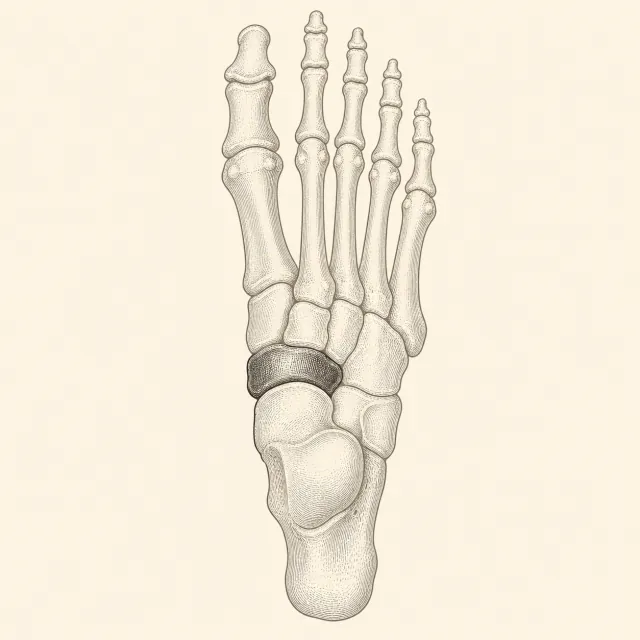
DescriptionA curved midfoot bridge between the rounded head of the talus and the three wedge bones in front.
Field noteIt meets five other tarsals and receives the posterior tibial tendon, an important dynamic supporter of the medial foot arch.
On record
The navicular’s curved joint with the talar head has been compared with a miniature hip joint and called the “coxa pedis.” StatPearls
The posterior tibial tendon attaches to the navicular and helps support the medial foot arch. StatPearls
cuboid bone
plural: cuboid bones
“cube-shaped foot bone”
cuboid bone2 (one per foot)
In the body2 (one per foot)
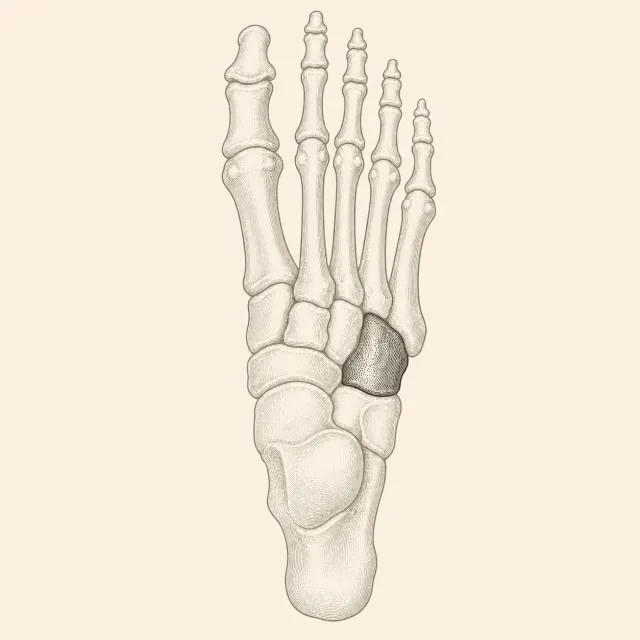
DescriptionA block-like bone on the outer midfoot, between the heel bone and the fourth and fifth metatarsals.
Field noteA deep groove underneath it guides the fibularis longus tendon across the sole of the foot.
On record
A groove beneath the cuboid acts as a track for the fibularis longus tendon. StatPearls
The cuboid begins ossifying around birth, between approximately the ninth fetal month and six months afterward. StatPearls
medial cuneiform
plural: medial cuneiforms
“inner wedge bone”
medial cuneiform2 (one per foot)
In the body2 (one per foot)
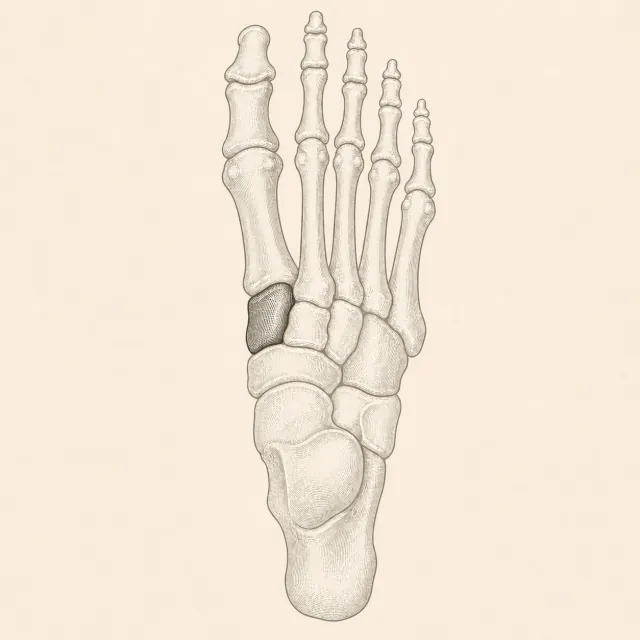
DescriptionThe largest of three wedge bones, on the big-toe side and directly behind the first metatarsal.
Field noteIt usually develops from two ossification centers. If they do not fuse, a rare two-part version of the bone remains.
On record
The medial cuneiform is the largest of the three cuneiforms and sits behind the first metatarsal. StatPearls
It commonly develops from two ossification centers; if they do not fuse, the bone can remain naturally divided. StatPearls
intermediate cuneiform
plural: intermediate cuneiforms
“middle wedge bone”
intermediate cuneiform2 (one per foot)
In the body2 (one per foot)
DescriptionThe smallest of three wedge bones, tucked behind the second metatarsal at the center of the midfoot.
Field noteIts shorter length creates a mortise that grips the base of the second metatarsal, helping stabilize the midfoot.
On record
The intermediate cuneiform is the smallest cuneiform, and its short shape creates a mortise that grips the second metatarsal. StatPearls
Its ossification center generally appears during the third year of life. StatPearls
lateral cuneiform
plural: lateral cuneiforms
“outer wedge bone”
lateral cuneiform2 (one per foot)
In the body2 (one per foot)
DescriptionThe outermost of three wedge bones, behind the third metatarsal and beside the block-like outer tarsal.
Field noteIt touches four neighbors: the navicular, cuboid, intermediate cuneiform and third metatarsal.
On record
The lateral cuneiform touches four neighbors: the navicular, cuboid, intermediate cuneiform and third metatarsal. StatPearls
Its underside receives a slip from the posterior tibial tendon and may receive another from a great-toe muscle. StatPearls
proximal phalanges of the foot
“base row of toe bones”
proximal phalanges of the foot10 (5 per foot)
In the body10 (5 per foot)
DescriptionThe first bone segment in every toe, immediately beyond the metatarsal.
Field noteEvery toe has one. Its base meets a metatarsal at the joint where the toe begins to bend away from the foot.
On record
Every toe has a proximal phalanx, which meets its metatarsal at the base of the toe. StatPearls
Small muscles within the foot attach to proximal phalanges and help control or spread the toes. StatPearls
middle phalanges of the foot
“center row of toe bones”
middle phalanges of the foot8 (4 per foot; none in the big toe)
In the body8 (4 per foot; none in the big toe)
DescriptionThe center segment in each of the four smaller toes; the big toe skips this row.
Field noteOnly toes two through five have one, so this row contains four bones per foot rather than five.
On record
Only toes two through five have middle phalanges. The great toe has no middle phalanx. StatPearls
The flexor digitorum brevis attaches to the middle phalanges and bends the smaller toes’ middle joints. StatPearls
distal phalanges of the foot
“toe-tip bones”
distal phalanges of the foot10 (5 per foot)
In the body10 (5 per foot)
DescriptionThe final segment in every toe, forming the bony core of each toe tip.
Field noteAll five toes have one. The big toe reaches it directly from its first segment because it has only two phalanges.
On record
Every toe has a distal tip bone; the great toe reaches it directly from its proximal phalanx. StatPearls
Long flexor tendons attach to the distal phalanges of toes two through five, helping curl those toe tips. StatPearls
05 · Learn them
Reading them is not the same as knowing them.
In the lab these are Case 06, The Foot, on the Explorer track. Case 13, The Phalanx Rows and Case 14, The Ankle Completed come later, on the Scholar track.
It introduces bones a few at a time, asks where they are, and comes back days later to check they stayed.
Start with theseBegin with four bones. It’s free, and you don’t need an account.