TheBone RoomStart learning

The bones

The bones of the hand

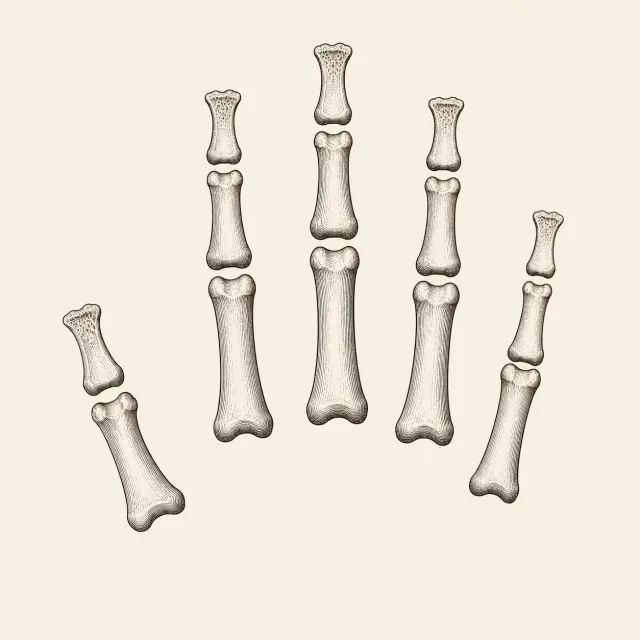
There are 27 bones in each hand and 54 across both. Each hand has eight carpals at the wrist, five metacarpals in the palm, and 14 phalanges in the fingers and thumb.

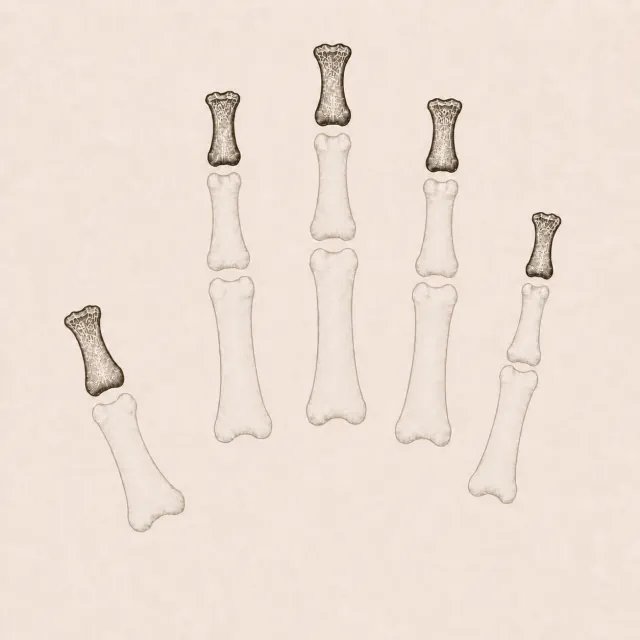
The count is tidy even when the hand itself is busy. The metacarpal heads make the knuckles that stand out when you close your fist. Beyond them, the phalanges fall into proximal, middle, and distal rows, terms that simply tell you how near each bone is to the body. Four fingers have all three. The thumb has a proximal and distal phalanx, with no middle one, so five digits add up to 14 rather than 15.

The Bone Room counts those three families as 27 of the body's 206 bones, then opens them into six entries so the rows can be learned separately. The eight individual carpals have their own wrist page, where names like scaphoid, lunate, and hamate start making sense from their shapes. Small sesamoid bones can also appear in the hand, especially around the thumb, but they are not part of the standard 27. That is worth knowing whenever a perfectly good diagram seems to have found a few extras.

These 6 entries account for 54 of the 206.How the 206 is counted.

On this page: Try one · Questions · The plates · The specimens · Nearby

01 · Try one

Can you name this one?

This is how the lab asks. A bone you name today comes back a week later to be named again, and that is how it stays known.

Identify the specimen

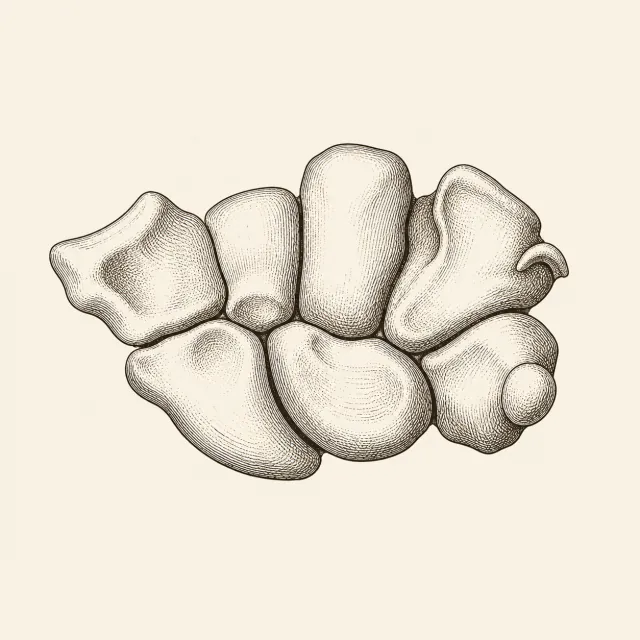
The cluster of small bones forming the wrist.

16 (8 per wrist)

carpals
“wrist bones”
In the body16 (8 per wrist)
DescriptionThe cluster of small bones forming the wrist.
Field noteEight per wrist, arranged in two rows, each with its own name: scaphoid, lunate, and friends. They await you in a later case file.

02 · Questions

The questions people ask about these bones.

How many bones are in the hand?

Twenty-seven: eight carpals, five metacarpals, and 14 phalanges. Across both hands, that makes 54. OpenStax, Bones of the Upper Limb

Why does the thumb have only two phalanges?

The thumb has a proximal and distal phalanx, while each of the other fingers also has a middle phalanx. The anatomy sources confirm that arrangement, but they do not offer a settled reason for why the thumb developed differently. OpenStax, Bones of the Upper Limb

Does the hand have sesamoid bones?

Yes. Small sesamoid bones are commonly found in the hand, particularly near the thumb, although their number can vary. They are additional to the usual count of 27. StatPearls, Sesamoid Bones

03 · The plates

Every specimen with a plate of its own.

04 · The specimens

What each one is called, and how it is counted.

carpals

“wrist bones”
carpals16 (8 per wrist)
In the body16 (8 per wrist)
DescriptionThe cluster of small bones forming the wrist.
Field noteEight per wrist, arranged in two rows, each with its own name: scaphoid, lunate, and friends. They await you in a later case file.
On record
  • Eight carpal bones make each wrist, arranged as two rows of four. OpenStax 8.2
  • The carpal bones form the floor and walls of the carpal tunnel; a strong ligament forms its roof. OpenStax 8.2
  • Nine muscle tendons and a major nerve pass through the narrow carpal tunnel into the hand. OpenStax 8.2
  • Several carpal names describe their shapes: scaphoid is boat-like, lunate moon-like, pisiform pea-like, and hamate hooked. StatPearls
metacarpals

“palm bones”
metacarpals10 (5 per hand)
In the body10 (5 per hand)
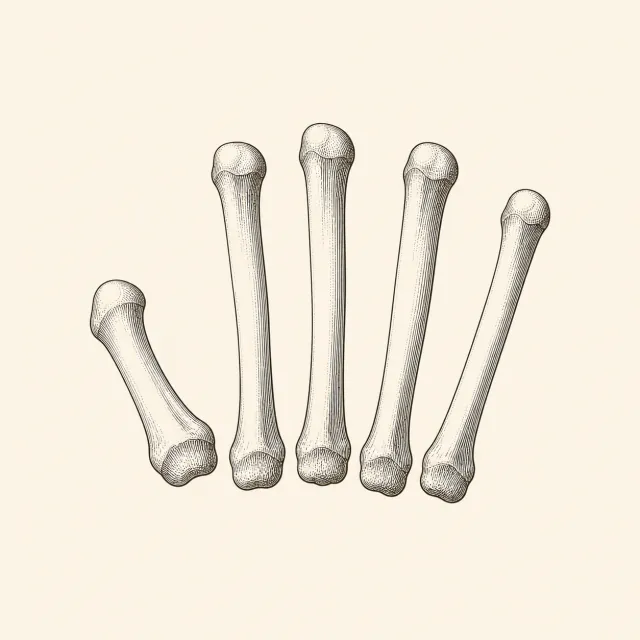
DescriptionThe five long bones hidden inside the palm.
Field noteNumbered one to five, thumb to pinky. Punch something badly and you may meet the "boxer’s fracture", a broken fifth metacarpal.
On record
  • The rounded heads of the metacarpals are the knuckles you see when you make a fist. OpenStax 8.2
  • The fourth and fifth metacarpals can shift slightly forward, helping the hand wrap firmly around an object. OpenStax 8.2

phalanges

“finger bones”
phalanges28 (14 per hand)
In the body28 (14 per hand)
DescriptionThe small bones inside the fingers and thumb.
Field noteSingular: phalanx, Greek for a row of soldiers. Each finger has three; the thumb makes do with two.
On record
  • A hand has 14 phalanges: three in each finger but only two in the thumb. StatPearls
  • “Phalanx” also names a close-packed formation of ancient soldiers, an apt image for rows of finger bones. OpenStax 8.2

proximal phalanges of the hand

“base row of finger bones”
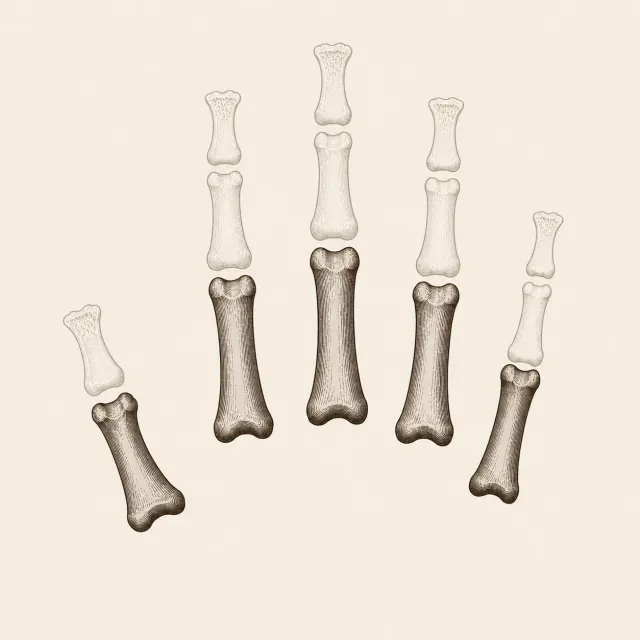
proximal phalanges of the hand10 (5 per hand)
In the body10 (5 per hand)
DescriptionThe first bone segment in every digit, running out from the palm toward the first finger joint.
Field noteEvery finger and thumb has one. Their bases meet the five metacarpals at the knuckle joints.
On record
  • The bases of the hand’s proximal phalanges meet the metacarpals at the knuckle joints. StatPearls
  • These knuckle joints can bend, straighten, move sideways and make small circular movements. StatPearls

middle phalanges of the hand

“center row of finger bones”
middle phalanges of the hand8 (4 per hand; none in the thumb)
In the body8 (4 per hand; none in the thumb)
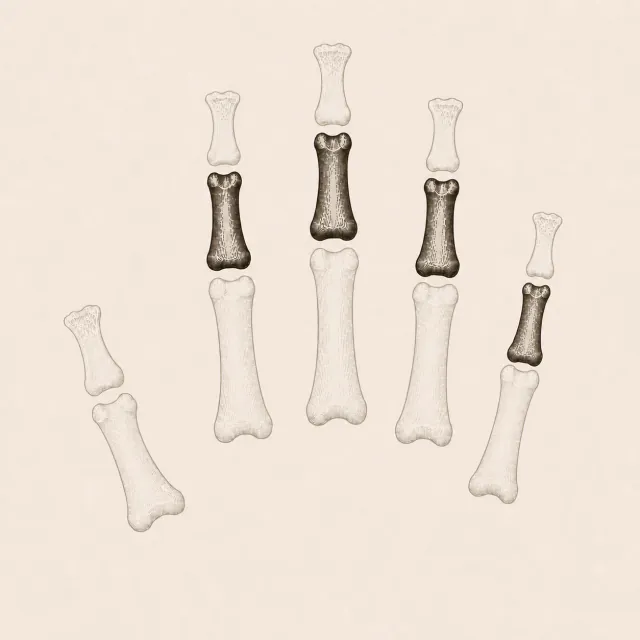
DescriptionThe center segment in each finger beyond the thumb; the thumb skips this row entirely.
Field noteOnly fingers two through five have one. The thumb goes directly from its first segment to its tip segment.
On record
  • Only fingers two through five have middle phalanges. The thumb skips this row. StatPearls
  • A major finger-flexing tendon attaches to each middle phalanx and helps bend the middle finger joint. StatPearls

distal phalanges of the hand

“fingertip bones”
distal phalanges of the hand10 (5 per hand)
In the body10 (5 per hand)
DescriptionThe final segment in every digit, directly beneath the fingertip and nail.
Field noteEach ends in a broad tuft and is tightly linked to the surrounding soft tissue; the nail plate protects it from above.
On record
  • Each distal hand phalanx ends in a broad tuft beneath the fingertip and nail. StatPearls
  • Deep flexor tendons anchor to the distal phalanges, allowing the fingertip joints to curl. StatPearls

05 · Learn them

Reading them is not the same as knowing them.

In the lab these are Case 05, The Hand, on the Explorer track. Case 13, The Phalanx Rows come later, on the Scholar track.

It introduces bones a few at a time, asks where they are, and comes back days later to check they stayed.

Start with theseBegin with four bones. It’s free, and you don’t need an account.

Nearby: arm and shoulder · leg · rib cage · spine and pelvis · wrist · foot and ankle · skull · ear · all nine