There are eight bones in each wrist, arranged in two rows of four. Together they are the carpals, and their names are scaphoid, lunate, triquetrum, pisiform, trapezium, trapezoid, capitate, and hamate.
That list becomes much friendlier once you know the names are little descriptions. There is a boat, a moon, a three-cornered bone, and one shaped like a pea. The second row gives you a small table, a table-like bone, a bone with a head, and one with a hook. It is less like memorizing a code and more like opening a drawer of oddly labeled specimens, then seeing why each label stuck.
The Bone Room gives every carpal its own entry because each has a name worth learning. In the standard count of 206, though, these eight are already part of the 27 bones in each hand. So this page shows 16 physical bones across the two wrists, while the hand page carries them in the arithmetic as the carpals. The two rows sit between the radius and ulna of the forearm and the metacarpals of the palm, where this small crowd of bones lets the wrist move without relying on a single hinge.
This is how the lab asks. A bone you name today comes back a week later to be named again, and that is how it stays known.
Identify the specimen
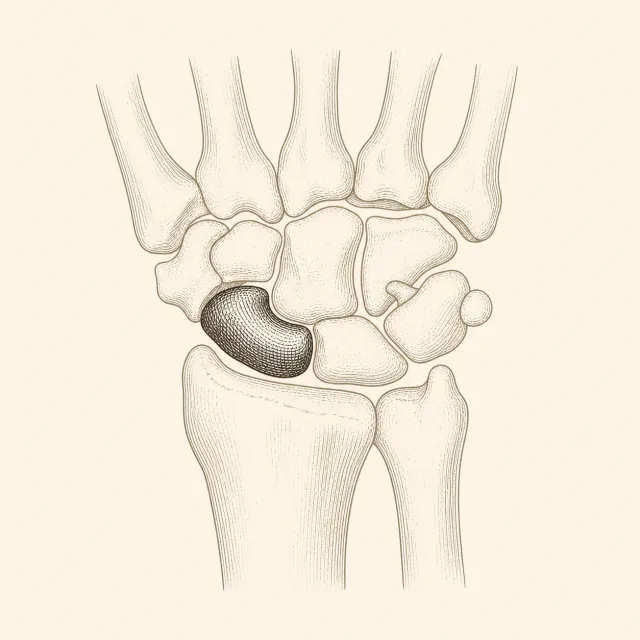
A boat-like bone on the thumb side of the row nearest the forearm, bridging the two carpal rows.
2 (one per wrist)
scaphoid
plural: scaphoids
“boat-shaped wrist bone”
In the body2 (one per wrist)
DescriptionA boat-like bone on the thumb side of the row nearest the forearm, bridging the two carpal rows.
Field noteThe most commonly fractured carpal, it receives much of its blood from the far end, leaving the nearer pole vulnerable if a fracture interrupts that supply.
Identify the specimen
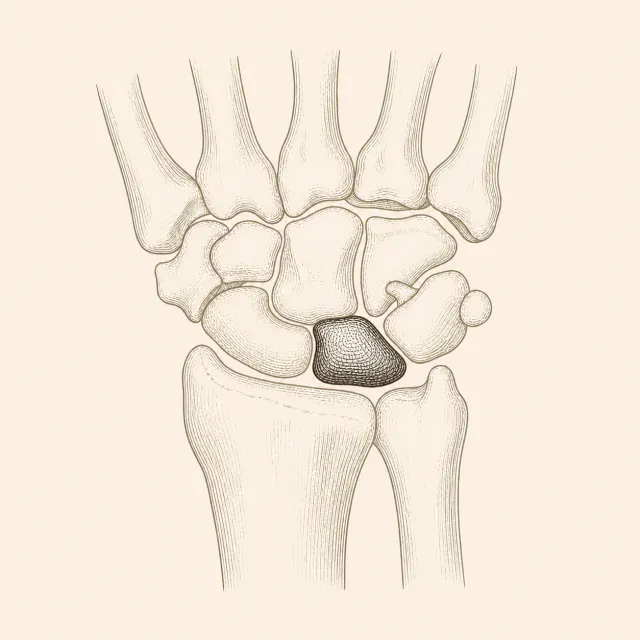
A crescent-shaped bone near the center of the row nearest the forearm, between boat-like and three-cornered neighbors.
2 (one per wrist)
lunate
plural: lunates
“moon-shaped wrist bone”
In the body2 (one per wrist)
DescriptionA crescent-shaped bone near the center of the row nearest the forearm, between boat-like and three-cornered neighbors.
Field noteIt meets the radius directly and lies close to the median nerve, which is why displacement can disturb sensation and strength in the hand.
Identify the specimen
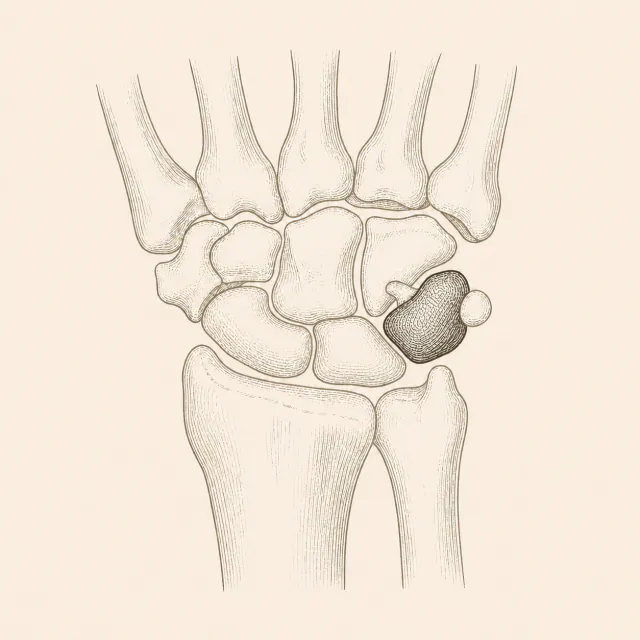
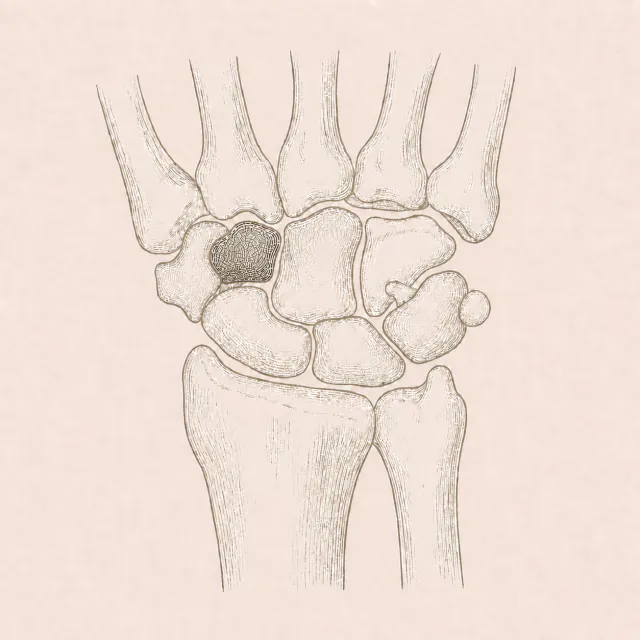
A pyramid-shaped member of the forearm-side row near the little finger, with a pea-shaped neighbor resting on its front.
2 (one per wrist)
triquetrum
plural: triquetra
“three-cornered wrist bone”
In the body2 (one per wrist)
DescriptionA pyramid-shaped member of the forearm-side row near the little finger, with a pea-shaped neighbor resting on its front.
Field noteAt the wrist joint it meets a fibrocartilage pad rather than articulating directly with the forearm bones.
Identify the specimen
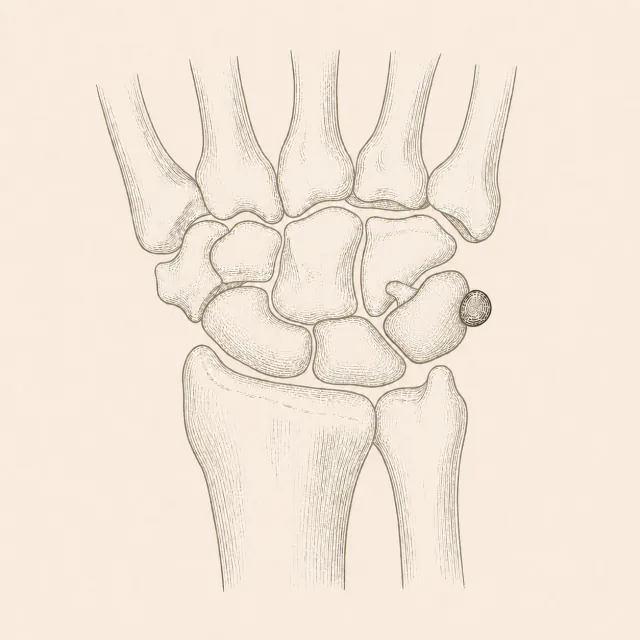
A small rounded carpal sitting on the front of a larger three-cornered neighbor, palpable at the inner base of the palm.
2 (one per wrist)
pisiform
plural: pisiforms
“pea-shaped wrist bone”
In the body2 (one per wrist)
DescriptionA small rounded carpal sitting on the front of a larger three-cornered neighbor, palpable at the inner base of the palm.
Field noteIt projects toward the palm and, with the hook-shaped carpal nearby, anchors the inner edge of the ligament roofing the carpal tunnel.
Identify the specimen
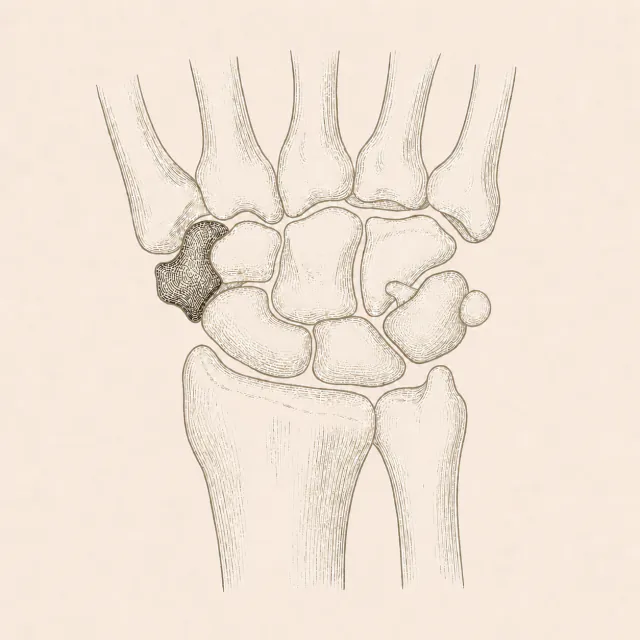
A palm-side carpal beneath the thumb, with a saddle-shaped surface for the first metacarpal.
2 (one per wrist)
trapezium
plural: trapezia
“thumb-saddle wrist bone”
In the body2 (one per wrist)
DescriptionA palm-side carpal beneath the thumb, with a saddle-shaped surface for the first metacarpal.
Field noteIts saddle joint lets the thumb sweep across the palm in opposition, making precise pinch and grasp possible.
02 · Questions
The questions people ask about these bones.
What are the eight wrist bones called?
Starting on the thumb side, the row nearest the forearm is the scaphoid, lunate, triquetrum, and pisiform. The row nearest the palm is the trapezium, trapezoid, capitate, and hamate. Anatomists call the first row proximal and the second distal. OpenStax, Bones of the Upper Limb
How are the wrist bones arranged?
The eight carpals form a proximal row beside the forearm and a distal row beside the palm. The sources describe this arrangement and the joints it creates, but they do not give a single evolutionary reason for it. StatPearls, Hand Carpal Bones
Often, although the classification is disputed. The pisiform sits inside the flexor carpi ulnaris tendon, as a sesamoid bone would, but researchers have also described it as a vestigial bone. StatPearls, Sesamoid Bones
03 · The specimens
What each one is called, and how it is counted.
scaphoid
plural: scaphoids
“boat-shaped wrist bone”
scaphoid2 (one per wrist)
In the body2 (one per wrist)
DescriptionA boat-like bone on the thumb side of the row nearest the forearm, bridging the two carpal rows.
Field noteThe most commonly fractured carpal, it receives much of its blood from the far end, leaving the nearer pole vulnerable if a fracture interrupts that supply.
On record
The scaphoid’s cartilage-covered shape helps it bridge the wrist’s proximal and distal carpal rows. StatPearls
It is the most commonly fractured carpal, and its backward-running blood supply makes its proximal end particularly vulnerable. NCBI Bookshelf
lunate
plural: lunates
“moon-shaped wrist bone”
lunate2 (one per wrist)
In the body2 (one per wrist)
DescriptionA crescent-shaped bone near the center of the row nearest the forearm, between boat-like and three-cornered neighbors.
Field noteIt meets the radius directly and lies close to the median nerve, which is why displacement can disturb sensation and strength in the hand.
On record
The lunate takes its name from its crescent or moon-like shape and sits close to the median nerve. StatPearls
When two carpal bones are congenitally fused, the lunate and triquetrum are the most commonly involved pair. StatPearls
triquetrum
plural: triquetra
“three-cornered wrist bone”
triquetrum2 (one per wrist)
In the body2 (one per wrist)
DescriptionA pyramid-shaped member of the forearm-side row near the little finger, with a pea-shaped neighbor resting on its front.
Field noteAt the wrist joint it meets a fibrocartilage pad rather than articulating directly with the forearm bones.
On record
The pyramid-shaped triquetrum meets the lunate, hamate and pisiform. StatPearls
The pea-shaped pisiform rests against the triquetrum’s palm-facing surface. StatPearls
pisiform
plural: pisiforms
“pea-shaped wrist bone”
pisiform2 (one per wrist)
In the body2 (one per wrist)
DescriptionA small rounded carpal sitting on the front of a larger three-cornered neighbor, palpable at the inner base of the palm.
Field noteIt projects toward the palm and, with the hook-shaped carpal nearby, anchors the inner edge of the ligament roofing the carpal tunnel.
On record
The pisiform is a pea-shaped attachment point for several tendons and ligaments. StatPearls
During early development, it is the last of the eight carpal cartilage centers to appear. StatPearls
trapezium
plural: trapezia
“thumb-saddle wrist bone”
trapezium2 (one per wrist)
In the body2 (one per wrist)
DescriptionA palm-side carpal beneath the thumb, with a saddle-shaped surface for the first metacarpal.
Field noteIts saddle joint lets the thumb sweep across the palm in opposition, making precise pinch and grasp possible.
On record
The trapezium’s saddle-shaped thumb joint makes opposition, and therefore precise pinching, possible. StatPearls
Its tubercle helps form the carpal tunnel’s bony wall and supports the base of the thumb. StatPearls
trapezoid
plural: trapezoids
“small table-shaped wrist bone”
trapezoid2 (one per wrist)
In the body2 (one per wrist)
DescriptionThe smallest carpal, wedged in the palm-side row between the thumb-saddle bone and the largest central wrist bone.
Field noteIts protected position between neighboring carpals and the base of the second metacarpal makes an isolated fracture uncommon.
On record
The trapezoid is the smallest of the eight carpal bones. StatPearls
Its deeply protected, strongly bound position makes an isolated fracture unusually rare. PMC
capitate
plural: capitates
“head-shaped wrist bone”
capitate2 (one per wrist)
In the body2 (one per wrist)
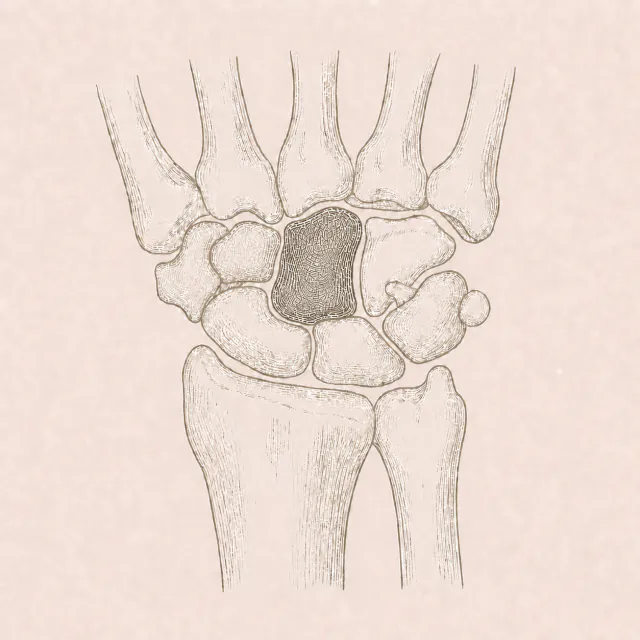
DescriptionThe largest carpal, standing at the center of the palm-side row with a rounded head.
Field noteIt is the largest and most central wrist bone, and, with the hamate, is among the first carpals to begin forming as cartilage before birth.
On record
The capitate is the largest and most central carpal bone. StatPearls
The capitate and hamate are the first carpal cartilage centers to appear during development. StatPearls
hamate
plural: hamates
“hooked wrist bone”
hamate2 (one per wrist)
In the body2 (one per wrist)
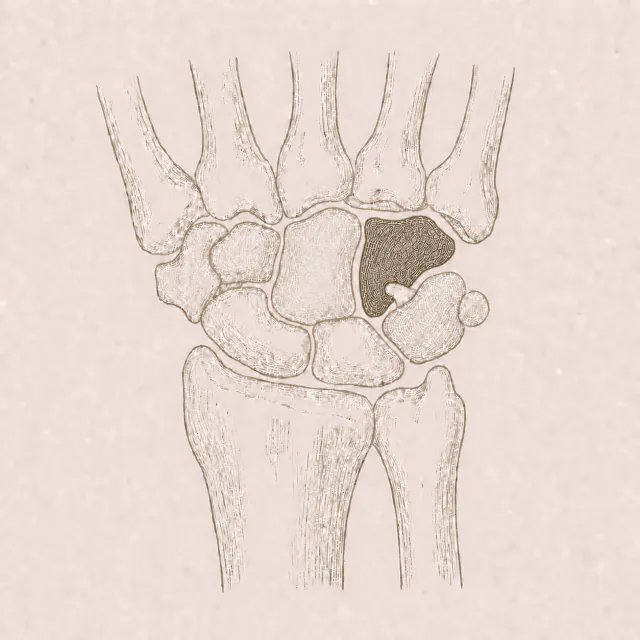
DescriptionA palm-side carpal near the little finger, marked by a strong hook projecting toward the palm.
Field noteIts hook guards the ulnar nerve and artery as they enter the hand through Guyon’s canal.
On record
The hamate’s hook helps protect the ulnar nerve and artery as they enter the hand. StatPearls
Blows transmitted through a baseball bat or golf club are recognized causes of hook-of-hamate fractures. StatPearls
04 · Learn them
Reading them is not the same as knowing them.
In the lab these are Case 15, The Wrist, on the Scholar track, which opens once the Explorer case files are done. The lab starts with the big bones, so the wrist comes later.
It introduces bones a few at a time, asks where they are, and comes back days later to check they stayed.