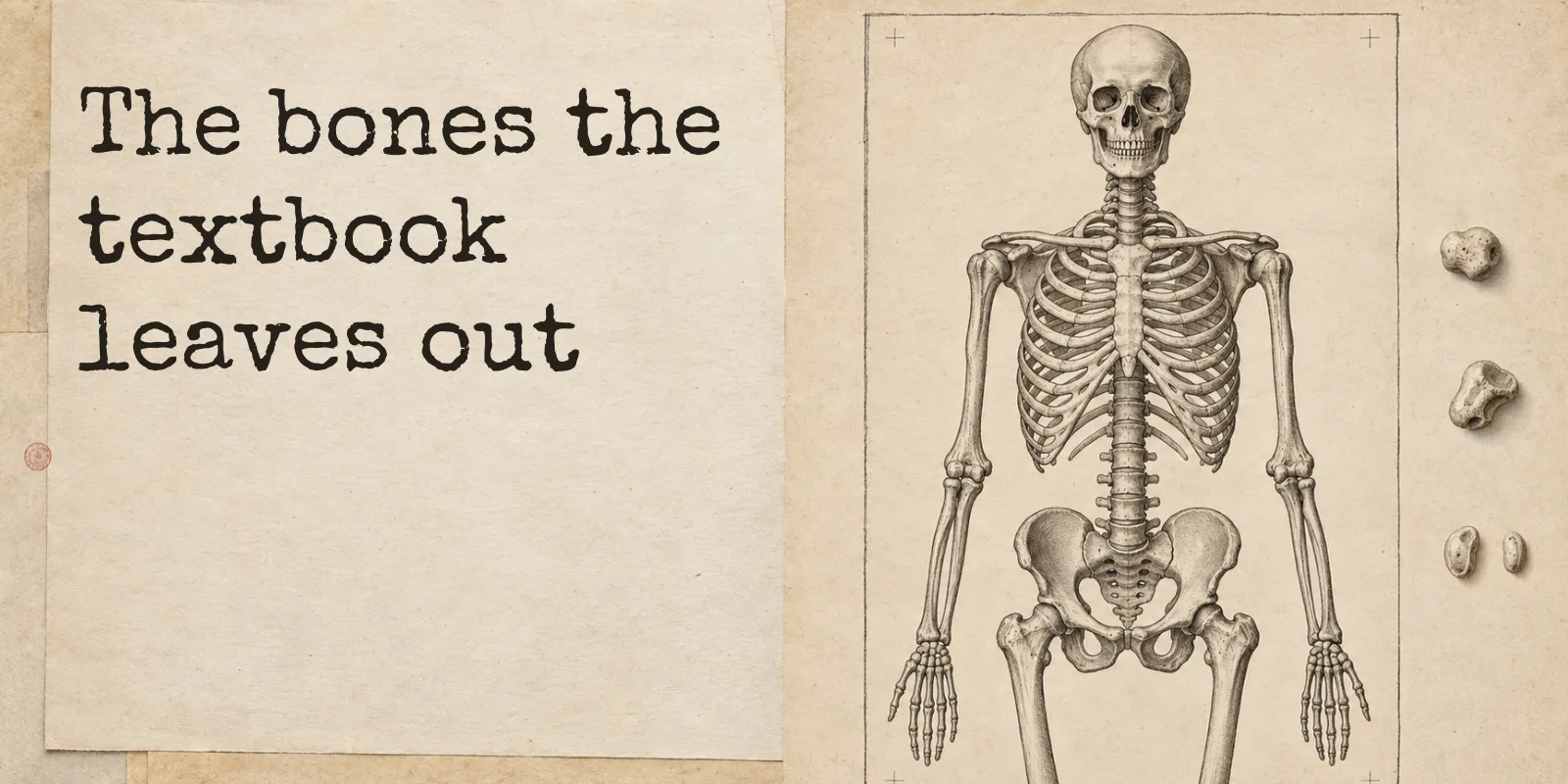
A sesamoid bone forms inside a tendon. Your kneecaps are the largest, almost everyone has two more under each big toe, and several others turn up in some people and are simply missing in others. That is why a real skeleton does not always come to 206.
A sesamoid bone is a bone that forms inside a tendon. Your two kneecaps are the largest ones you own, almost everybody has two more tucked under each big toe, and a handful of others are present in some people and simply absent in others.
The textbook The Bone Room checks itself against, OpenStax Anatomy and Physiology, says two things a few chapters apart. The adult skeleton has 206 bones. Sesamoid bones “vary in number and placement from person to person.” Both of those hold at once, and the space between them has a surprising amount in it.
A bone that grows inside a tendon
A tendon is the cord that ties a muscle to a bone. Where one of those cords crosses a joint and takes a beating, a small bone can form inside the cord itself. OpenStax describes exactly that: sesamoid bones “form in tendons … where a great deal of pressure is generated in a joint,” and they “protect tendons by helping them overcome compressive forces.”
StatPearls puts the job mechanically. A sesamoid acts as a pulley, “providing leverage, reducing friction,” changing the angle at which the tendon pulls on the bone at the far end.
The name is a description of the shape and nothing more. A sesamoid bone is, in the textbook’s words, “shaped like a sesame seed,” and most of them are roughly that size. Sesame itself reached English through Latin and Greek from a much older Semitic word that meant something like oil-seed, so the bone is named after a plant that was being pressed for oil in Babylon.
How many you have is a harder question than it sounds. StatPearls cites a figure of up to 42 reported in a single person, which should tell you that “how many bones does a human have” has a soft edge on it somewhere.
The kneecap is the one everybody has
The patella is the largest sesamoid in the body, and it sits inside the tendon of the quadriceps at the front of the knee. You can find yours now. Straighten your leg so the muscle goes slack, press the front of your knee, and the loose disc of bone that slides around under your fingers is a sesamoid bone doing its job.
That job is mostly leverage. By holding the tendon away from the joint, the patella lengthens what StatPearls calls the moment arm, the perpendicular distance between the pulling force and the axis the joint turns on, so the same quadriceps produces more turning force at the knee. It also acts as a shield for the deeper structures of the joint and keeps the quadriceps tendon from dragging across the femur.
On its status OpenStax is unambiguous: “The patellae are the only sesamoid bones found in common with every person.” Every other bone on this page is optional. The page on the bones of the leg counts the patella among the four from hip to ankle, because for everybody reading this, it is there.
Even the kneecap arrives late. It is cartilage at birth, and primary ossification does not usually begin until a child is five or six, though something may show on a radiograph at two or three. So a toddler has kneecaps that a knee X-ray cannot find, the same trick the rest of the infant skeleton plays and the one the post on why babies have more bones than adults follows through.
The two under your big toe
Under the head of the first metatarsal, the long bone that leads out to your big toe, sit two more sesamoids, one toward the inside of the foot and one toward the outside, embedded in the tendon of flexor hallucis brevis.
They are not exotic. A meta-analysis of 37 studies found sesamoids at that joint “nearly always present,” and the load they sit under explains why: the first metatarsal takes somewhere between 30 and 50 percent of the weight passing through the foot during a step.
That load shows up in clinic. In a review of 359 injuries to these bones in young athletes, 40 percent of the patients were dancers and roughly another quarter ran or played soccer, and the two leading diagnoses were sesamoiditis, an inflammation around the bones, and sesamoid stress fracture.
Then the counting goes strange. The same meta-analysis found the inner sesamoid of the big toe divided into separate pieces in about 10.7 percent of feet, almost always two pieces. For something like one person in ten, a bone that most people carry as one bone is two, and it has been that way since childhood.
The page on the bones of the foot has the rest of that region, and what the 26 in it are.
The ones that come and go
Past the kneecap and the big toe there is a small cast of sesamoids that some people have and some do not.
The fabella, Latin for little bean, sits behind the lateral condyle of the femur, in the tendon of the lateral head of the gastrocnemius, the outer of the two calf muscles. Reported prevalence in humans runs “from 3 to 87%.” A spread that wide usually means there is something wrong with the question rather than with the studies.
It also seems to be getting more common. A 2019 systematic review pulling together 58 studies back to 1875 found people were nearly 3.5 times more likely to have a fabella in 2018 than in 1918, with no matching rise in ten other sesamoid bones. The authors offer a careful explanation: humans have grown taller and heavier over the same century, longer shin bones and larger calf muscles put more force through that tendon, and force is what makes a sesamoid in the first place.
The os peroneum forms in the tendon of the peroneus longus near the outside of the foot. A Turkish study of 1,651 foot radiographs found it in 5.8 percent of them. A Jordanian study of 624 feet found it in 22 percent, rising to 30 percent among older patients. A team who dissected twenty cadaveric feet found it in 45 percent.
The cyamella is the rare one. It forms in the tendon of the popliteus at the back of the knee, and a 2021 review put its ossified prevalence at 0.57 to 1.8 percent, with the authors finding three in 212 Korean knees.
Why the numbers disagree with each other
Look at the os peroneum figures again: 5.8 percent, 22 percent, 45 percent. The first two came from X-rays and the third from dissection, and that difference does a lot of the work.
The clearest demonstration is in the same foot meta-analysis. There is a sesamoid that sometimes sits at the interphalangeal joint of the big toe, the joint in the middle of the toe itself. Pooled across all studies it turns up in 22.4 percent of feet. In studies based on X-rays, 21.1 percent. In studies where somebody opened the foot and looked, 71.6 percent.
An X-ray shows calcium. A sesamoid that has stayed cartilage is invisible on one, and plenty of them stay cartilage: a Chinese study found 57.9 percent of cartilaginous fabellae were missed on radiographs. So the question “how many sesamoid bones does this person have” carries a hidden second half, how many can the method see, and the honest answer changes depending on who is asking and with what equipment.
What all this does to the 206
| What is being counted | What goes into it | Where sesamoids sit |
|---|---|---|
| The standard 206 | The conventional reference list for an adult skeleton | Both patellae are in. Nothing else from this family is. |
| Variable ossified structures | Bones present in some people and absent in others | Fabella, os peroneum, cyamella, the toe sesamoids, wormian bones in the skull |
| One particular skeleton | Whatever is actually in that body | Can hold more than 206 without anything being wrong |
The foot is where you can watch the convention wobble. The standard count gives each foot 26 bones, and you will also see 28, the same 26 with the big toe’s pair added in. The Bone Room keeps the 26 and treats the pair as extra, so that the total on the site is the total in the textbook.
What I will not give you is the top of the range. Tidy figures get quoted for the most bones a person can have, and I could not find a source for any of them that names which structures it is adding and on what evidence, so this post leaves that number open. The 206 is a reference list, and a reference list does not have to be a census to be useful.
There is one wrinkle running the other way, which I like more than I expected to. The pisiform, the pea-sized bone at the inner base of your palm, is counted among the 206 as one of the eight carpals. It also sits inside the tendon of flexor carpi ulnaris, doing exactly what a sesamoid does, and StatPearls notes that this “has led to debate over whether it is a sesamoid bone or a vestigial bone.” The 206 may already contain a sesamoid nobody files under that heading.
When a scan report says “accessory ossicle”
An accessory ossicle is a small bone that falls outside the standard list, and the phrase reads alarmingly on a radiology report when it is the first time you have met it.
Usually it is old news. Radiologists describe these as small fragments with well-corticated margins sitting beside a joint, generally causing no symptoms at all, and the smooth rim is the tell: a fresh break has a raw edge, while a bone that has been sitting there since you were twelve has grown a proper shell of cortex all the way around. They are common. One Turkish series found accessory ossicles in 26.1 percent of 1,651 foot radiographs.
The honest caveat is that telling the two apart can be hard. A German group reviewing 611 foot CT scans concluded that an accessory ossicle at the front of the heel bone and a fracture in the same place cannot be reliably separated clinically or on a plain radiograph, so they recommend a CT, and they found that more than half of the ossicles in their sample went unmentioned in the original report.
The skull has its own version. Wormian bones are small, irregular bones that form in or near the sutures, and one Indian series found them in 35.3 percent of 147 skulls. The authors’ argument for knowing them is the same one: on an image they can be mistaken for a fracture. The post on counting the bones of the skull covers what else is going on up there.
What a forensic anthropologist does with them
This is the part I came looking for first, because the whole project started with Bones and a fictional lab where somebody names a fragment across a table.
An actual biological profile is narrower than the show suggests. It is four estimates: age at death, sex, ancestry, and stature. A fabella is none of those, and it will not tell you any of them.
It belongs to the other half of the description, the individualizing traits, the same list that holds healed fractures and dental work and anything else the people who knew someone might recognize. On its own an accessory bone identifies nobody. Beside a person’s own old X-rays it is one more feature that either matches or does not.
Two ordinary skeletons, two totals
Two skeletons can both be entirely ordinary and still hold a different number of bones. Put one with a fabella behind each knee beside one without, and you have two more ossified structures in the first, both skeletons healthy, and the 206 untroubled by either of them. The 206 was answering a different question all along: what goes on the list that everyone teaching and reading and reporting agrees to use.
The 206 and how it adds up has that arithmetic in full, including which of the count The Bone Room teaches as individual names and which arrive as groups. And if you would like the kneecap to be a name you can produce rather than one you recognize, the lab is free and starts with the large bones, a few specimens at a time, the patella among the first of them.
What are sesamoid bones?
Sesamoid bones are small bones that form inside tendons where a tendon crosses a joint under pressure. They work like pulleys, changing the angle at which a tendon pulls and reducing friction where it crosses bone. The name describes the shape, which OpenStax compares to a sesame seed.
Are sesamoid bones part of the 206?
Two of them are. OpenStax counts both patellae and says they are the only sesamoid bones every person has. The smaller, variable ones sit outside the standard list, so an individual skeleton can hold more ossified structures than 206 without anything being wrong.
Does everyone have the same sesamoid bones?
No. The patellae are the only ones present in everybody. The pair under each big toe is nearly always there. The fabella behind the knee is reported in anywhere from 3 to 87 percent of people depending on the population and the imaging method, and the cyamella turns up in around 1 percent.
Can a person have more than 206 bones?
Yes. Variable sesamoids and wormian bones in the skull can push the number of ossified structures in one body past 206, and that is ordinary variation rather than a sign of disease. There is no reliable figure for how far past, because it depends on which structures are being counted and on whether the method used can see them.
Is an accessory ossicle on a scan something to worry about?
Usually it is an incidental finding of a bone that has been there for years, and most cause no symptoms. Radiologists look for a well-corticated margin, since a recent fracture has a raw edge. Telling the two apart on a plain radiograph can be difficult enough that a CT is sometimes recommended after an injury.
Sources
Every anatomical claim above is checked against OpenStax Anatomy and Physiology 2e, StatPearls on the NCBI Bookshelf, or a named study, the same references the lab uses. Where two sources give different figures, the text says so.
Show all 17 sources
- OpenStax, Anatomy and Physiology 2e, 6.2 Bone Classification: a sesamoid bone is small, round and shaped like a sesame seed; they form in tendons where a great deal of pressure is generated in a joint; they protect tendons by helping them overcome compressive forces; they vary in number and placement from person to person; the patellae are the only sesamoid bones found in common with every person.
- OpenStax, 7.1 Divisions of the Skeletal System: the 206 bones of the adult skeleton, 80 axial and 126 appendicular.
- StatPearls, Anatomy, Sesamoid Bones: a sesamoid is embedded in a tendon near a joint and functions as a pulley; leverage, reduced friction; up to 42 reported in one individual; the fabella near the lateral head of gastrocnemius, cyamella in the popliteus tendon, os peroneum in the peroneus longus tendon and the hallux pair as normal variants; the pisiform in flexor carpi ulnaris and the debate over whether it is a sesamoid or vestigial bone.
- StatPearls, Anatomy, Bony Pelvis and Lower Limb, Knee Patella: the largest sesamoid, within the quadriceps femoris tendon; it increases the patellar ligament’s moment arm, shields deeper structures, and keeps the tendon off the femur; primary ossification usually at age 5 or 6, with radiographic evidence possible at 2 or 3.
- StatPearls, Anatomy, Bony Pelvis and Lower Limb: Metatarsal Bones: two sesamoids plantar to the first metatarsal head within the flexor hallucis brevis tendon; the first metatarsal bears approximately 30 to 50 percent of the load during the gait cycle.
- Yammine, Anatomical Science International, 2015, The sesamoids of the feet in humans: a systematic review and meta-analysis: 37 studies; sesamoids nearly always present at the hallux MTP joint; the interphalangeal sesamoid at 22.4 percent overall, 71.6 percent in cadaveric studies and 21.1 percent radiologically; medial hallucal sesamoid partition at 10.7 percent and lateral at 1.3 percent, bipartism 92 percent of partitions.
- Berthaume, Di Federico and Bull, Journal of Anatomy, 2019, Fabella prevalence rate increases over 150 years, and rates of other sesamoid bones remain constant: the fabella sits behind the lateral femoral condyle in the tendon of the lateral head of gastrocnemius; prevalence in humans varies from 3 to 87 percent; 58 studies from 1875 to 2018; people nearly 3.5 times more likely to have a fabella in 2018 than in 1918, with no increase in ten other sesamoid bones; the proposed explanation of increased human height and weight; 57.9 percent of cartilaginous fabellae not visible on radiographs in a Chinese population.
- Berthaume and Bull, Clinical Anatomy, 2021, Cyamella (a popliteal sesamoid bone) prevalence: a rare, generally asymptomatic sesamoid in the proximal popliteal tendon; ossified prevalence rates of 0.57 to 1.8 percent; cyamellae found in 3 of 212 Korean knees.
- Candan, Torun and Dikici, Foot & Ankle Orthopaedics, 2022, The Prevalence of Accessory Ossicles, Sesamoid Bones, and Biphalangism of the Foot and Ankle: 1,651 foot radiographs; accessory ossicles in 26.1 percent; os peroneum in 5.8 percent; bipartite hallux sesamoid in 1.8 percent.
- Kalbouneh et al., Folia Morphologica, 2022, The anatomical variations of the lateral sesamoid bones of the foot: os peroneum in 22 percent of 624 feet, rising to 30 percent in the elderly group; these sesamoids may be radiographically misinterpreted as fractures after trauma.
- Gomes et al., Foot and Ankle Surgery, 2020, The Os Peroneum incidence: a cadaveric study: an os peroneum found in 45 percent of twenty dissected cadaveric feet.
- Orthopaedic Journal of Sports Medicine, 2019, Sesamoid injuries in pediatric and adolescent athletes presenting to sports medicine clinic: 359 hallucal sesamoid injuries; 40 percent dance, 13 percent running, 13 percent soccer; sesamoiditis 30 percent and sesamoid stress fracture 13 percent as the leading diagnoses.
- Kim et al., Journal of the Korean Society of Radiology, 2021, Clinical Features and Radiological Differential Diagnoses of Symptomatic Sesamoid Bones and Accessory Ossicles: sesamoid bones and accessory ossicles are normal anatomic variants, usually small osseous fragments with well-corticated margins adjacent to a joint, and usually asymptomatic.
- Hennings et al., Surgical and Radiologic Anatomy, 2019, Os calcaneus secundarius, a relevant differential diagnosis to fracture or pseudarthrosis of processus anterior of the calcaneus: clinical or conventional radiological differentiation is uncertain and a CT scan is recommended; 7 of 12 accessory ossicles went unmentioned in the initial CT reports.
- Goyal, Garg and Kumar, International Journal of Applied and Basic Medical Research, 2019, Incidence and Medicolegal Significance of Wormian Bones in Human Skulls in North India Region: wormian bones are small bones in or near the sutures of the skull, irregular in size, shape and number; found in 52 of 147 skulls, an incidence of 35.3 percent; knowing them helps distinguish a skull fracture from a suture with wormian bones.
- Austin and King, Academic Forensic Pathology, 2016, The Biological Profile of Unidentified Human Remains in a Forensic Context: the biological profile includes age at death, sex, ancestry, stature, and individualizing traits such as healed fractures, dental work and other anomalous conditions of the bones and teeth.
- Etymonline, sesame: from Latin sesamum, from Greek sēsamon, an early borrowing via Phoenician from a Late Babylonian word, compare Assyrian shamash-shammu, literally oil-seed.