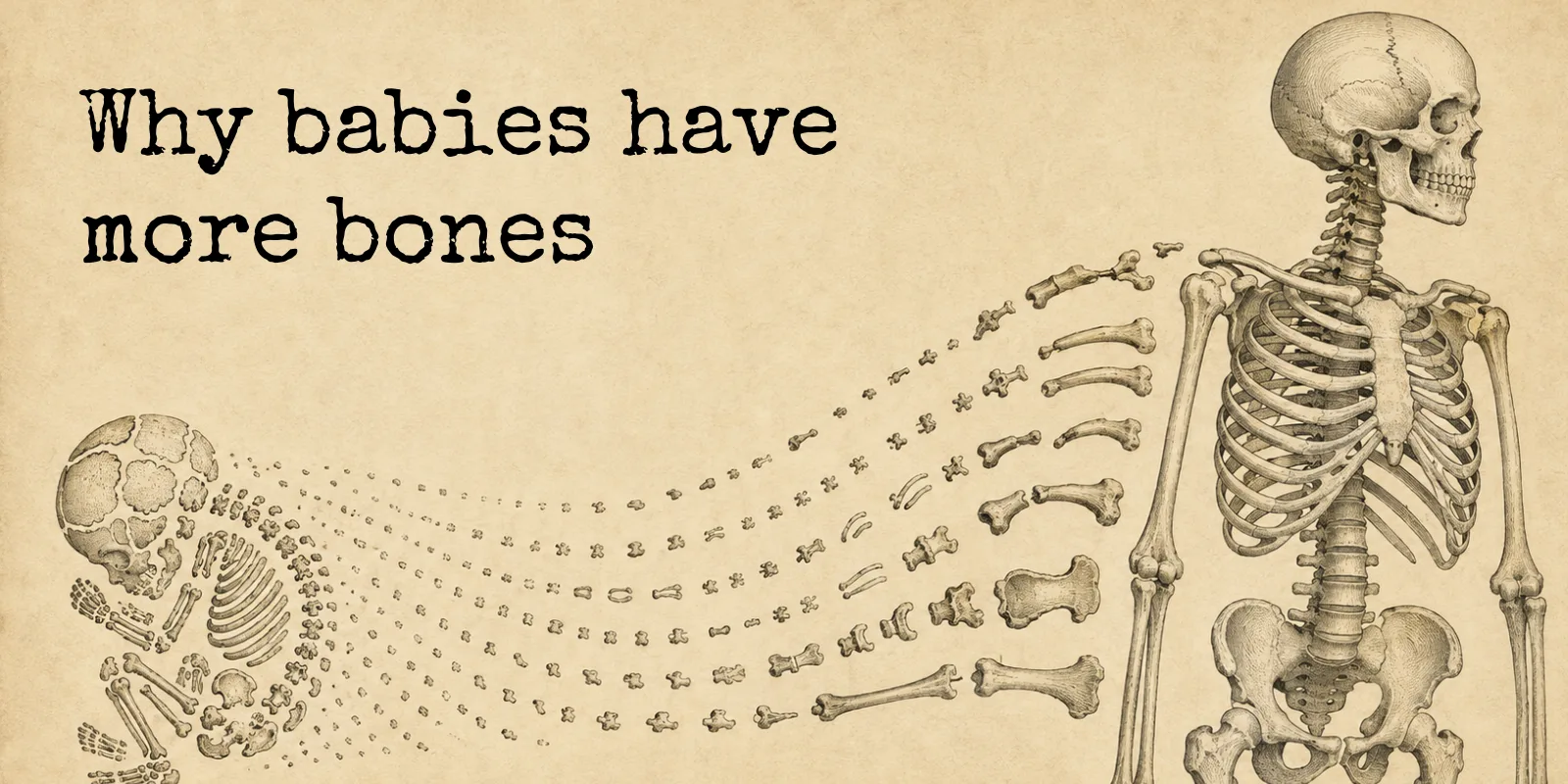
A newborn has roughly 270 bones and an adult has 206, and nothing gets thrown away in between. Bones that start life in pieces slowly grow into one, and the slowest of them are still at it long after your twenties.
A newborn has roughly 270 bones. An adult has 206. That sounds like a lot to lose, until you find out that nothing is lost at all. The extra bones do not fall out or dissolve. They grow together, a few pieces at a time, over about twenty-five years, and the slowest of them keep going well beyond that.
What makes this so surprising is what it does to the number 206, which turns out to be a convention as much as a measurement. The count looks like a hard fact of nature, on a level with the number of teeth. It is more like a rule anatomists agreed on: count the adult skeleton, and count each fused bone as one.
Where the two numbers come from
The adult figure comes from the standard textbook split. The skull, spine and rib cage make 80 bones, the arms, legs and the girdles that hang them off the trunk make 126, and together that is 206. The same textbook says, in one plain sentence, that younger people have more bones because some of theirs fuse during childhood and adolescence to form an adult bone.
The newborn figure is softer. The medical reference StatPearls puts it at about 270, and you will also see 275 or “about 300” elsewhere. Nobody is arguing about the anatomy. They are drawing the line around “one bone” in slightly different places, because a baby’s skeleton has a lot of pieces that are still hardening, and whether you count a half-formed piece as a bone yet is a judgment call.
The adult figure wobbles a little too, in the other direction. Some people carry an extra rib in the neck, which shows up in roughly one person in a hundred or two. Some have small extra bones tucked into the seams of the skull. And the number of sesamoid bones, the little bones that form inside tendons, of which the kneecap is the big one, varies from person to person. So 206 is the reference everyone works from, and your own body may be a bone or two off it.
The guide to the 206 explains what that number means for someone learning the names, and why The Bone Room teaches 48 of them and introduces the rest in groups. This post is about the other end of the story: how a skeleton gets down to 206 in the first place.
What fusing actually means
A bone that fuses does not shrink or disappear. Two pieces sit next to each other with cartilage between them, bone tissue grows across the gap, and at some point there is no longer a gap to speak of. What used to be five things is now one thing, and the count drops by four.
Different parts of the body do this on completely different schedules, which is the easily missed part. Some of it happens in the first year. Some of it does not start until you are twenty. Three examples make it easy to picture.
Five vertebrae become one sacrum
The sacrum is the broad triangle at the base of your spine, wedged between the two hip bones. It starts life as five separate vertebrae, stacked like the ones above it.
The surprising part is how late they join. Fusion of the sacrum does not begin until after about age 20, and it is not finished until middle age. So a teenager, who looks fully grown from the outside, still has five sacral vertebrae in the process of becoming one. If you have ever seen a photo of an adult sacrum, the four faint ridges across the front are the old borders between them.
Three bones become one hip, on each side
A child’s pelvis has six named bones, three on each side. The ilium is the wide upper part, the wing you can rest your hands on. The ischium is lower and toward the back, and its roughest patch is what carries your weight when you sit. The pubis is at the front.
All three meet at the hip socket, the deep cup that holds the head of the femur, and for most of childhood they are separated there by cartilage. During the late teenage years, bone grows across those seams and the three become one hip bone. Anatomy still names the three regions, which is why you will hear “ilium” and “ischium” on an adult skeleton that has only one bone there.
The two hip bones never fuse with each other. They meet at the front at a joint of cartilage, and at the back each one joins the sacrum. The whole pelvis is a ring made of two hip bones, the sacrum and the coccyx below it.
A few tiny vertebrae become one tailbone
The coccyx, or tailbone, is the smallest example and the least predictable one. It forms from small coccygeal vertebrae, usually four, though sources describe anywhere from three to five. They fuse on the same slow schedule as the sacrum, starting after age 20 and finishing some time in middle age, and some people never fully complete it.
That is one more reason the number 206 works best as a convention. If you counted every adult’s tailbone segments individually, the total would move by a bone or two from person to person.
The skull is the early one
The skull goes the other way round: most of its changes happen in the first two years.
A newborn’s skull has the same named bones as an adult’s, but the bones do not yet meet. The gaps between them are covered by membrane, and the wider gaps are the soft spots you can feel on a baby’s head. The word for them is fontanelle, from an old French word for a little spring, which describes exactly what they look like: a small dip where something is pulsing underneath.
The soft spots earn their keep twice. During birth, they let the skull bones slide over each other so the head can pass through the birth canal. After birth, they give the skull room to expand while the brain grows. The one at the back closes within a couple of months. The large one at the front, where the frontal and parietal bones meet, takes longer, and on average it is gone somewhere between 13 and 24 months. By age two, the fontanelles have generally disappeared.
The skull does not turn into one solid piece, though. The bones knit together along fibrous seams called sutures, which is why an adult skull still counts as 22 separate bones: 8 in the braincase and 14 in the face. One of them does fuse properly, and early. The lower jaw is two halves at birth, and they join into a single U-shaped mandible during the first year.
There is no birthday when the count reaches 206
It would be tidy if the skeleton were finished at 18, or 21. It just does not work like that.
The hip bones fuse in the late teens. Long bones stop growing in length in early adulthood, when the growth plates near their ends turn to bone. The sacrum and coccyx start after 20 and carry on for years. And the collarbone, which is the very first bone to start turning into bone in the embryo, is among the last to finish, with growth plates that may not close until somewhere between 20 and 25.
So a ten-year-old has somewhere between 270 and 206 bones, and no textbook will give you a precise number for that age, because it depends on which fusions have happened in that particular child. The change from a baby’s skeleton to an adult’s is a long, uneven process, and each region finishes on its own clock.
Why start in pieces at all
Because a growing body needs room to change shape. A skull made of one locked plate would have nowhere to go while the brain grows, and a pelvis set in its adult form at birth could never widen through childhood. Long bones have the same problem, which is why they keep a strip of cartilage near each end until early adulthood.
The “extra” bones in a baby are the scaffolding of a body still under construction. Cartilage sits between the pieces because it is softer and more flexible than bone, and bone gradually replaces it as the region finishes growing. A baby’s skeleton is a system built to grow, and fusion is simply how it arrives at its adult shape.
So how many bones does a person have?
The short answer is 206, and it is a useful answer, because it gives everyone the same list to work from. The longer answer is that it depends on when you count, what you count and whose skeleton you are counting.
A newborn has about 270 separate bones. Over roughly twenty-five years, fusion brings that down to something close to the adult figure, and the sacrum and coccyx go on quietly finishing for years after that. The adult figure of 206 holds for most people, give or take an extra sesamoid or a spare rib.
The idea I keep coming back to is that an adult skeleton is what forms when separate pieces grow together, rather than what is left after some went missing. You end up with fewer bones than you started with, and every one of them earned its place.
Frequently asked questions
Why do babies have more bones than adults?
Because many bones begin as several pieces separated by cartilage, and those pieces fuse as the skeleton matures. Five sacral vertebrae become one sacrum, three bones on each side become one hip bone, and the small coccygeal vertebrae become one tailbone.
Is 270 the exact number of bones in a baby?
No. About 270 is the commonly quoted figure, and some sources say nearer 300. The difference comes from how you count pieces that are still forming, not from any disagreement about the anatomy.
At what age does the skeleton finish fusing?
There is no single age. The soft spots in the skull close by around age two, the hip bones fuse in the late teens, and the sacrum, coccyx and collarbone are still finishing in the twenties and beyond.
Can adults have more than 206 bones?
Yes. Extra sesamoid bones, small extra bones in the skull sutures and a cervical rib are all normal variants. The number 206 is a reference count, not a measurement of every adult.
If the rest of the skeleton has started to look interesting, the lab is free. Start with a few of the big bones today, then come back tomorrow to see which names stayed.
Sources
Every anatomical claim above is checked against OpenStax Anatomy and Physiology 2e or StatPearls on the NCBI Bookshelf, the same references the lab uses. Two entries in the list sit outside that pair, and neither carries an anatomical claim: Cleveland Clinic, for the “around 300” figure that other sources give, and a dictionary, for where the word fontanelle comes from. Where two sources give different figures, the text says so.
Show all 15 sources
- OpenStax, Anatomy and Physiology 2e, 7.1 Divisions of the Skeletal System: 206 bones, 80 axial and 126 appendicular; younger people have more because bones fuse during childhood and adolescence.
- StatPearls, Physiology, Bone: approximately 270 bones at birth, decreasing as bones fuse during growth.
- Cleveland Clinic, How many bones does a baby have?: the “around 300” figure.
- OpenStax, 7.3 The Vertebral Column: the sacrum from five vertebrae, the coccyx from four; fusion does not start until age 20 and is not completed until middle age.
- StatPearls, Anatomy, Back, Coccygeal Vertebrae: three to five coccygeal segments.
- OpenStax, 8.3 The Pelvic Girdle and Pelvis: the hip bone from the ilium, ischium and pubis, fusing in the late teenage years; the acetabulum; the ischial tuberosities carrying weight when seated; the pelvis as two hip bones, sacrum and coccyx.
- OpenStax, 7.5 Embryonic Development of the Axial Skeleton: what fontanelles do during birth and brain growth; they disappear by age two; the largest is at the front between the frontal and parietal bones.
- StatPearls, Anatomy, Head and Neck: Fontanelles: the posterior fontanelle closes within six to eight weeks; the anterior closes on average between 13 and 24 months.
- OpenStax, 7.2 The Skull: 22 skull bones, 8 cranial and 14 facial; the mandible’s two halves fuse during the first year.
- StatPearls, Anatomy, Shoulder and Upper Limb, Clavicle: the clavicle is the first bone to begin ossifying and among the last to finish, with growth plates that may not close until 20 to 25.
- OpenStax, 6.4 Bone Formation and Development: bones grow in length until early adulthood; growth stops when bone replaces the cartilage of the growth plate.
- StatPearls, Anatomy, Thorax, Cervical Rib: cervical ribs in roughly 0.5 to 1 percent of people.
- StatPearls, Anatomy, Sesamoid Bones: the number of sesamoid bones varies between people.
- StatPearls, Anatomy, Head and Neck, Coronal Suture: Wormian bones as accessory bones within sutures, considered normal variants.
- Online Etymology Dictionary, fontanelle: from Old French, a diminutive of the word for a spring.