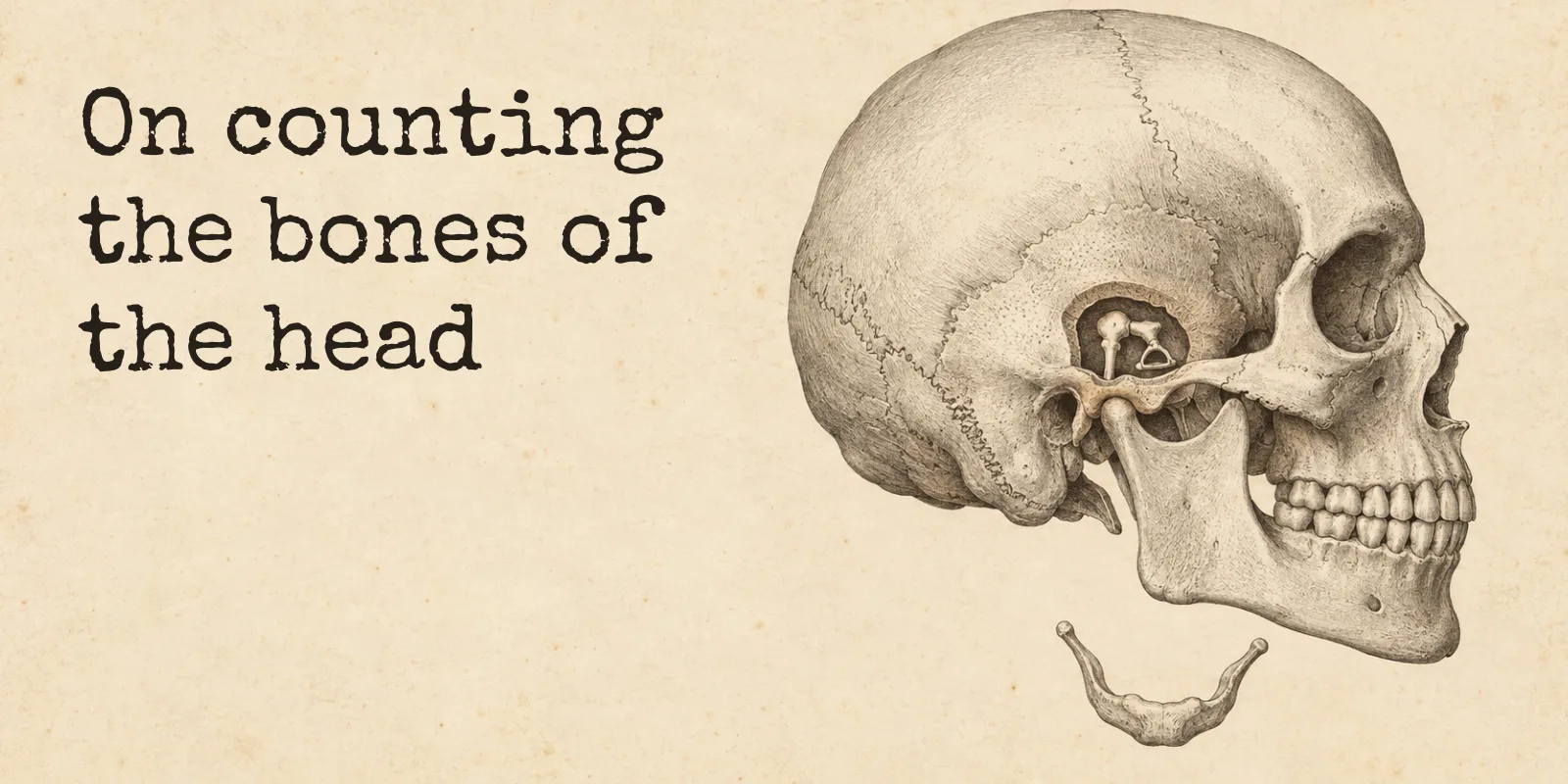
The adult skull has 22 bones, 8 around the brain and 14 in the face. You will also see 28 and 29, and neither is a mistake. Those counts take in the six tiny ear bones and the hyoid in the neck, which the textbook lists beside the skull rather than inside it.
The adult skull has 22 bones. Eight of them form the braincase around the brain, and the other fourteen build the face. That is the count in the anatomy textbook and the one to learn first.
You will also run into 28 and 29, and it is tempting to assume one of those has to be a mistake. Neither is. The bigger totals take in the six tiny bones of the middle ear and the hyoid, a small bone in the neck, which the same textbook lists beside the skull rather than inside it. Once you know which seven bones are being added, the three numbers stop arguing with each other.
The 22, and where the line is drawn
The textbook The Bone Room checks itself against, OpenStax Anatomy and Physiology, puts it in one sentence: the adult skull consists of 22 bones, 21 of them fixed together into a single unit, and the 22nd is the mandible, the lower jaw, which is the only skull bone that moves.
Those 22 split into two groups. The braincase, which anatomists call the cranium, has eight bones, and the face has fourteen. The split matters because “cranial bone” means one of the eight around the brain, and a fair amount of the confusion over the count comes from people using it to mean any bone in the head.
The eight bones of the braincase
- The frontal bone, one. The forehead, and the roof of each eye socket.
- The parietal bones, two. One on each side, forming most of the top and upper sides of the head. They meet each other along the midline at the sagittal suture.
- The temporal bones, two. One on each side, below the parietal bones. Each has small cavities inside it that house the middle and inner ear, which is where the ear bones come into this story.
- The occipital bone, one. The back and base of the skull, with the large opening the spinal cord passes through.
- The sphenoid bone, one. A complex bone across the center of the skull base that the textbook calls a keystone, because it joins with almost every other bone of the skull.
- The ethmoid bone, one. A single bone in the midline, between the eye sockets, forming the roof and side walls of the upper nasal cavity.
If you want a way to hold those eight in order, there is a mnemonic for the cranial bones, along with what it leaves out.
The fourteen bones of the face
Six pairs and two singles.
- The nasal bones, two, joining each other to form the bony bridge of the nose.
- The maxillae, two, the upper jaw. The curved lower edge of each one holds the upper teeth.
- The zygomatic bones, two, the cheekbones.
- The palatine bones, two, behind the maxillae. Together they form the back quarter of the hard palate.
- The lacrimal bones, two, small bones in the inner wall of each eye socket, where tears drain into the canal that leads down to the nose.
- The inferior nasal conchae, two, curled bones inside the nasal cavity that swirl the incoming air to warm and moisten it. There are two more conchae on each side, and those are parts of the ethmoid, so this is the only pair that counts as a bone of its own.
- The vomer, one, forming the lower back part of the wall between the two sides of the nose.
- The mandible, one, the lower jaw, and the only skull bone that moves.
Eight and fourteen make 22. Every joint between them apart from the jaw’s is a suture, which the textbook defines as an immobile joint between adjacent bones of the skull. The jaw’s joint is the exception, and it is why the mandible is the only bone in the skull that moves.
Why some sources say 28
Add the auditory ossicles, the six bones of the middle ear, and you get 28.
Each ear has three: the malleus, the incus and the stapes, which are Latin for hammer, anvil and stirrup, because that is roughly what each one looks like. They sit in an air-filled cavity inside the temporal bone, so they are inside the skull in the plain sense of the word. The malleus is attached to the eardrum, the stapes is attached to the inner ear, and the incus links the two, so a sound arriving at the eardrum is passed along the chain as vibration. The stapes is the smallest bone in the body, at about three millimeters long.
So why leave them out of the 22? Because the 22 counts the bones that make the skull’s structure, the case and the face, and the ossicles are hearing equipment that happens to be stored inside it. A source that says 28 is counting everything bony inside the head, and a source that says 22 is counting the skull.
Why some sources say 29
The widest count adds one more bone, the hyoid, and this is where the counting gets genuinely strange, because it is not in the skull at all.
The hyoid is a small U-shaped bone in the front of the neck, below the lower jaw and level with the fourth neck vertebra. It is the only bone in the body that does not touch another bone. Muscles and ligaments hold it in place, running to it from the tongue, the floor of the mouth, the larynx and the throat, and the textbook says outright that because it contacts no other bone it is not part of the skull.
It gets counted with the head anyway, and the reason is the sum that the 206 rests on. OpenStax gives the axial skeleton, the skull, spine and rib cage, 80 bones, and it gets there by taking the 22 skull bones plus “an additional seven bones associated with the head”, the hyoid and the six ossicles. That is 29 for the head, 26 for the vertebral column and 25 for the rib cage, 80 in all. The textbook uses 29 when it is adding up the skeleton and 22 when it is describing the skull, in the same chapter.
The three numbers side by side
| Count | What it includes | What it is really counting |
|---|---|---|
| 22 | 8 cranial bones and 14 facial bones | The skull |
| 28 | The 22, plus the 6 auditory ossicles | Every bone inside the head |
| 29 | The 28, plus the hyoid | The head’s share of the 80-bone axial skeleton |
The tell is usually one word. A source that says “bones of the skull” almost always means 22. A source that says “bones of the head” may mean either of the bigger numbers, and it is worth a glance to see whether the hyoid has been let in.
Does the count change as you age?
A newborn’s skull bones are separated by sutures that are still soft fibrous tissue, and at the corners where several bones meet there are wider gaps, the fontanelles, six of them. They let the skull change shape on its way through the birth canal, and afterwards they give the brain room to grow. The fontanelles have closed by about age two. The sutures stay, and the bones keep growing along them through childhood. The post on why babies have more bones than adults follows that side of the story.
The sutures then close very slowly. The coronal suture, the one running across the top of the head from ear to ear, fuses on average around age 24. It would be reasonable to assume the whole thing eventually seals into one solid bowl, and a 2023 study that looked for exactly that found it rarely happens: even in people aged 100 and over, most of the skull sutures were still open. So the eight bones of the braincase stay eight bones, and stay findable, for a whole lifetime.
The mandible goes the other way. At birth it is two bones, a left half and a right half, which fuse into one U-shaped jaw during the first year. So a newborn has one more piece in the jaw than an adult does, and nobody adjusts the count for it, because 22 is a description of the adult skull.
Which number to use
Say 22 unless you are adding up the whole skeleton, in which case the textbook’s own arithmetic needs the 29. More useful than either number is the check behind them: when a total looks wrong, find out what has been let in before deciding anyone is mistaken. The 206 has the same kind of edges, which is why The Bone Room teaches 48 individual bone names and brings in the rest as numbered or grouped sets. In the lab the braincase arrives first as one plate, eight bones joined into a single case, and the eight come round one at a time later on.
How many bones are in the skull?
The adult skull has 22 bones: 8 cranial bones forming the braincase and 14 facial bones. That count leaves out the six auditory ossicles in the middle ears and the hyoid bone in the neck.
Why do some sources say the skull has 28 or 29 bones?
A source that says 28 has added the six ossicles, three in each middle ear, to the 22. A source that says 29 has also added the hyoid. OpenStax counts all 29 as the head’s contribution to the 80 bones of the axial skeleton, while still describing the skull itself as 22.
Are the ear bones part of the skull?
The three ossicles in each ear sit in a cavity inside the temporal bone, so they are physically inside the skull. Anatomy references list them separately from the 22, as bones associated with the head.
Is the mandible part of the skull?
Yes. The mandible is one of the 14 facial bones and is included in the 22. It is the only movable bone of the skull; the other 21 are joined at sutures, which are immobile joints.
Is the hyoid part of the skull?
No. The hyoid sits in the neck below the jaw and does not touch any other bone, so OpenStax says it is not part of the skull. It is counted with the head only in the wider 29-bone total.
If the skull has left you wanting the rest of the case, the lab is free. You can start with the big bones and work down to the skull, meeting only a few specimens at a time, and see which names you can recover by the end of the week.
Sources
Every anatomical claim above is checked against OpenStax Anatomy and Physiology 2e or StatPearls on the NCBI Bookshelf, the same references the lab uses. Where two sources give different figures, the text says so.
Show all 10 sources
- OpenStax, Anatomy and Physiology 2e, 7.2 The Skull: the skull consists of 22 bones, 21 immobile and the mandible; the 8 bones of the brain case and the 14 facial bones by name; a suture is an immobile joint between skull bones; the hyoid contacts no other bone and is not part of the skull; the sphenoid as a keystone; the temporal bone’s cavities housing the middle and inner ear; the palatine bones forming the posterior quarter of the hard palate; the conchae swirling air; the vomer and the nasal septum; the mandible’s two halves fusing in the first year.
- OpenStax, 7.1 Divisions of the Skeletal System: 206 bones, 80 axial and 126 appendicular; the skull formed by 22 bones plus “an additional seven bones associated with the head”, the hyoid and the six ear ossicles; 24 vertebrae plus the sacrum and coccyx; 12 pairs of ribs and the sternum.
- OpenStax, 14.1 Sensory Perception: malleus, incus and stapes translate roughly as hammer, anvil and stirrup; the malleus attaches to the tympanic membrane and the stapes to the inner ear; vibration passes along the chain.
- StatPearls, Anatomy, Head and Neck, Ear Ossicles: the middle ear as an air-filled cavity in the petrous part of the temporal bone; the stapes connecting to the oval window; the stapes as the smallest bone in the body.
- NIH Curriculum Supplement, Information about Hearing, Communication, and Understanding: the stapes about 3 mm long.
- StatPearls, Anatomy, Head and Neck, Hyoid Bone: a U- or horseshoe-shaped bone in the midline of the neck, below the mandible and in front of the fourth cervical vertebra; unconnected to adjacent bones and anchored by muscles from the larynx, pharynx, tongue and floor of the mouth.
- OpenStax, 7.5 Embryonic Development of the Axial Skeleton: fontanelles let the skull change shape in the birth canal and the brain grow afterwards; they disappear by age 2; the sutures allow continued growth in childhood.
- StatPearls, Anatomy, Head and Neck: Fontanelles: six fontanelles in infancy; the anterior closes on average between 13 and 24 months.
- StatPearls, Anatomy, Head and Neck, Coronal Suture: the coronal suture closes and fuses around age 24.
- Plastic and Reconstructive Surgery Global Open, 2023, Gaining Closure: Do Cranial Sutures Fuse at Reported Age Ranges?: complete closure of the sagittal, coronal and lambdoid sutures rarely occurs; even in patients aged 100 or older, most sutures apart from the metopic remained open.