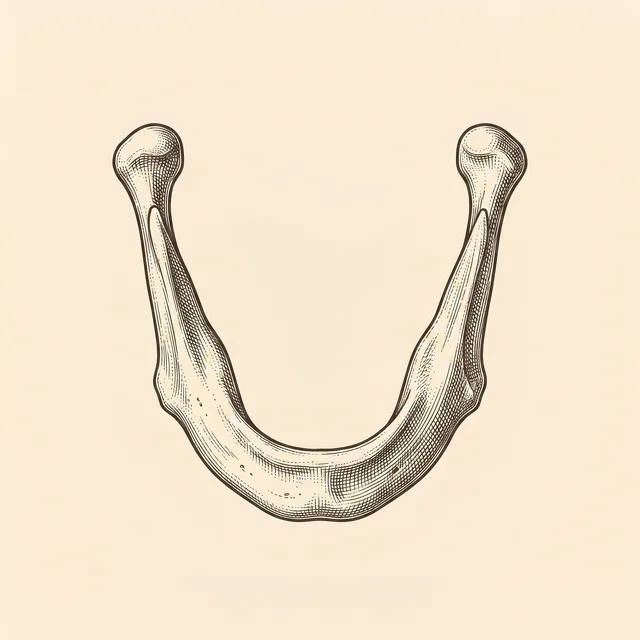
The hyoid is a small U-shaped bone at the front of your neck, just under the jaw, and it is the only bone in the body that does not meet another bone. Muscles and ligaments hold it in place, and forensic pathologists check it for fractures.
The hyoid is a small U-shaped bone at the front of your neck, just under the jaw, and it is the only bone in the body that does not touch another bone. There is no joint connecting it to the skeleton at all. Muscles and ligaments hold it where it is.
OpenStax, the textbook the lab checks against, puts it very plainly: the hyoid “does not contact any other bone”. Cleveland Clinic goes the extra step and calls it the only bone in your body that doesn’t connect to another one.
The name is the shape. Hyoid comes from the Greek for shaped like the letter upsilon, which is the Greek U.
Where the hyoid sits
The hyoid lies in the midline of the neck, below the base of the mandible and just above the thyroid cartilage of the larynx, the voice box. You can see where it hangs on the bones of the skull page. The tips of the U point backward, so the curve of the bone faces forward under your chin.
It works as a base for the tongue, which sits on top of it, and it is attached to the larynx below and the pharynx behind. StatPearls places it in front of the fourth neck vertebra in an adult. The same article describes it lying in front of the second and third vertebrae in infancy and then moving down as a child grows, to the level of the fourth and fifth, so the level depends a little on which sentence you read.
Part of the head, and not part of the skull
Because it touches nothing, the hyoid is left out of the skull. OpenStax says so directly: it is an independent bone “and thus is not part of the skull”.
It still gets counted with the head, though, because the textbook needs it for the sum. The 80 bones of the axial skeleton include the 22 of the skull plus seven more bones associated with the head, which are the hyoid and the six tiny bones of the middle ear. So the hyoid is one of the 206, even though it belongs to no neighbor. I wrote about why that makes the skull 22, 28 or 29 bones depending on who is counting.
What holds it up
The hyoid hangs from the skull on two thin ligaments. Each stylohyoid ligament runs from the styloid process, a long downward point on the temporal bone that OpenStax says is named for its likeness to a stylus, a writing tool, down to one of the small horns of the hyoid. That is a real connection to the skull, but it is made of ligament, so no bone ever meets bone.
Below, a sheet of tissue called the thyrohyoid membrane ties it to the top of the thyroid cartilage and keeps it from being pulled too far down. Around all that, StatPearls describes four pairs of muscles above the hyoid and four pairs below, anchoring it to the larynx, the pharynx, the tongue and the floor of the mouth.
Cleveland Clinic calls it the only “floating bone” in the body. I like the nickname, as long as floating means nothing touches it, because the bone itself is held in a web of muscle pulling on it from above and below.
The parts of the U
The hyoid has a body, which is the broad flat piece at the front of the U, and two pairs of horns. The greater horns are the long arms of the U reaching backward. The lesser horns are much smaller, and they are where the stylohyoid ligaments attach.
The detail that surprised me most is how the horns are joined to the body, which is by fibrous tissue or by a true synovial joint. So the one bone in the body with no joints to anything else can have small joints inside itself, between its own pieces.
What the hyoid does
Swallowing is where you can see the hyoid at work. The muscles above the hyoid lift it, which raises the floor of the mouth, and the muscles above and below it together draw it forward, which StatPearls says supports the opening of the upper esophageal sphincter, the entrance to the esophagus.
The same article connects the hyoid to speech and breathing too. Keeping the airway open depends partly on where the hyoid sits, and the bone contributes to making sound, along with its roles in moving the tongue and chewing.
Why forensic pathologists check it
I came to bones through a forensic anthropology show, where the skeleton is evidence, so this is the part of the hyoid closest to where my interest started.
Fractures of the hyoid and the cartilages of the larynx are well documented in deaths from manual strangulation, ligature strangulation and hanging, and StatPearls calls that trauma a key forensic indicator of manual strangulation. The fractures are more frequent in strangulation than in hanging. Blunt injury to the neck can also break the hyoid.
The breaks usually involve the greater horns, or the place where a horn meets the body. A 1995 study that X-rayed 15 fractured hyoids found the 19 fractures split evenly between the middle and back thirds of the greater horn, with only one in the front third. Every fracture sat at a point where the horn curved at between 30 and 60 degrees, so the authors concluded that the shape of an individual bone decides exactly where it gives way.
A broken hyoid is one finding
A fractured hyoid is found in only about a third of strangulation homicides. That figure appears both in StatPearls and in a 1996 study in the Journal of Forensic Sciences. It follows that an intact hyoid does not exclude strangulation as the cause of death.
The same 1996 study lists what might decide whether a hyoid breaks: how much force was applied and how, the age of the person, whether hands or a ligature were used, and the anatomy of the bone itself. When the authors compared 10 hyoids that had broken with 10 that had not, the broken ones came from older victims, and 70 percent of them were ossified or fused, against 30 percent of the unbroken ones.
Nor does a fracture on its own say how it happened, since hanging and blunt injury to the neck can break the hyoid too.
How age changes the bone
That fusion is why age matters. In many adults the joints between the horns and the body slowly turn to bone, which StatPearls calls physiological ankylosis and gives as the reason hyoid fractures are more common in older people.
The timing varies a lot from person to person. A 2016 CT study of hyoids across the lifespan found that fusion normally happens in adulthood but may not happen at all in some people, and in its oldest group, aged 75 to 95, both sides were still unfused in 16 percent.
Fusion matters in the other direction as well. A hyoid whose horns still move against the body can look as though it has been broken, and StatPearls warns that this natural mobility must not be mistaken for a fracture during a postmortem examination.
Frequently asked questions
What bone touches no other bone?
The hyoid, a small U-shaped bone at the front of the neck. It forms no joint with any other bone; ligaments from the skull’s styloid processes and muscles above and below hold it in place.
Where is the hyoid bone?
In the midline of the neck, below the lower jaw and just above the thyroid cartilage of the voice box. In an adult it sits roughly in front of the fourth neck vertebra, though sources also give the fourth and fifth.
What does the hyoid bone do?
It is the base the tongue sits on and an anchor for the muscles of the tongue, larynx and pharynx. It moves up and forward when you swallow, and its position helps keep the airway open.
Does a broken hyoid prove strangulation?
No. A hyoid fracture is an important forensic finding, but hanging and blunt neck injury can also cause one. It is found in only about a third of strangulation homicides, so an intact hyoid does not rule strangulation out either.
The hyoid is one of the plates in the lab’s case file on the head and throat. If you want to be able to name it without looking, The Bone Room is free, and it only lets you claim the hyoid once you have named it on three separate days, the last time typed from memory.
Sources
Every anatomical claim above is checked against OpenStax Anatomy and Physiology 2e or StatPearls on the NCBI Bookshelf, the same references the lab uses, with Cleveland Clinic for the nickname and three peer-reviewed forensic studies for the fracture and fusion figures. Where two sources give different figures, the text says so.
Show all 7 sources
- OpenStax, Anatomy and Physiology 2e, 7.2 The Skull: the hyoid is an independent bone that does not contact any other bone and thus is not part of the skull; small and U-shaped, in the upper neck near the level of the inferior mandible, tips of the U pointing posteriorly; base for the tongue above, attached to the larynx below and the pharynx posteriorly; the styloid process anchors a ligament that supports the hyoid.
- OpenStax, 7.1 Divisions of the Skeletal System: 206 bones in the adult; 80 axial bones; seven bones associated with the head, the hyoid and the ear ossicles.
- StatPearls, Anatomy, Head and Neck: Hyoid Bone: midline, inferior to the mandible, anterior to the 4th cervical vertebra, just superior to the thyroid cartilage; anterior to C2 and C3 in infancy, descending to C4 and C5; unconnected to adjacent bones; body, two greater and two lesser horns, horns united to the body by fibrous tissue or a synovial joint; stylohyoid ligaments from the styloid processes to the lesser horns; thyrohyoid membrane restricting downward displacement; four pairs of suprahyoid and four pairs of infrahyoid muscles; suprahyoids elevate the hyoid and the floor of the mouth; hyoid moved anteriorly, supporting opening of the upper esophageal sphincter; roles in airway patency, phonation, tongue movement and mastication; fusion of the horns in adulthood, not in all individuals; physiological ankylosis with age; fractures in manual and ligature strangulation and hanging, more frequent in strangulation, in about a third of strangulation homicides; an intact hyoid does not exclude strangulation; blunt neck trauma; fractures of the greater horns or the body-horn junction; more common in older individuals; natural mobility at the junction not to be misinterpreted as a fracture; hyodeides, shaped like the letter upsilon.
- Cleveland Clinic, Hyoid Bone: the only bone in the body that doesn’t connect to another bone; the only “floating bone”.
- Pollanen MS, Bulger B, Chiasson DA, The location of hyoid fractures in strangulation revealed by xeroradiography, Journal of Forensic Sciences, 1995: 19 fractures in 15 hyoids; 47% each in the middle and posterior thirds of the greater horn, 5% anterior; all at 30 to 60 degrees of curvature; location determined by the shape of the horn.
- Pollanen MS, Chiasson DA, Fracture of the hyoid bone in strangulation, Journal of Forensic Sciences, 1996: fractured in one-third of homicides by strangulation; absence does not exclude strangulation; force, age, instrument and anatomy as possible factors; 10 fractured versus 10 unfractured hyoids, fractured in older victims, 70% versus 30% fused.
- Fisher E and colleagues, Hyoid bone fusion and bone density across the lifespan: prediction of age and sex, Forensic Science, Medicine, and Pathology, 2016: fusion normally occurs in adulthood but may not occur at all in some individuals; bilateral non-fusion in 16% of the 75 to 95 age group.