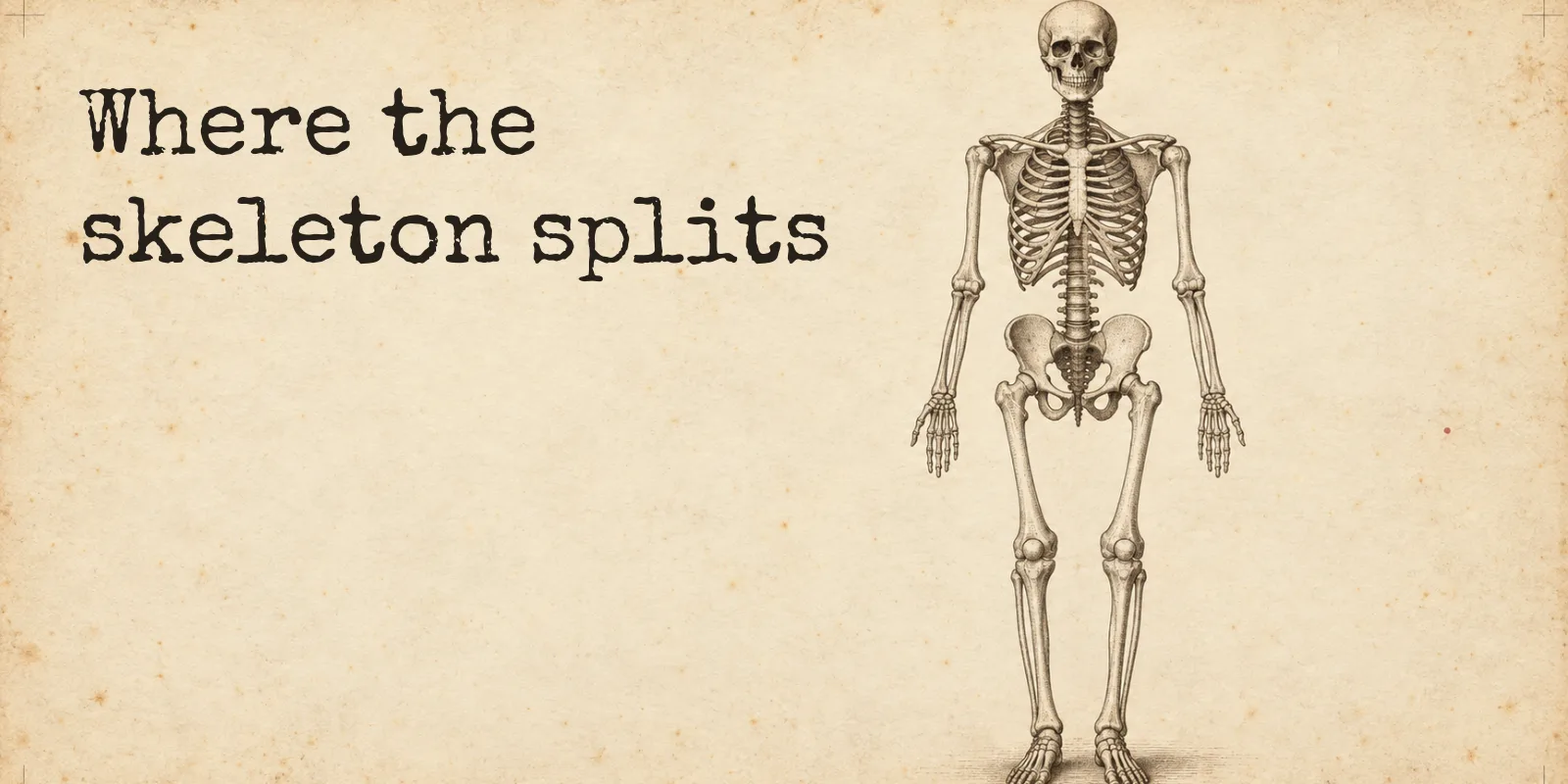
The axial skeleton is the head, neck, chest and back, 80 bones in the adult count. The appendicular skeleton is the limbs and the bones that anchor them, 126. The pelvis is where the rule looks broken, and the reason it is not turns out to be the most useful thing here.
The axial skeleton is the central column of the body, which is the head, the neck, the chest and the back, and it comes to 80 bones in the adult count. The appendicular skeleton is everything that hangs off that column: the two arms, the two legs, and the bones that anchor each limb to the middle. That is 126. Add them and you have the 206 that everybody quotes.
The rule holds cleanly almost everywhere. Nobody hesitates over the femur or the sternum. It comes apart in two places, the pelvis and the shoulder, where bones from both divisions sit side by side close enough to touch, and that is usually the point where a person decides they must have misunderstood the rule in the first place.
I ran into it while building the lab, because every bone in the data has to be filed under one division or the other and somebody has to make that call. Most of them took a second. The sacrum took longer, because it sits in the middle of the pelvis and looks for all the world like part of the hip, and it is filed as axial. The reason it is filed that way is the one thing here worth keeping.
What each half actually contains
OpenStax Anatomy and Physiology, the textbook The Bone Room checks itself against, gives the axial skeleton as the bones of the head, neck, chest and back, and puts the total at 80. The appendicular is “all bones of the upper and lower limbs, plus the bones that attach each limb to the axial skeleton”, and comes to 126.
Both numbers add up in public, which is worth seeing once.
| Axial, 80 | Appendicular, 126 | ||
|---|---|---|---|
| Skull | 22 | Clavicles and scapulae | 4 |
| Hyoid and the six ear ossicles | 7 | Upper limbs, 30 each | 60 |
| Vertebrae | 24 | Hip bones | 2 |
| Sacrum and coccyx | 2 | Lower limbs, 30 each | 60 |
| Ribs | 24 | ||
| Sternum | 1 |
Thirty bones in an upper limb is the humerus, the radius and ulna, eight carpals, five metacarpals and fourteen phalanges. Thirty in a lower limb is the femur, the patella, the tibia and fibula, seven tarsals, five metatarsals and fourteen phalanges, which comes out the same by coincidence rather than by symmetry, since the hand has an extra carpal where the lower limb has the kneecap.
The seven bones in the second row of the axial column are the ones people miss. Six of them are the auditory ossicles, three in each middle ear, buried inside the temporal bone. The seventh is the hyoid, a small horseshoe in the neck under the jaw that touches no other bone at all and hangs from muscles and ligaments. The textbook counts all seven in the axial 80 while listing them as associated with the head rather than inside the skull’s 22, which is why the skull can be 22, 28 or 29 depending on who is counting.
Where the two words come from
Axial is from the Latin axis, an axle or a pivot, the same word behind the imaginary line the Earth turns on. It is a good name, because the skull, the spine and the rib cage really do form a line the rest of the body is arranged around. Anatomy uses the word twice, incidentally: the second vertebra in your neck is a bone called the axis, and the skull and the first vertebra rotate on the tooth-shaped peg sticking up out of it.
Appendicular takes the longer road. It comes from the Latin appendicula, a small addition or a little appendage, which is a diminutive of appendix, which comes from appendere, to cause to hang from something, built on pendere, to hang. Etymonline’s entry for the word finishes with the note that in anatomy it is “opposed to axial”, which is unusually blunt for a dictionary and saves a paragraph of explanation.
Between them the two names already carry the rule, one for the axle and one for the things hung on it, which is more help than most anatomical vocabulary offers.
The pelvis, where the rule looks broken
Here is the part that trips everyone, and it is a vocabulary problem more than an anatomy one.
OpenStax keeps two words apart that most people use interchangeably. The pelvic girdle is the bone that attaches a lower limb to the axial skeleton, and in that textbook’s usage it is a single bone, the hip bone or coxal bone, one on each side. The pelvis is the whole structure those two hip bones make together with the sacrum and the coccyx.
Once the words are separated, the answer falls out. The girdle is appendicular. The pelvis is a region, and a region can hold whatever it likes, so it holds two appendicular hip bones and the axial sacrum and coccyx sitting between them at the back.
You will also see “the pelvic girdle” used for both hip bones together, which is harmless and probably more common in speech. What no source does is put the sacrum inside the girdle. The sacrum is a run of vertebrae that fused, and a vertebra is axial wherever it ends up.
Where the two divisions meet is the sacroiliac joint, the largely immobile join between the ilium of each hip bone and the side of the sacrum, and it is what your weight crosses on the way down.
The shoulder, where the join is one small joint
The same thing happens higher up, with the same answer and a much stranger arrangement.
The clavicle and the scapula form the pectoral girdle, so both are appendicular. The ribs and the sternum lying right against them are the thoracic cage, so both are axial. Being neighbors decides nothing.
What makes the shoulder worth a paragraph of its own is how little bone is actually holding it on. The sternoclavicular joint, where the inner end of the collarbone meets the top of the breastbone, is the only bony articulation between the entire pectoral girdle and the axial skeleton. Everything else is soft tissue. The scapula does not articulate with the ribs at all; it is wrapped in muscle front and back and rides on the chest wall, and the left and right girdles are not joined to each other, so each shoulder works independently of the other.
Which means the boundary between the two halves of your skeleton runs, on each side, through a single small joint at the top of your breastbone. It is also part of why the collarbone breaks so often: a strut doing that much work, with that little holding it.
Why the split is worth having
A textbook division can be a filing convention and nothing more. This one earns its keep, and comparing the two girdles is the quickest way to see why.
The pectoral girdle attaches to the axial skeleton by one small, highly mobile joint per side. That is the arrangement that gives the shoulder its range, because the clavicle can swing at the sternum, the scapula can slide on the ribs behind it, and the two sides move separately. You pay for it in stability, which is why shoulders dislocate and collarbones break.
The pelvic girdle does the opposite. Each hip bone is bound to the sacrum at a joint that barely moves, and that immobility is the point: it lets your weight pass sideways out of the vertebral column, through the girdle and the hip joint, and down into whichever leg happens to be under you. Stand on one foot and you can feel the whole arrangement doing its job.
That contrast is what the division is for. The column has to hold still enough to carry the load and to shield the brain, the spinal cord, the heart and the lungs, and it doubles as the anchor for the muscles that move your head, neck and back. The limbs have to travel. Each girdle is where one of those requirements is traded against the other, and the two of them settled on different answers.
Which is a pattern rather than a rule, and the exceptions are the part I like. Ribs are axial and they move every time you breathe, lifting outward like bucket handles while the sternum swings up like a pump handle. Hip bones are appendicular and they carry your entire upper body.
The bones that cause all the trouble
| Bone | Division | Why |
|---|---|---|
| Sacrum | Axial | Five vertebrae, fused |
| Coccyx | Axial | The last segments of the vertebral column |
| Hip bone (coxal bone) | Appendicular | It is the pelvic girdle |
| Ribs | Axial | Thoracic cage |
| Sternum | Axial | Thoracic cage |
| Clavicle | Appendicular | Pectoral girdle |
| Scapula | Appendicular | Pectoral girdle |
| Hyoid | Axial | Counted with the head |
| Ear ossicles | Axial | Counted with the head |
| Patella | Appendicular | It is part of the lower limb |
Read down the “why” column and there is only one question being asked each time: is this bone part of the central column, or is it part of a limb and the girdle that hangs the limb on. Everything else, including where the bone physically sits, is a distraction.
Reading that table is not the same as knowing it
You have just read ten rows and every one of them made sense, and that feeling is the trap. Recognizing that “sacrum, axial” looks right is a much lower bar than producing it yourself with nothing in front of you, and the gap between those two things is most of the reason anatomy feels learned on Tuesday and gone by Saturday.
So look away from the screen and answer these out loud.
- Name three things in the axial skeleton.
- Name three things in the appendicular skeleton.
- Which bones in the pelvic region are axial, and which are appendicular?
- Which single joint attaches the shoulder girdle to the axial skeleton?
Then check them against the table. If they came back cleanly, try the same four in three days without reading this again, because a thing you can produce today and again on Thursday is in a different condition from a thing you have only read. If some of them have gone, that is ordinary, and it is the point at which spacing the attempts out starts to be worth more than rereading.
Why 80 and 126 are adult numbers
Both figures describe a conventional adult skeleton, and the bones underneath them are still moving.
The vertebral column starts out as 33 vertebrae and ends up as 24, plus the sacrum and the coccyx. The five sacral vertebrae fuse into the single sacrum and the coccygeal ones fuse into the coccyx, and neither process begins until after age 20 or finishes before middle age, which is later than most people assume. OpenStax gives the coccyx as four fused vertebrae; StatPearls gives it as three to five, with real variation in whether they fuse at all.
The hip bone has its own version. It arrives as three separate bones, the ilium, the ischium and the pubis, and they fuse into one coxal bone per side during the late teenage years. Their names survive as the names of the three regions of the adult bone.
None of that touches the classification. A sacrum made of five vertebrae is axial for exactly the reason one vertebra is. A hip bone made of three fused bones is appendicular because the thing it is, once it is one bone, is a pelvic girdle. That is the advantage of a rule built on what a bone does rather than on a count: the count is a convention and it changes with age, and a baby’s skeleton has more bones than yours, but the two halves stay where they are.
Frequently asked questions
What is the difference between the axial and appendicular skeleton?
The axial skeleton is the central column: the skull, the ear ossicles and hyoid, the vertebral column, and the rib cage and sternum, 80 bones in the adult count. The appendicular skeleton is the arms and legs plus the girdles that anchor them, which is 126. The axial half mostly supports and protects; the appendicular half mostly moves.
Is the pelvis axial or appendicular?
Both, because the pelvis is a region rather than a single structure. The two hip bones are appendicular, since each one is a pelvic girdle. The sacrum and coccyx are axial, since they are the bottom of the vertebral column. They meet at the sacroiliac joint.
Is the clavicle part of the axial skeleton?
No. The clavicle and the scapula form the pectoral girdle, which is appendicular, even though the clavicle touches the sternum and the scapula lies across the ribs. That contact point, the sternoclavicular joint, is the only bony articulation between the shoulder girdle and the axial skeleton.
Why is the sacrum axial when it sits in the pelvis?
Because it is vertebral column. The sacrum is five sacral vertebrae fused into one bone, and the division a bone belongs to follows what it is part of rather than the region it occupies.
How many bones are in the axial and appendicular skeleton?
Eighty axial and 126 appendicular, which is the conventional adult 206. The axial 80 is 22 skull bones, seven more associated with the head, 24 vertebrae, the sacrum and coccyx, 24 ribs and the sternum. The appendicular 126 is four girdle bones at the shoulders, two hip bones, and 30 bones in each of the four limbs.
The split is one of the few pieces of anatomy vocabulary that pays for itself on the first day, because it turns a heap of 206 names into two heaps with a reason behind them. The lab is free and starts with the big, familiar bones, and you can begin without an account.
Sources
Every anatomical claim above is checked against OpenStax Anatomy and Physiology 2e or StatPearls on the NCBI Bookshelf, the same references the lab uses. Where two sources give different figures, the text says so.
Show all 14 sources
- OpenStax, Anatomy and Physiology 2e, 7.1 Divisions of the Skeletal System: 206 bones in the adult skeleton; the axial skeleton forms the vertical, central axis of the body and includes all bones of the head, neck, chest and back; 80 axial bones; the skull’s 22 plus “an additional seven bones associated with the head”, the hyoid and the six ear ossicles; 24 vertebrae plus the sacrum and coccyx; 12 pairs of ribs and the sternum; 126 appendicular bones, being all bones of the upper and lower limbs plus the bones that attach each limb to the axial skeleton; the axial skeleton protects the brain, spinal cord, heart and lungs and anchors the muscles that move the head, neck and back; younger individuals have more bones because some fuse during childhood and adolescence.
- OpenStax, Chapter 8 introduction: the appendicular skeleton as the limb bones plus the bones that anchor the limbs to the axial skeleton; the pectoral girdle anchoring the upper limb to the thoracic cage and the pelvic girdle attaching the lower limb to the vertebral column; the lower limbs adapted for weight-bearing support and locomotion, the upper limbs for manipulation.
- OpenStax, 8.1 The Pectoral Girdle: the pectoral girdle as the scapula and clavicle; the sternoclavicular joint as the only bony articulation between the pectoral girdle and the axial skeleton; the scapula surrounded by muscle on both sides and not articulating with the ribs; the right and left girdles not joined to each other and operating independently; the single highly mobile joint allowing the girdle’s extensive mobility.
- OpenStax, 8.2 Bones of the Upper Limb: 30 bones in each upper limb, excluding the clavicle and scapula; the humerus as the single bone of the arm; the radius and ulna as the paired forearm bones; eight carpals, five metacarpals and 14 phalanges.
- OpenStax, 8.3 The Pelvic Girdle and Pelvis: the pelvic girdle formed by a single bone, the hip bone or coxal bone; the pelvis as the entire structure formed by the two hip bones, the sacrum and the coccyx; the ilium firmly united to the sacrum at the largely immobile sacroiliac joint; the ilium, ischium and pubis as three separate bones that fuse during the late teenage years and whose names name the three regions of the adult bone; weight transferred laterally from the vertebral column through the pelvic girdle and hip joints into either lower limb.
- OpenStax, 8.4 Bones of the Lower Limb: 30 bones in each lower limb; the femur as the single bone of the thigh; the tibia and fibula; seven tarsals, five metatarsals and 14 phalanges; the patella as the largest sesamoid bone in the body.
- OpenStax, 7.3 The Vertebral Column: the column develops as 33 vertebrae and reduces to 24 plus the sacrum and coccyx; seven cervical, 12 thoracic and five lumbar vertebrae; the sacrum formed by the fusion of five sacral vertebrae and the coccyx by the fusion of four coccygeal vertebrae, both beginning after age 20 and completing in middle age; the axis and its dens as the pivot for rotation of the head.
- OpenStax, 7.4 The Thoracic Cage: the cage as the 12 pairs of ribs with their costal cartilages and the sternum, anchored behind to the 12 thoracic vertebrae; it protects the heart and lungs.
- StatPearls, Anatomy, Thorax, Wall Movements: the bucket-handle movement of the ribs and the pump-handle movement of the sternum during inhalation.
- StatPearls, Anatomy, Head and Neck, Hyoid Bone: a U-shaped or horseshoe-shaped bone in the midline of the neck below the mandible, unconnected to any adjacent bone and anchored by muscles and ligaments.
- StatPearls, Anatomy, Abdomen and Pelvis: Bones (Ilium, Ischium, and Pubis): “The pelvic girdle, also known as the os coxae … consists of the fused bones identified individually as the ilium, ischium, and pubis”; the girdle as the link between the axial skeleton and the lower limbs.
- StatPearls, Anatomy, Back, Coccygeal Vertebrae: the coccyx described as three to five fused segments.
- Etymonline, axis: from Latin axis, “axle, pivot, axis of the earth or sky”.
- Etymonline, appendicular: from Latin appendicula, “a little addition, small appendage”, diminutive of appendix, from appendere, “cause to hang (from something)”, from pendere, “to hang”; “In anatomy, opposed to axial.”