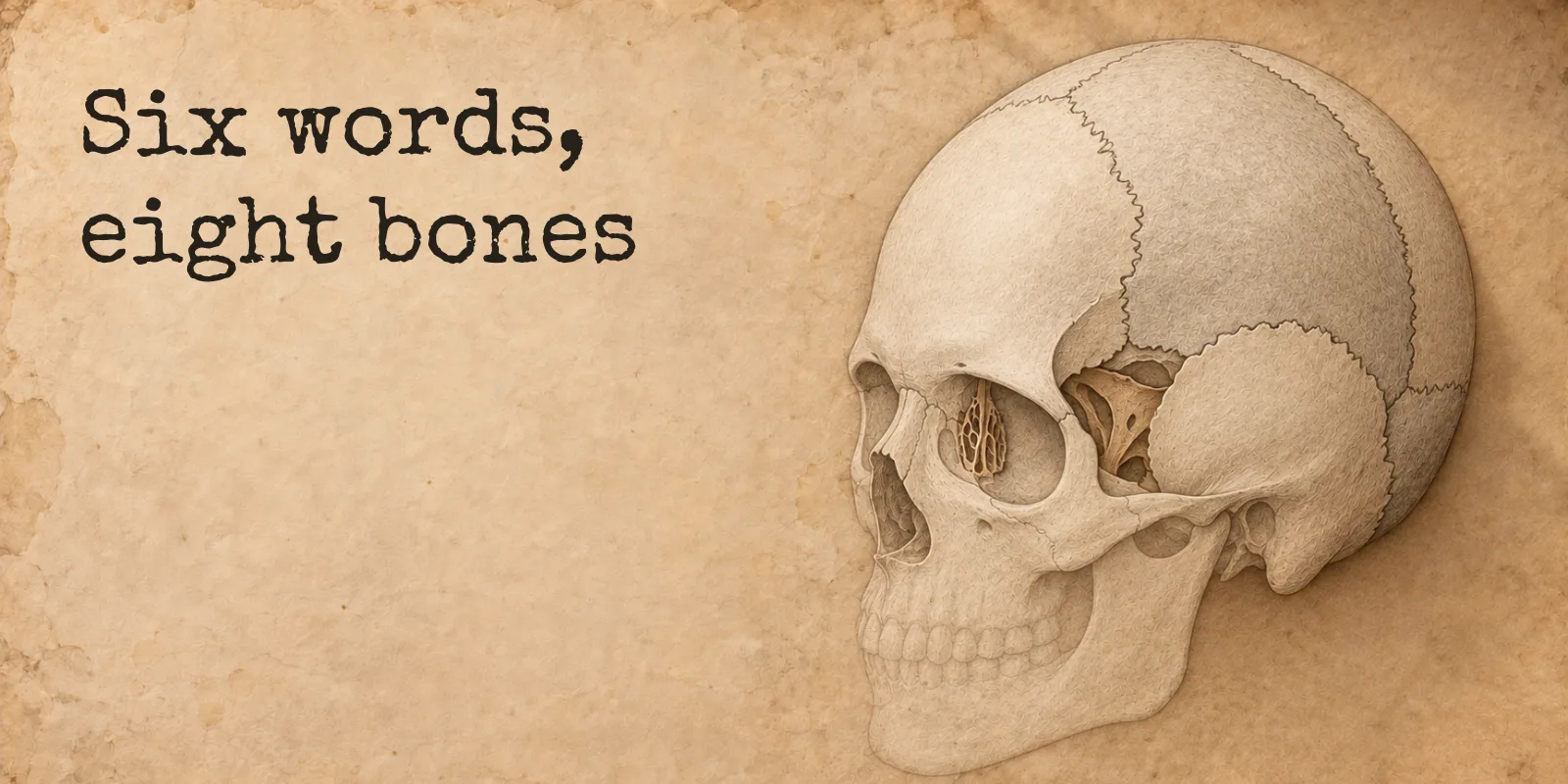
Ethan's Fried Spanish Pasta Tempted Octavia gives you six words for eight bones, because two of the names are pairs. Here is the decode, where each bone actually sits, and the second mnemonic hidden inside the names themselves.
The eight cranial bones are the frontal, the occipital, the sphenoid, the ethmoid, and a pair each of parietals and temporals. The mnemonic you will meet most often is “Ethan’s Fried Spanish Pasta Tempted Octavia,” which gives you six words for those six names, and two of the names count twice.
That last part is where the phrase starts costing you something. You can recite all six words and still be unable to say why the answer is eight, or which bone sits at the back of the head, because the sentence was only ever carrying the sounds.
Six words, eight bones
The decode:
| Cue | Bone | How many |
|---|---|---|
| Ethan’s | ethmoid | 1 |
| Fried | frontal | 1 |
| Spanish | sphenoid | 1 |
| Pasta | parietal | 2 |
| Tempted | temporal | 2 |
| Octavia | occipital | 1 |
Four of the bones are single and sit on the midline: frontal, occipital, sphenoid, ethmoid. Two come as a left and a right: parietal and temporal. So the sum is 1 + 1 + 1 + 2 + 2 + 1, and the total is eight.
Most versions of the mnemonic write “parietal” and “temporal” as one entry each and leave it there, which makes the list look six long and then the number eight arrives from nowhere. Whenever you write the phrase out, write the pairs as pairs.
These eight are the braincase only
The skull has 22 bones. Eight of them form the braincase, which anatomists also call the neurocranium, and the other fourteen build the face, the viscerocranium: the maxillae, the zygomatic bones, the nasal bones, the mandible and the rest. The mnemonic covers the eight and nothing else.
It is worth holding that line, because “cranial bone” gets used loosely to mean any bone in the head, and then the count stops agreeing with itself. The post on how many bones are in the skull has the full 22, along with why you will also see 28 and 29.
The four you can find with your own hands
These are the easy half, because you can touch four of the eight without a diagram.
Fried = frontal
One bone, forming your forehead and the upper rim of both eye sockets. Put your palm on your forehead and you have found it.
Inside the skull it keeps going, and forms the floor of the anterior cranial fossa, the shallow front compartment of the skull’s inner floor where the frontal lobe of the brain rests. The ethmoid and sphenoid help form that floor too, so the frontal is the front of it rather than all of it.
Pasta = parietal
Two bones, one left and one right, forming most of the roof and upper sides of the braincase. They meet each other along the top of your head at the sagittal suture, and meet the frontal bone in front at the coronal suture, the one that runs across the skull from ear to ear.
Tempted = temporal
Two bones, one on each side, sitting lower than the parietals. Each one carries the external acoustic meatus, which is the opening of the ear canal, so if you put a finger in front of your ear you are on the temporal bone.
That gives you a vertical rule for the side of the skull that is hard to lose: parietal above, temporal below, and the ear is the line between them.
Octavia = occipital
One bone, forming the back and base of the skull. If someone asks which cranial bone is at the back of the head, this is it.
It is pierced by the foramen magnum, the large opening the spinal cord passes through on its way to the brainstem. Foramen is Latin for a hole or opening, from forare, to pierce, and magnum is large, so the name is a plain description of a big hole.
The two you cannot
The sphenoid and the ethmoid are the ones people lose, and they get lost for a reason that has nothing to do with the mnemonic. Both sit deep inside the skull base, so a side-view diagram shows you almost nothing of either, and there is no part of your own head you can press to find them.
Spanish = sphenoid
One bone, spanning the central base of the skull behind the eye sockets. OpenStax calls it a keystone, because it joins with almost every other bone of the skull, and it forms much of the middle cranial fossa, the deeper compartment behind the anterior one, where the temporal lobes sit.
There is a saddle-shaped hollow at its center, the sella turcica, and the pituitary gland sits in it.
Ethan’s = ethmoid
One bone, on the midline, and the one the mnemonic puts first. The ethmoid forms the roof and the lateral walls of the upper nasal cavity, the upper part of the nasal septum, and part of the medial wall of each eye socket. It sits above the nasal cavity and between the orbits, rather than behind the nose.
The separation to hold on to is front and back: the ethmoid is the more forward of the two deep bones, and the sphenoid sits behind it at the central base. If you can keep those two apart you have done the hard part of this map.
The better mnemonic is the names
Each of the six names already tells you where the bone is or what it looks like, and once you can hear that in them the phrase stops doing much work.
- Frontal, from Latin frons, brow or forehead. It is the forehead bone.
- Parietal, from Latin paries, a wall. The walls of the braincase.
- Temporal, from Latin tempora, the temples of the head. The bone at your temple.
- Occipital, from Latin occiput, the back of the skull, built from ob, against, and caput, head. The back of the head.
- Sphenoid, from Greek sphen, a wedge. A wedge driven across the skull base.
- Ethmoid, from Greek ethmos, a sieve. Its cribriform plate is perforated like one, and the nerve fibers of smell pass up through the holes from the nose into the brain.
Most of those are just a location said in Latin, which is why they hold better than “Ethan’s” does. The cue arrives inside the word you are trying to remember instead of sitting next to it, and the wrist works the same way: each of the eight carpal names describes something about its bone.
PEST OF 6, and the number it gets wrong
The other cue you will meet is “PEST OF 6”: Parietal, Ethmoid, Sphenoid, Temporal, Occipital, Frontal. It covers the same six names in a different order.
It is worth knowing that the version circulating on study sites spells the 6 out as “there are six bones in total,” and there are not. There are six names and eight bones. A mnemonic that hands you the wrong total is a strange thing to learn on purpose, so if you use this one, read the 6 as the number of words.
Switching between the two phrases will not fix a location problem anyway. If you can recite either and still cannot place the sphenoid, the sentence was never the weak link.
What the phrase cannot do for you
Saying “Ethan’s Fried Spanish Pasta Tempted Octavia” over and over in one evening builds a real kind of memory: the phrase starts to feel known when you see it again. That feeling is recognition, and producing a bone name from nothing when someone points at the back of a skull is recall. The two come apart, and they come apart most obviously about a week later. The post on recognition versus recall has the experiments behind that, including the one where the students who felt most confident did worst.
The cheap test is a blank sheet. Draw a rough skull from the side, mark the forehead, the upper sides, the lower sides around the ears, the back, the deep front between the orbits and the central base, and write a name in each region without looking at anything. Then do it again in two days, because filling it in twice in one evening only asks whether the sentence is still in your head from twenty minutes ago.
Whichever regions come back blank are the ones to work on, and if two of them go it will probably be the two you cannot reach with your own hand.
What is the mnemonic for the eight cranial bones?
One common cue is “Ethan’s Fried Spanish Pasta Tempted Octavia”: ethmoid, frontal, sphenoid, parietal, temporal, occipital. Another is “PEST OF 6”. Both give six names, and because the parietal and temporal bones are paired, six names produce eight bones.
What are the 8 cranial bones?
The frontal, occipital, sphenoid and ethmoid bones, which are single, plus the left and right parietal bones and the left and right temporal bones. Together they form the braincase around the brain.
Which cranial bones are paired?
The parietal bones and the temporal bones. Each of those names covers a left and a right bone, which is why a six-word mnemonic still adds up to eight.
Which cranial bone is at the back of the skull?
The occipital bone. It forms the back and base of the skull and contains the foramen magnum, the large opening through which the spinal cord passes.
Why do the sphenoid and ethmoid feel harder than the rest?
Both sit deep in the base of the skull, where a surface diagram barely shows them and you cannot find either by touch. The ethmoid is the more anterior, above the nasal cavity and between the eye sockets; the sphenoid lies behind it across the central skull base.
I learned the names of bones because I wanted to watch Bones and follow along, and a sentence about Spanish pasta was never going to get me there. The lab meets the braincase first as a single plate, eight bones in one case, and brings the eight back one at a time later on, each one typed from memory on separate days rather than in one sitting. It is free, and you can open a case file without making an account.
Sources
Every anatomical claim above is checked against OpenStax Anatomy and Physiology 2e or StatPearls on the NCBI Bookshelf, the same references the lab uses. Where two sources give different figures, the text says so.
Show all 9 sources
- OpenStax, Anatomy and Physiology 2e, 7.2 The Skull: the brain case consists of eight bones, the paired parietal and temporal bones plus the unpaired frontal, occipital, sphenoid and ethmoid; the frontal bone forms the forehead, the supraorbital margin, the roof of the orbit and the floor of the anterior cranial cavity; the parietal bones form most of the upper lateral side of the skull, with the sagittal and coronal sutures; the temporal bone forms the lower lateral side and carries the external acoustic meatus; the occipital bone forms the posterior skull and contains the foramen magnum, which allows passage of the spinal cord; the sphenoid as a keystone joining almost every other bone of the skull, with the sella turcica at the midline of the middle cranial fossa; the ethmoid as a single midline bone forming the roof and lateral walls of the upper nasal cavity, the upper portion of the nasal septum and part of the medial wall of the orbit, with the cribriform plates and olfactory foramina; the 14 facial bones by name; the anterior, middle and posterior cranial fossae.
- OpenStax, 7.1 Divisions of the Skeletal System: 206 bones in the adult skeleton, 80 of them axial; the skull is formed by 22 bones, with an additional seven bones associated with the head.
- StatPearls, Anatomy, Head and Neck, Skull: the skull’s 22 bones divided into the neurocranium, which protects the brain, and the viscerocranium, which forms the face; the anterior cranial fossa formed by the frontal, sphenoid and ethmoid bones and housing the frontal lobe; the middle fossa formed by the sphenoid and the two temporal bones and containing the temporal lobe; the posterior fossa formed by the occipital and temporal bones.
- Registered Nurse RN, Human Skull Bones (Cranial and Facial Bones) Mnemonic: “Ethan’s Fried Spanish Pasta Tempted Octavia” in circulation as a cranial bones mnemonic, with the word-to-bone decode.
- Anatomy Note, Cranial Bones Mnemonic: PEST OF 6: the second mnemonic, and the circulating gloss of the 6 as the number of bones rather than the number of names.
- Online Etymology Dictionary, frontal: from Latin frons, “brow, forehead.”
- Online Etymology Dictionary, parietal: from Latin paries, “wall.”
- Online Etymology Dictionary, temporal, occipital and sphenoid: temporal from Latin tempora, the temples of the head; occipital from Latin occiput, “back of the skull,” from ob and caput; sphenoid “wedge-shaped,” from Greek sphen, “a wedge.”
- Online Etymology Dictionary, foramen, and Wiktionary, ethmoid: foramen from Latin “hole, opening, aperture,” from forare, “to pierce”; ethmoid from Ancient Greek ethmos, “strainer, sieve,” via ethmoeides, “like a strainer, perforated.”