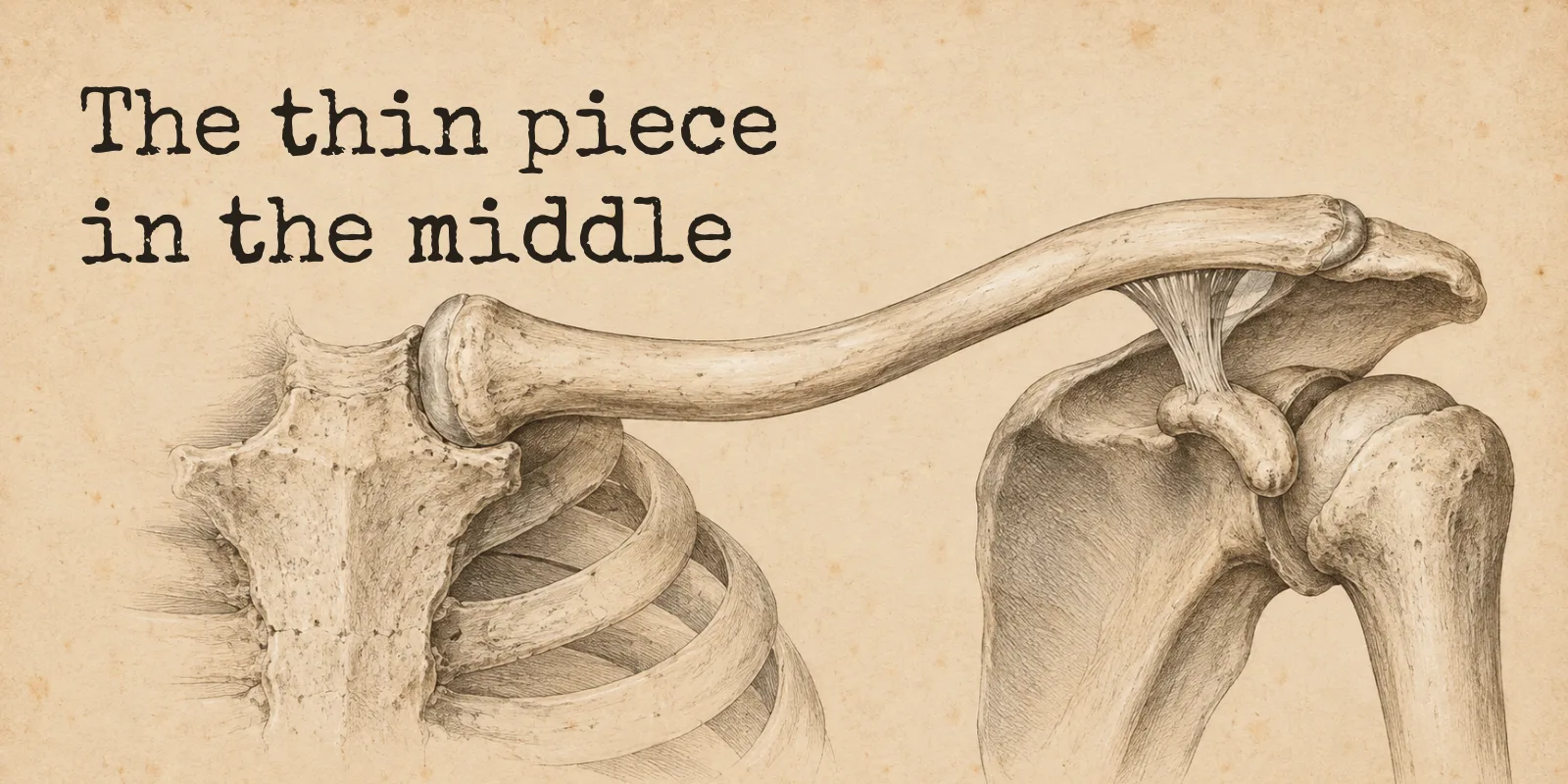
The collarbone breaks so often because of one stretch about halfway along it, where the bone is thinnest and no ligament is holding on. Almost every break arrives through the shoulder rather than through the hand, which is the opposite of what I had assumed.
The collarbone breaks so often because of one stretch of bone about halfway along it. The middle third of the clavicle is its thinnest segment and it has no ligament attached anywhere along it, so when force comes through the shoulder, that is where the bone gives.
Clavicle is only the medical name for the collarbone. If a report says clavicle fracture, it means a broken collarbone, and nothing more than that.
It is also one of the words that started this whole thing. On the forensics show I was watching, someone would be handed a fragment and say clavicle as casually as you or I would say apple, and everyone in the room would nod. This is the article I would have wanted then.
Where it sits, and the one job nothing else does
Run your fingers from the base of your neck out toward your shoulder and the hard ridge under the skin is your clavicle. OpenStax makes a point of this: you can palpate the entire length of it, which is unusual, and it is part of why the bone turns up in so many injuries.
It is an S-shaped bone lying across the front of the shoulder. The medial end attaches to the sternum, and the lateral end joins the scapula just above the shoulder joint.
That medial attachment is the interesting one. The sternoclavicular joint is the only bony articulation between the upper limb and the axial skeleton, which is the skull, spine, ribs and sternum, the central column the rest of you hangs off. Everything your arm does has to reach your trunk through that one small joint, by way of the collarbone. That joint is the boundary itself: it is where the two halves of the skeleton meet, with the clavicle on the limb side of it and the sternum on the column side.
So the clavicle works as a strut. It is anchored by muscles from above and extends sideways to hold the scapula out from the chest wall, which is what gives your arm its range, and it carries force from the limb back toward the sternum. Underneath it run the brachial plexus and the subclavian artery and vein, and the bone’s position shields them.
That is a lot of responsibility for something you can feel through your skin.
The middle third is thin, and nothing is holding on to it
The two ends of the clavicle are busy places. Medially, the costoclavicular ligament attaches at the costal tuberosity and supports the sternoclavicular joint. Laterally, the outer third gives attachment to the deltoid and the trapezius, front and back. The subclavius muscle sits in a groove along the underside.
The midshaft has none of that. StatPearls puts it plainly: because the midshaft of the clavicle is the thinnest segment and contains no ligamentous attachments, it is the most easily fractured part of the bone.
Shape adds to it. A straight bar passes load along one line, while a double-curved strut has to manage that load while bending around the contour of the chest, so a hard push at one end concentrates the bending somewhere in the middle.
The clavicle is a perfectly strong bone with one stretch that gets less help than the rest, and force has a way of finding it.
Almost every break comes in through the shoulder
This is the part I had wrong, and so did the lab. The field note attached to the clavicle in The Bone Room used to say the bone takes the hit when you fall on an outstretched arm. That is the one route the evidence rules out, and writing this article is what caught it.
I assumed a broken collarbone was what happened when you put a hand out to break a fall. The force travels up through the hand and the forearm and into the shoulder, the story goes, and the collarbone is the last thing in the chain. That mechanism even has a name people use, FOOSH, for fall onto an outstretched hand.
The evidence does not support it. StatPearls reports that in 87 percent of cases a clavicle fracture follows a fall directly onto the lateral shoulder, with direct trauma to the bone itself and falls onto an outstretched hand as the less common routes.
That figure is worth following back, because almost everything you will read is quoting the same study. Stanley, Trowbridge and Norris published it in 1988, in a consecutive series of 150 patients. Of the cases where they had detailed information about the injury, which was 81 percent of them, 94 percent had broken the clavicle from a direct blow on the shoulder and 6 percent from a fall on the outstretched hand. Their conclusion was that clavicular fractures are caused by a direct force rather than an indirect one, against the received view at the time.
So the widely quoted split of 87 percent onto the shoulder, 7 percent a direct blow to the bone, and 6 percent onto an outstretched hand is that same finding with the direct group broken in two. It rests on detailed information from something like 120 people, gathered in the 1980s, and it has been passed along ever since without much to replace it. Take the shape of it rather than the decimal.
| How the force arrives | What meets it first | What the clavicle does |
|---|---|---|
| A fall onto the outer shoulder | The point of the shoulder and the acromion | The shoulder is driven inward and the clavicle takes the load between it and the sternum |
| A direct blow to the collarbone | The bone itself, where the blow lands | Local force at the point of contact |
| A fall onto an outstretched hand | The hand, then the forearm and the shoulder | Force travels up the limb and reaches the clavicle last |
A cyclist coming off on one shoulder and an older person going sideways in the kitchen are doing the same thing to the same bone, at very different speeds.
Which third actually breaks
The numbers follow the anatomy almost exactly. In the StatPearls figures, the middle third accounts for 69 percent of clavicle fractures, the distal third for 28 percent, and the proximal third for 3 percent.
OpenStax is slightly less specific and says fractures usually occur between the middle and lateral portions of the bone. Both are pointing at the same unreinforced stretch.
The location changes what happens next, because the muscles pulling on each piece are different ones. In a middle-third fracture the shoulder typically drops downward, since the pectoralis major and the latissimus dorsi pull on the outer fragment while the sternocleidomastoid pulls the inner fragment up. That sagging of the shoulder downward and forward is one of the signs the surgeons’ own patient guidance lists first.
Uncommonly, the broken ends tent the skin over the fracture.
What is left afterward
A healing clavicle sits close enough to the surface that you can usually feel the repair happening. The AAOS guidance says a large bump may develop over the fracture site as it heals, that it usually gets smaller over time, and that a small one often stays for good.
That bump is callus, the temporary bridge of cartilage and rough new bone the body throws across a break before it spends years tidying the result. It is the same sequence in every bone; the collarbone is just the one where you can put a finger on it.
I am not going to give you healing times. The honest position is that they depend on the fracture, the displacement, the treatment and the person, and none of my references will commit to a number for a named bone.
Is it the most commonly broken bone? The sources disagree
Here my two main references say different things, so I will give you both.
OpenStax, which is the reference The Bone Room checks its anatomy against, states flatly that the clavicle is the most commonly fractured bone in the body. StatPearls puts clavicle fractures at up to 10 percent of all fractures, affecting around 1 person in 1,000 a year. The surgeons’ patient guidance gives a lower figure, about 5 percent of all adult fractures.
Then there is the wrist. The Swedish national fracture register, reporting on 23,394 distal radius fractures over three years, opens by calling them the most common orthopedic fractures in the western world.
Both of those cannot be the top of the list. My guess is that the textbook line is older than the registry data and has been carried forward, but a guess is what it is, so the fair answer is that the clavicle is one of the most commonly fractured bones and that where exactly it ranks depends on whose numbers you are reading.
A little key
The name is from the Latin clavicula, a diminutive of clavis, meaning key. Little key, or little bolt. It reached English around the 1610s by way of French, and it is a loan translation of the Greek kleis, which meant both key and collarbone.
Why a key? Etymonline is careful here and says the bone was supposedly so called from its function as the fastener of the shoulder, which is a hedge I appreciate, because nobody alive was in the room when the word was chosen. The shape of a Roman key is often given as the reason too. Both stories fit a slender curved bone that locks your arm to your chest through one small joint.
Either way, a little key that fastens the shoulder is a much easier thing to carry around than eight letters of Latin with nothing behind them.
Frequently asked questions
Why does the collarbone break so easily?
Easily is the wrong word for it. A healthy clavicle does not break from ordinary contact, and the breaks that do happen follow real force, usually a fall or a collision. What makes them common is that the bone sits exposed at the top of the chest and has a thin middle third with no ligament holding on to it, so force coming through the shoulder tends to concentrate there.
Is the clavicle the most commonly broken bone?
It depends which source you ask. OpenStax says the clavicle is the most commonly fractured bone in the body, while the Swedish national fracture register calls distal radius fractures, at the wrist end of the forearm, the most common orthopedic fractures in the western world. It is safe to say the clavicle is among the most commonly fractured bones, and unsafe to give it the top spot.
Which part of the collarbone usually breaks?
The middle third, in about 69 percent of cases, against 28 percent for the distal third nearer the shoulder and 3 percent for the proximal third nearer the breastbone. The middle is the thinnest segment and the only stretch with no ligament attached to it.
Can you break your collarbone by falling on your shoulder?
Yes, and that is by far the usual way it happens. Around 87 percent of clavicle fractures follow a fall directly onto the outer shoulder, which drives the shoulder inward and loads the clavicle between the acromion and the sternum.
Why is the collarbone called the clavicle?
From the Latin clavicula, little key, a diminutive of clavis, key. It came into English around the 1610s and translates the Greek kleis, which meant key and collarbone both. The usual explanation is that the bone acts as the fastener of the shoulder, though the sources hedge on it.
What stays with me about this bone is how much of your arm’s freedom depends on one thin curve of it, and that the thing you are most likely to do to it is land on your shoulder.
The clavicle is in the lab’s arm case, next to the scapula and the humerus, and it is a good place to start because you can feel it while you learn it. It is free, and you can begin without an account.
Sources
Every anatomical claim above is checked against OpenStax Anatomy and Physiology 2e or StatPearls on the NCBI Bookshelf, the same references the lab uses. Four entries sit outside that group: the 1988 paper the mechanism figures originally come from, the Swedish fracture register study that disagrees with OpenStax about which bone breaks most, a dictionary for the etymology, and the surgeons’ patient guidance from the AAOS, which carries no anatomical claim and is cited for the sagging shoulder, the skin tenting and the bump left behind. The weakest numbers here are the mechanism percentages, which trace to one series of 150 patients from the 1980s; the article says so where it uses them. Where sources give different figures, the text gives both.
Show all 7 sources
- OpenStax, Anatomy and Physiology 2e, 8.1 The Pectoral Girdle: the clavicle (collarbone) is an S-shaped bone located on the anterior side of the shoulder, attached on its medial end to the sternum of the thoracic cage, its lateral end articulating with the scapula just above the shoulder joint; the pectoral girdle consists of the scapula and clavicle; anchored by muscles from above, the clavicle serves as a strut that extends laterally to support the scapula and transmits forces acting on the upper limb to the sternum and axial skeleton; the sternoclavicular joint is the only bony articulation between the pectoral girdle of the upper limb and the axial skeleton; you can easily palpate the entire length of your clavicle; the clavicle is the most commonly fractured bone in the body, usually between the middle and lateral portions of the bone.
- StatPearls, Anatomy, Shoulder and Upper Limb, Clavicle: a sigmoid-shaped long bone; clavicular fractures account for approximately 10 percent of all fractures, with direct lateral impact to the shoulder accounting for 87 percent of cases; the anatomical location protects the brachial plexus, subclavian artery and subclavian vein; the subclavius occupies the subclavian groove on the inferior surface; the costal tuberosity receives the insertion of the costoclavicular ligament and supports the sternoclavicular joint; the lateral third provides attachment for the deltoid and trapezius muscles anteriorly and posteriorly; the clavicle is the first bone to begin ossification during embryologic development.
- StatPearls, Clavicle Fracture: in 87 percent of reported cases a clavicle fracture results from a fall directly onto the lateral shoulder; the middle third accounts for 69 percent of cases, the distal third 28 percent, the proximal third 3 percent; clavicle fractures represent up to 10 percent of all fractures and affect approximately 1 in 1,000 people annually; because the midshaft of the clavicle is the thinnest segment and does not contain ligamentous attachments, it is the most easily fractured aspect of the clavicle; in middle-third fractures the shoulder drops downward from the pull of the pectoralis major and latissimus dorsi on the distal fragment, while the sternocleidomastoid displaces the proximal fragment upward.
- D. Stanley, E. A. Trowbridge and S. H. Norris, The mechanism of clavicular fracture: a clinical and biomechanical analysis, The Journal of Bone and Joint Surgery (Br), 1988: a consecutive series of 150 patients with clavicular fractures; detailed information about the injury was available in 81 percent of cases, of which 94 percent had sustained a direct blow to the shoulder and 6 percent a fall on the outstretched hand; the biomechanical analysis supported a direct rather than an indirect mechanism. This is the origin of the percentages quoted in the clinical summaries above.
- Swedish Fracture Register, Epidemiology, classification, treatment and mortality of distal radius fractures in adults, BMC Musculoskeletal Disorders, 2020: an observational study of 23,394 distal radius fractures in 22,962 patients in Sweden between 2015 and 2017, which states that distal radius fractures are the most common orthopedic fractures in the western world. Cited for the disagreement with OpenStax over which bone is fractured most.
- AAOS OrthoInfo, Clavicle fracture (broken collarbone): clavicle fractures are about 5 percent of all adult fractures and are most often caused by a direct blow to the shoulder; signs include sagging of the shoulder downward and forward; the broken ends of the bone may cause tenting of the skin over the fracture site, though this is uncommon; a large bump over the fracture site may develop as the fracture heals, usually getting smaller over time, though a small bump often remains permanently.
- Etymonline, clavicle: from Medieval Latin clavicula, literally small key or bolt, a diminutive of clavis “key”; the anatomical term reached English around the 1610s by way of French clavicule and is a loan translation of Greek kleis “key, collarbone”; the bone was so called supposedly from its function as the fastener of the shoulder.