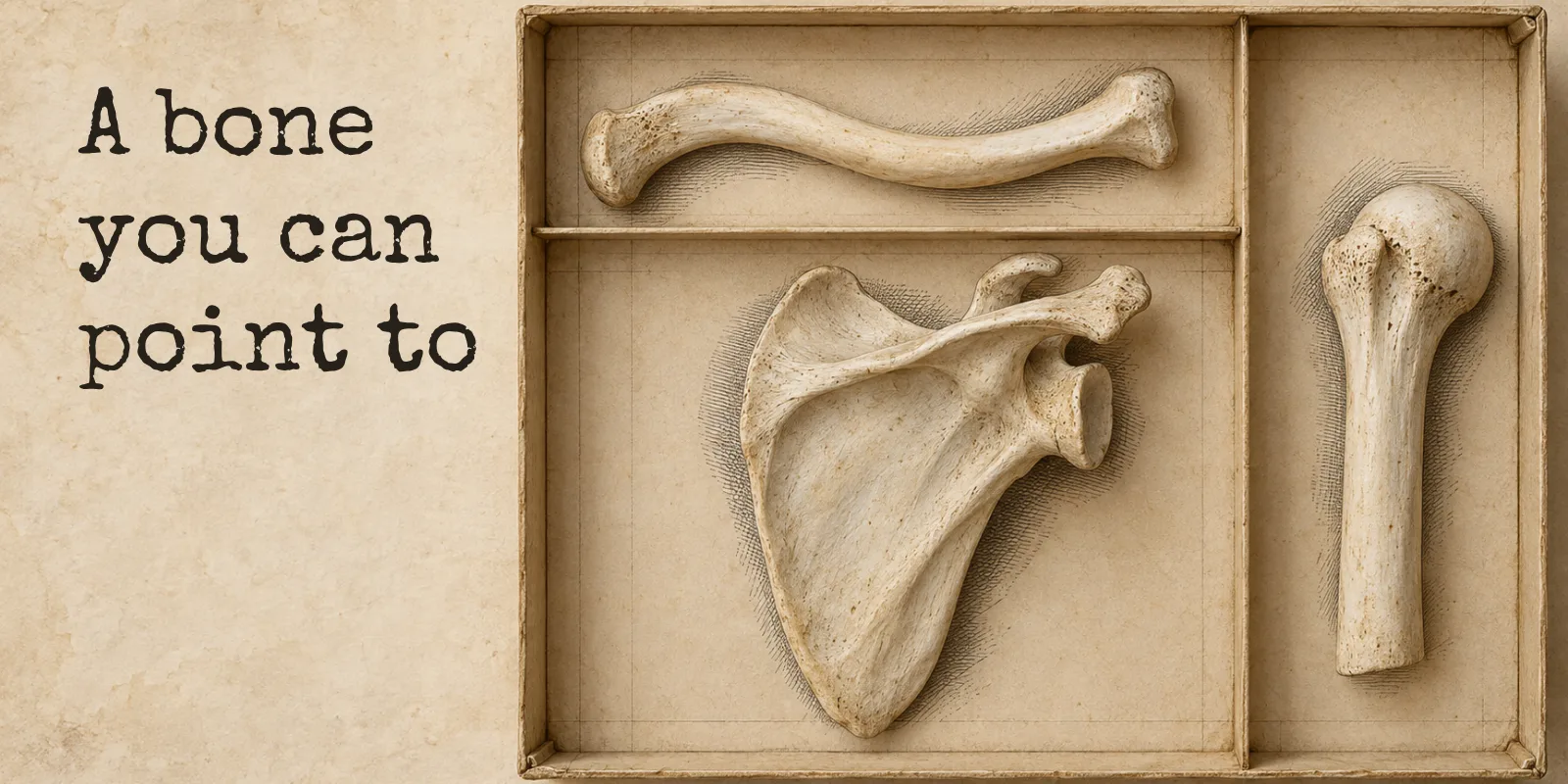
Recognition is picking the answer out when it is already in front of you. Recall is producing it with nothing to point at. Most anatomy practice trains the first one and then quietly tests you on the second.
Recognition means identifying something when the answer is available to you, on a label or in a list of options. Recall means producing the answer yourself with nothing in front of you to point at. Bone diagrams are very good at training the first one, which is why the scapula can feel familiar on Monday and be gone on Tuesday.
I did this to myself for months. I would open a quiz, get most of them, feel clever for an evening, and by the weekend the names had quietly wandered off again. It never occurred to me that the quiz and the weekend were asking two different questions.
What the two tasks are
Psychologists separate them by what the test gives you. A recognition test hands you the correct answer among incorrect ones and asks you to select it; a production test asks you to generate the answer from memory. The reason recognition usually feels easy is that its cue is close to a copy of the thing you studied, so the diagram is doing a large share of the remembering on your behalf.
A review of retrieval practice in health professions education puts the ladder plainly: multiple choice lets a student pick an answer they recognize but might not have been able to produce unprompted, short answers and fill-in-the-blank raise the demand, and free recall is the most demanding of the three because no cue and no suggested answer arrive with the question.
Recognition is usually the easier of the two, though the ladder has a wobble in it. People sometimes fail to recognize a target sitting right in front of them and then produce it later when a different cue turns up, because a cue works by matching the way the thing went in.
The label makes a study session look better than it went
In a 2006 experiment, students read a prose passage and then either studied it three more times or studied it once and took three recall tests with no feedback at all. Five minutes later, the group who had reread it did better, 83 percent against 71 percent. A week later that reversed: the tested group recalled 61 percent and the rereading group 40 percent. The rereading group had read the whole passage 14.2 times on average. The tested group had read it 3.4 times.
The detail I keep coming back to is what those students believed about themselves. Asked at the end of the session how well they thought they would remember the passage in a week, the rereading group, the group who went on to do worst, was the most confident of the three.
Which means the feeling of a session going well is telling you about the session, not about next week.
The same bone, three tasks, three different questions
Take the scapula, the shoulder blade, a flat triangular bone lying over the ribs on your upper back. The picture can stay exactly the same while the task changes underneath it, and each version takes away one more piece of help.
| The task | What you are given | What it asks of you |
|---|---|---|
| Pick “scapula” from clavicle, scapula, humerus | The image and the answer, among others | Choosing the right one from a set |
| Name an unlabeled image | The image only | Producing the name, with the shape as a cue |
| Type the name from a blank prompt | Little or nothing | Producing the name unaided |
Multiple choice is genuine retrieval practice, and it is a fair way to meet a name for the first time, when the alternative is a blank you have no chance of filling. What it cannot tell you is whether you could have produced the word on your own, because it never asked. Four of the studies in that review compared question types directly and found free recall came out ahead of recognition.
Names are the hard part, and there is an experiment about it
The face you know with the name just out of reach is the everyday version of this. Participants were shown unfamiliar faces and told, for each one, an occupation and a surname. Some of the words could work as either, so half the participants learned “this man is a baker” and the other half learned “this man is called Mr. Baker”, with the same word, the same face and the same sounds on both sides.
The occupations were recalled better than the names. Since the words were identical, the difficulty could not be blamed on how common they were, how they sounded, or how easy they were to picture. It is called the Baker/baker paradox, and it is among the strongest evidence that proper names are harder to retrieve than ordinary nouns.
The explanation is that a name tells you nothing about its owner. “Baker” as an occupation opens onto bread, flour, early mornings, a shop. “Baker” as a surname connects to one face by a single arbitrary thread, and arbitrary threads are the ones that break.
Bone names are proper names in exactly this sense, and worse, because they are proper names in Latin. Which is the argument for hanging something onto each one. The scapula has no bony attachment to the rib cage at all, so it floats on your back, held in place almost entirely by muscle. That is now attached to the word for me, and the word is harder to lose because of it.
Going blank is doing something
The blank feels like the failure state, so it is worth knowing that it has been tested on purpose. Researchers gave people questions rigged so that nobody could answer them, then showed the answer afterwards. Trying and failing, then seeing the answer, produced better later memory than being shown the question and answer together with no attempt in between.
What the attempt needs is the answer arriving straight after it. Check first and the question turns back into recognition, because by the time you are looking at the bone you are already looking at the word.
Getting it right once is a claim about today
A name you produce correctly at the end of a session was produced while the session was still in the room with you. Whether it survives a week is a separate question, and the only thing that answers it is asking again a week later.
The most useful study I found on this is about anatomy specifically. Students learned sets of skeletal muscles under five strategies, and every strategy took exactly 24 minutes, so nobody got more time than anyone else. A week later, the group who had studied and retrieved on three different days across a week scored 33.88 on the recall test. The group who did all their studying and retrieving in one sitting scored 12.86. Studying alone across three days, with no retrieval, landed in between at 24.72.
Roughly two and a half times the recall, out of the same 24 minutes.
A 2021 meta-analysis of 29 studies found the same thing across subjects, with a large advantage for spacing retrieval practice out over massing it together, g = 0.74.
The bit where the popular advice runs ahead of the evidence
The familiar advice is that intervals should keep growing: review after a day, then three, then a week, then a month. That same meta-analysis tested expanding schedules against uniform ones and found no significant difference between them, g = 0.032. The authors write that their results do not support the widespread belief that intervals should be progressively increased. Expanding schedules did pull ahead in one place, when an item was tested many times.
What is well established is that the gap should exist, and that its best length depends on how long you want to hold on to the name. In a study of more than 1,350 people, the optimal gap between a first study session and a review grew as the final test moved further away, though it shrank as a proportion of the wait, from roughly 20 to 40 percent of a one week delay down to about 5 to 10 percent of a one year delay.
So the lab’s growing intervals are a reasonable design, and a kind one, since a bone you keep getting right stops eating your evenings. The spacing is what earns its keep. The growing is a convenience I would not defend as more than that.
What that looks like in the lab
The Bone Room asks you to name a bone on three separate days before it counts it as cataloged, and the last of those has to be typed from memory, with no options on screen. Your first meeting with a specimen is gentler than that, because a blank prompt for a word you have never seen is not a test of anything.
After that the bone goes quiet and comes back unannounced as a cold case, first after a week, then at 14, 30, 60 and 90 days. Getting a cold case wrong sends the bone back into training, which is not a punishment so much as the system doing the only honest thing available to it. The whole arrangement is described on how it works, and the reasoning behind the count itself is in the 206 piece.
I built it this way because I was the person being fooled by the quizzes, and typing is the only version of the question I cannot talk my way out of. You can try it without an account, and it costs nothing.
Frequently asked questions
What is the difference between recognition and recall?
Recognition asks you to identify the right answer when it is present, on a label or among options. Recall asks you to produce it from memory with no answer in front of you. A labeled diagram tests the first, and an exam question or a conversation usually tests the second.
Why can I recognize a bone but not name it?
Because you have probably practiced the recognition version far more often, and because names are unusually hard to retrieve. Experiments show the same word is recalled better as an occupation than as a surname, since a name carries no information about the thing it belongs to.
Is multiple choice bad for learning anatomy?
No, it is real retrieval practice and a sensible way to meet a name. It just cannot tell you whether you could have produced the word unprompted. Reviews of retrieval practice in health professions education generally find free recall outperforms recognition questions.
How do I practice recall for bone names?
Look at the bone, cover the label, and write or type the name before you check. Then check straight away, because the attempt only pays off if the answer follows it. Come back to the same bone on another day rather than repeating it in one sitting.
What is retrieval practice?
Trying to produce an answer from memory before looking at it. In one experiment, students who read a passage once and tested themselves three times recalled 61 percent of it a week later, against 40 percent for students who reread it four times, despite reading it far less.
Sources
The memory research above is cited from the published papers, and the anatomy from OpenStax Anatomy and Physiology 2e and StatPearls, the same references the lab uses. Where a finding is contested, or where it cuts against how The Bone Room is built, the text says so.
Show all 9 sources
- Kathleen B. McDermott and Henry L. Roediger III, Memory (Encoding, Storage, Retrieval), Noba: recognition tests as selecting correct from incorrect information against production tests involving recall; recognition usually producing better performance because its cue is close to a copy of the studied event; the finding that a target you fail to recognize can still be recalled under different cues.
- Trumble, Lodge, Mandrusiak and Forbes, Systematic review of distributed practice and retrieval practice in health professions education, Advances in Health Sciences Education, 2023: recognition questions let students select an answer they recognize but may not have recalled unprompted; cued recall raises the demand and free recall is the most demanding; four studies comparing question types found free recall more effective than recognition.
- Roediger and Karpicke, Test-Enhanced Learning: Taking Memory Tests Improves Long-Term Retention, Psychological Science, 2006: Experiment 2, the 83 against 71 percent split at five minutes and the 61 against 40 percent reversal at one week; the 14.2 and 3.4 average readings; the repeated-study group being the most confident that they would remember the passage in a week.
- Serge Brédart, The cognitive psychology and neuroscience of naming people, Neuroscience and Biobehavioral Reviews, 2017: the McWeeny et al. (1987) faces experiment with ambiguous words learned as names or occupations; occupations recalled better; the effect not attributable to frequency, phonological complexity, distinctiveness or imageability; proper names lacking descriptiveness.
- Kornell, Hays and Bjork, Unsuccessful Retrieval Attempts Enhance Subsequent Learning, Journal of Experimental Psychology: Learning, Memory, and Cognition, 2009: questions designed so that retrieval would fail; attempting before seeing the answer beat being shown question and answer together.
- Dobson, Perez and Linderholm, Distributed retrieval practice promotes superior recall of anatomy information, Anatomical Sciences Education, 2017: skeletal muscle sets learned under five strategies of exactly 24 minutes each; one-week recall of 33.88 for study and retrieval across three days, 24.72 for study alone across three days, and 12.86 for study and retrieval in a single day.
- Latimier, Peyre and Ramus, A Meta-Analytic Review of the Benefit of Spacing out Retrieval Practice Episodes on Retention, Educational Psychology Review, 2021: 29 studies; spaced retrieval practice over massed at g = 0.74; no significant difference between expanding and uniform schedules at g = 0.032; the authors’ statement that the results do not support the belief that intervals should be progressively increased; the number of exposures as the moderator that favors expanding.
- Cepeda, Vul, Rohrer, Wixted and Pashler, Spacing effects in learning: a temporal ridgeline of optimal retention, Psychological Science, 2008: more than 1,350 participants; the optimal gap growing as the test delay grew, while falling as a proportion of that delay from about 20 to 40 percent at one week to about 5 to 10 percent at one year.
- OpenStax, Anatomy and Physiology 2e, 8.1 The Pectoral Girdle, and StatPearls, Anatomy, Thorax, Scapula: the scapula as a flat triangular bone on the upper back, with no direct bony attachment to the thorax, held by muscle.