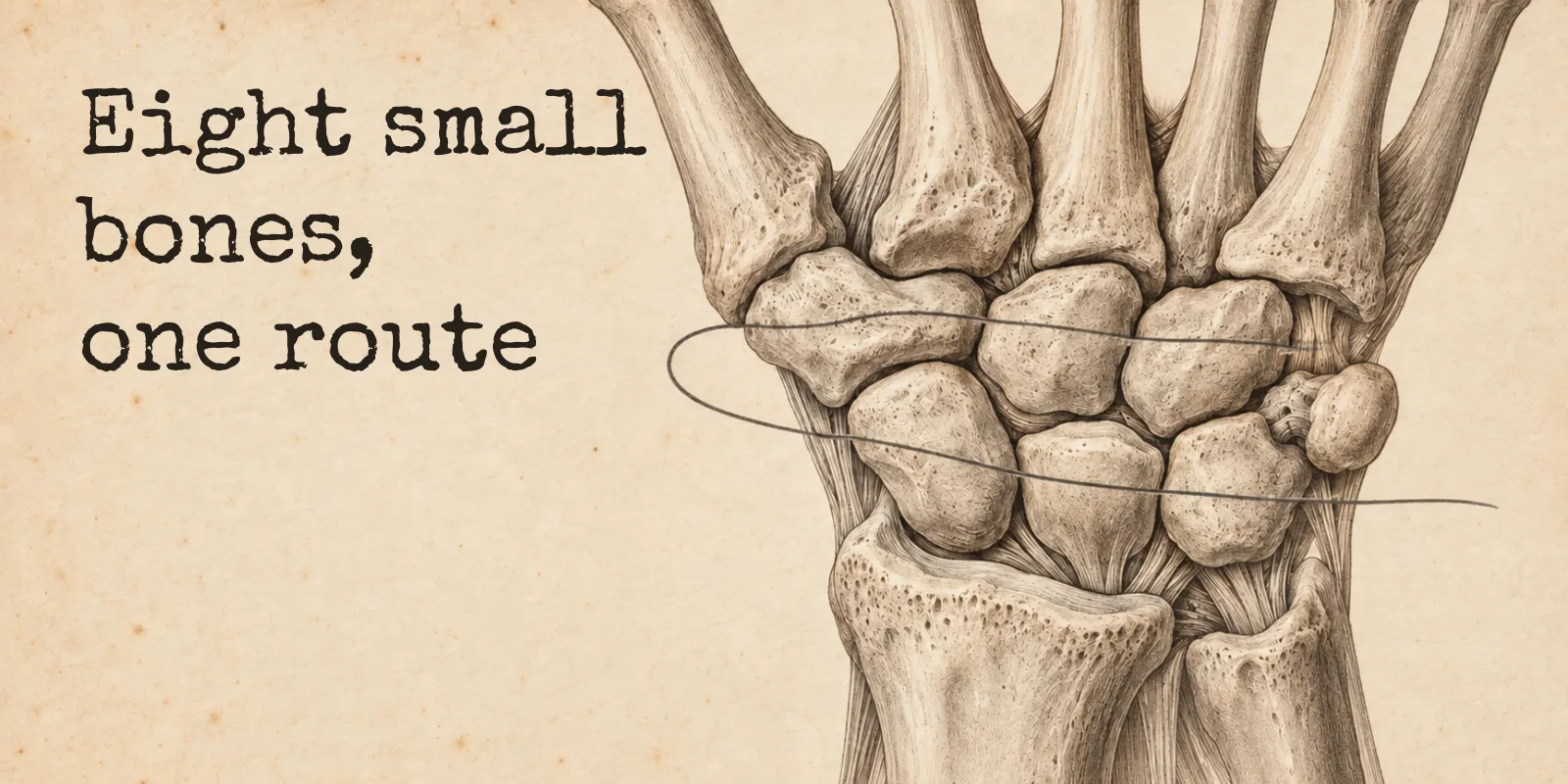
Some Lovers Try Positions That They Can't Handle gives you eight initials in order. Here is the route through the wrist those initials follow, what each of the eight names describes, and why the other popular version of the mnemonic runs the opposite way.
“Some Lovers Try Positions That They Can’t Handle” spells out the eight carpal bones in order: scaphoid, lunate, triquetrum, pisiform, trapezium, trapezoid, capitate, hamate. The sentence is the easy part. What it does not hand you is the direction it travels through the wrist, and that turns out to be the thing that decides whether you can produce the names or only nod at them.
Hamate was one of the words that got me into this. On the television series that started all of it, someone would be handed a fragment and say hamate the way you or I would say apple, and I wanted to know what that felt like from the inside.
The eight bones, and the route the sentence takes
Each wrist has eight small carpal bones, arranged as a proximal row of four and a distal row of four. Proximal means nearer the point where the limb attaches, so the proximal row is the one closer to the forearm, and the distal row sits closer to the bones of the hand. If those two words are still slippery, I wrote about proximal and distal separately.
You also need the two side words. In anatomical position, with the palms facing forward, lateral means toward the thumb and medial means toward the little finger.
| Mnemonic word | Bone | Row |
|---|---|---|
| Some | Scaphoid | Proximal |
| Lovers | Lunate | Proximal |
| Try | Triquetrum | Proximal |
| Positions | Pisiform | Proximal |
| That | Trapezium | Distal |
| They | Trapezoid | Distal |
| Can’t | Capitate | Distal |
| Handle | Hamate | Distal |
So the sentence crosses the proximal row from the thumb side to the little-finger side, then goes back to the thumb side and crosses the distal row the same way. Two sweeps in the same direction, one row at a time.
The other mnemonic runs the other way
Here is the part I wish someone had told me earlier. OpenStax, the textbook every anatomy claim on this site is checked against, teaches a different sentence: “So Long To Pinky, Here Comes The Thumb.” It starts on the thumb side and names the proximal bones lateral to medial, exactly as the first one does, and then it makes a U-turn and names the distal bones medial to lateral, so the last four come out hamate, capitate, trapezoid, trapezium.
So both sentences describe the same eight bones and agree about the first four, and then the final four arrive in opposite orders. That is why picking one and staying with it does more for you than collecting several, because the distal row is where the two versions come apart, and a half-memory of both leaves you with four bones that could run either way.
What the eight names actually mean
The names are small descriptions of shape, which is the part that finally made them stick for me. Once you can see a boat and a moon and a pea, you are no longer holding eight arbitrary sounds in your head.
Scaphoid. From the Greek skaphē, a light boat or skiff, and before that something dug or cut out. It sits on the thumb side of the proximal row, beneath the anatomical snuffbox, the small hollow that appears at the base of your thumb when you extend it. It is also the carpal that breaks most often by a wide margin: scaphoid fractures make up 60 to 70 percent of all carpal fractures, and tenderness in that snuffbox after a fall onto an outstretched hand is the classic reason someone gets sent for an X-ray.
Lunate. From the Latin lunatus, half-moon shaped, from luna. It lies between the scaphoid and the triquetrum, and it sits near the median nerve.
Triquetrum. Three-cornered, which StatPearls renders as pyramid-shaped. Third along the proximal row.
Pisiform. Pea-shaped, and the one whose position the mnemonic quietly misleads you about. It does not sit in line with the other three. It articulates with the front surface of the triquetrum and projects forward, which is why it is the small bump you can feel at the inner base of your palm, and why only the scaphoid, lunate and triquetrum reach up to meet the radius at the wrist joint.
Trapezium. From the Greek trapezion, which OpenStax glosses simply as “table.” Literally it is a little table, from trapeza, built out of the roots for four and foot. A four-footed thing. Euclid later stretched the same word to cover a four-sided figure with unequal sides, which is the sense most of us met at school, so if you have seen the trapezium explained as an irregular quadrilateral, that is fair too. It carries a saddle-shaped surface for the first metacarpal, so the joint at the base of your thumb sits on top of it.
Trapezoid. Same table root, and OpenStax gives it as “resembles a table.” You will often see it called the smallest of the eight, and StatPearls does say so, although in a sentence worded loosely enough that it could mean only the smallest of its immediate neighbors. Other references hand the title to the pisiform instead. I could not find a source clean enough to settle it, so I would treat the smallest carpal as an open question rather than something to learn.
The muddle between these two has a history behind it. The two words were transposed in English in the late eighteenth century and only partly straightened out in the late nineteenth, by which point American English had gone its own way with them. So if you feel like the names have swapped places on you, they did once, for about a hundred years.
The check I use now is alphabetical. Crossing from the thumb toward the little finger you meet trapezium and then trapezoid, and m comes before o.
Capitate. From the Latin capitatus, headed, from caput. It has a rounded head and it is the largest and most central of the eight, which makes the name useful for finding it as well as picturing it.
Hamate. The hooked bone, named for the hook-like hamulus projecting from its palm side, which you can sometimes feel through the skin near the little finger.
Where it usually breaks
If the sentence has not held for you, the failure is normally in one of four specific places, and each one wants a different thing.
- You can say the sentence but cannot expand the initials. The cue is in memory and the names are not attached to it yet. Cover the list and write all eight out longhand, so S has to produce “scaphoid” with nothing to point at.
- You have the names and lose the rows. Say or write the row label before each group of four, and anchor it to your own arm rather than to a diagram.
- You reverse trapezium and trapezoid. Drill that pair on its own with the alphabetical check, away from the other six.
- You know them on sight and go blank without the list. This is the gap between recognition and recall, and it is the reason a mnemonic can feel completely familiar and still deliver nothing when the page is face down.
Practicing your way off the sentence
The mnemonic is scaffolding, and the point of scaffolding is that you eventually take it down.
Use the sentence once to lay the sequence down, then cover it and write all eight names in order from memory. Check what you produced, correct only what you missed, and then leave it until tomorrow. Coming back on a separate day is the part that does the work, because repeating a list ten times in one sitting mostly teaches you what the list looks like, and a day’s gap forces you to rebuild it instead.
If you can produce all eight on three different days, you have real evidence rather than a feeling. And if you get seven and swap the two trapez- bones, you have been handed a very precise instruction about what to practice next.
Frequently asked questions
What is the mnemonic for the carpal bones?
“Some Lovers Try Positions That They Can’t Handle.” Each initial gives you a bone in sequence: scaphoid, lunate, triquetrum, pisiform, trapezium, trapezoid, capitate, hamate. It crosses the proximal row from thumb side to little-finger side, then crosses the distal row in the same direction.
What are the eight carpal bones in order?
The proximal row, running from the thumb side to the little-finger side, is the scaphoid, lunate, triquetrum and pisiform. The distal row, in the same direction, is the trapezium, trapezoid, capitate and hamate.
What is the difference between the trapezium and the trapezoid?
The trapezium sits on the thumb side of the distal row and carries the saddle joint at the base of the thumb. The trapezoid sits immediately next to it, one place toward the little finger. Crossing from thumb to little finger you meet them in alphabetical order, trapezium then trapezoid.
Which carpal bone is fractured most often?
The scaphoid, which accounts for 60 to 70 percent of carpal fractures. It takes much of the force transmitted through the radius in a fall onto an outstretched hand, and the injury is easy to miss on an early X-ray.
Is there more than one carpal bones mnemonic?
Yes, and they do not all travel the same way. OpenStax teaches “So Long To Pinky, Here Comes The Thumb,” which names the proximal row from thumb side to little finger and then doubles back along the distal row in the opposite direction. Choose one and stay with it.
Sixteen of the body’s 206 bones are carpals, and they are among the last ones most people get to. In The Bone Room each of the eight has its own engraved plate and its own case file, and you meet them a few at a time, typing the name from memory on separate days rather than choosing it from a list. It is free, and you can start without an account.
Sources
Every anatomical claim above is checked against OpenStax Anatomy and Physiology 2e or StatPearls on the NCBI Bookshelf, the same references the lab uses, with a dictionary for the word origins. Where two sources give different figures, the text says so.
Show all seven sources
- OpenStax, 8.2 Bones of the Upper Limb: the eight carpals and both rows in order, lateral and medial as thumb and little-finger sides, the meaning of each of the eight names, the pisiform’s forward-projecting position against the triquetrum, the hook of the hamate, and the “So Long To Pinky, Here Comes The Thumb” mnemonic with its U-turn.
- StatPearls, Anatomy, Shoulder and Upper Limb, Hand Carpal Bones: the pyramid-shaped triquetrum, the lunate’s position near the median nerve, the trapezium’s saddle-shaped facet for the first metacarpal, the trapezoid called the smallest carpal, in the loosely worded sentence the text flags, the capitate as largest and most central, and the hamate named for its hamulus.
- StatPearls, Scaphoid Wrist Fracture: scaphoid fractures as 60 to 70 percent of carpal fractures, and how often they are missed on early imaging.
- Etymonline, scaphoid: Greek skaphē, a light boat or skiff, literally a thing dug or cut out.
- Etymonline, lunate and capitate: Latin lunatus from luna, and capitatus from caput.
- Etymonline, trapezium and trapezoid: trapezion as a little table from trapeza, four plus foot, Euclid’s extension of it to a four-sided figure with unequal sides, and the transposition of the two terms in English in the late eighteenth century.
- Michelle Spear, Professor of Anatomy at the University of Bristol, Why anatomy’s naughtiest mnemonics work so well: that this is the mnemonic in common use, and the distinctiveness effect behind why it is remembered.