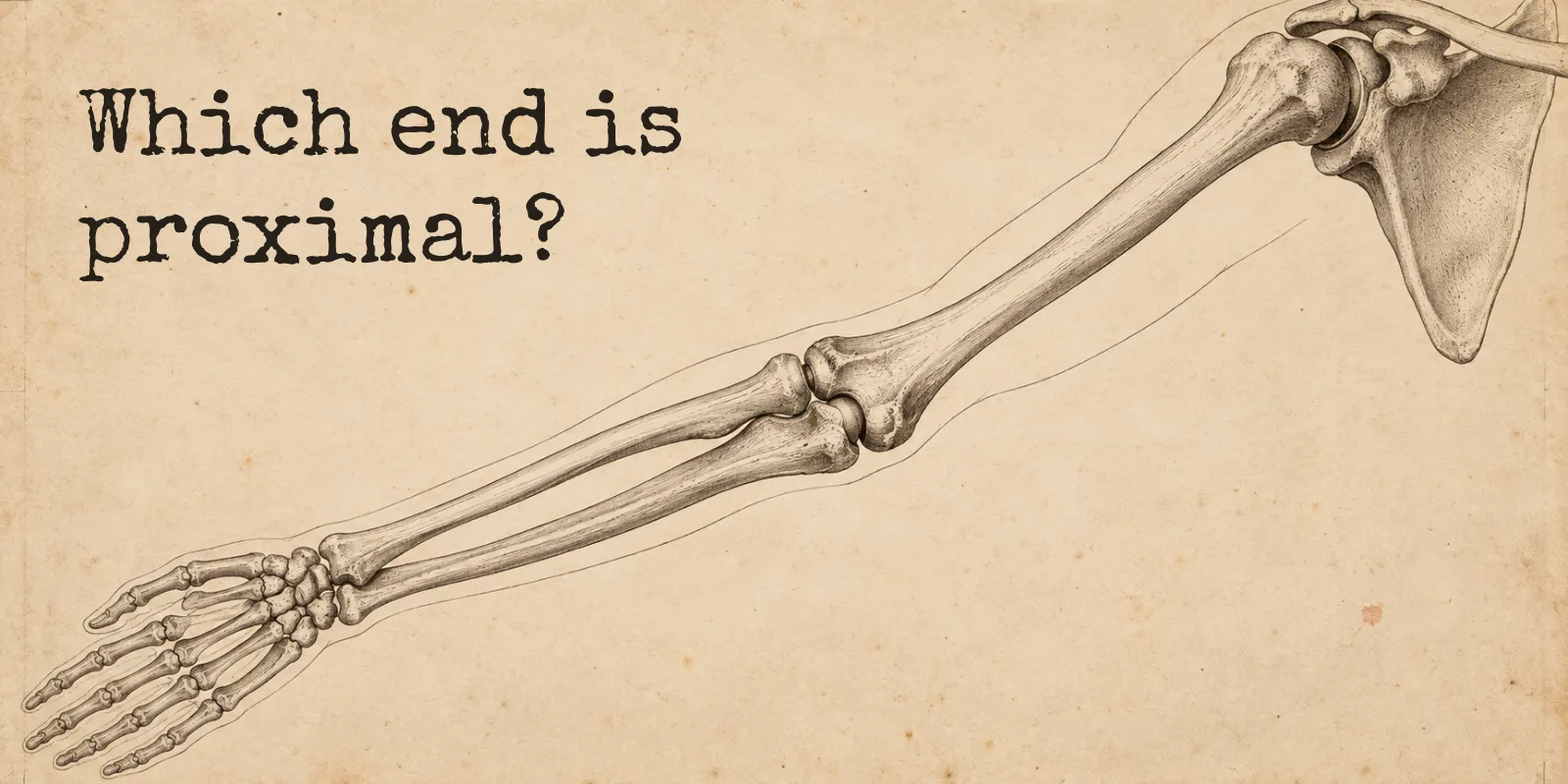
Proximal means nearer the point where a limb attaches to the trunk, and distal means farther from it. Which end of a bone each word points to, why the same joint is proximal on one bone and distal on the next, and what neither word says about how bad a break is.
Proximal means nearer to the point where a limb attaches to the trunk. Distal means farther from it. Put either word in front of a bone name and you have been told which end of that bone something sits on, and only that.
So “distal radius” is the wrist end of the forearm bone on the thumb side, and “proximal femur” is the hip end of the thigh bone. The word is an address.
I came to these two words late, which I now think was backwards of me. When I started learning bone names I was collecting nouns, because nouns were what I kept hearing on the television show that got me into this. The directional words looked like grammar, and grammar could wait. Then I noticed that most of what I was reading about any given bone was location, and the location was written in the words I had skipped over.
What each word points at
The textbook definition is short. Proximal describes a position in a limb that is nearer to the point of attachment or the trunk of the body, and distal describes a position that is farther from it.
The point of attachment is the whole trick. For anything in the arm it is the shoulder, and for anything in the leg it is the hip, so once you know which joint a bone is reaching toward, you know which of its two ends is which.
Where the words come from
Both go back to Latin, and both are younger than you might expect.
Proximal comes from proximus, meaning nearest or next, and the anatomical sense of the word, situated near the center of the body, dates to 1803. Distal was built the following year, in 1804, out of the English word distant plus the same -al ending, on the model of words like central and dorsal. Behind distant sits the Latin distare, to stand apart, from dis- and stare.
I like that they arrived a year apart, because it means somebody had the first word for a year before anyone bothered to build its opposite.
Finding the proximal end of any limb bone
Three questions get you there for any bone in an arm or a leg.
- What is the bone called? Look it up if you need to.
- Which of its two ends is nearer the shoulder, for an arm bone, or the hip, for a leg bone?
- That end is proximal, and the other one is distal.
The humerus is the easy case, because the head of the humerus is the round part that sits at the shoulder, and the distal end of the humerus has two articulation areas that join the ulna and the radius to form the elbow joint. Shoulder end proximal, elbow end distal.
The femur works the same way at the other end of the body. Its rounded proximal end is the head of the femur, which fits into the socket of the hip bone, and at the far end its two condyles meet the tibia to make the knee joint.
The radius is the one worth slowing down on, since it is the bone the phrase “distal radius” belongs to. The radius runs parallel to the ulna on the lateral side of the forearm, which is the thumb side when your palms face forward. The head of the radius forms its proximal end, up at the elbow, and its distal end has a smooth surface that meets two of the wrist bones. So a report saying distal radius is pointing at the wrist, and the fact that it is the thumb side has nothing to do with it.
The tibia is the medial bone of the leg and the larger of the pair it makes with the fibula. Its condyles meet the femur at the knee, so that end is proximal, and its distal end, including the bump of the medial malleolus you can feel on the inside of your ankle, meets the talus as part of the ankle joint.
Four bones and their two ends
These four turn up in reports a lot. Distal radius fractures are the most common upper extremity fracture in every age group except 18 to 34 year olds, and in people over 50 they are the second most common fracture of any kind, after the hip.
| Bone | Proximal end | Distal end | The phrase, translated |
|---|---|---|---|
| Humerus | Shoulder | Elbow | “Proximal humerus” is the shoulder end of the upper arm bone |
| Radius | Elbow | Wrist | “Distal radius” is the wrist end of the forearm bone on the thumb side |
| Femur | Hip | Knee | “Proximal femur” is the hip end of the thigh bone |
| Tibia | Knee | Ankle | “Proximal tibia” is the knee end of the shin bone |
The same joint is proximal on one bone and distal on the next
This is the part that catches people, and it caught me.
The elbow is the distal end of the humerus. The elbow is also the proximal end of the radius. Your elbow has not moved between those two sentences; the bone being measured along has changed. The knee does the same thing, sitting at the distal end of the femur and the proximal end of the tibia.
You can watch the words behave this way inside a single definition. StatPearls defines a hip fracture as a fracture of the proximal femur between the femoral head and 5 cm distal to the lesser trochanter. Proximal there is measured from the trunk, and distal in the same sentence is measured downward from a small bump on the femur itself. The words describe a direction along a structure, and they need you to know which structure before they mean anything.
Superior and inferior answer a different question
A report may also use superior and inferior. Superior describes a position above or higher than another part of the body, and inferior a position below or lower.
Those two depend on the body being read in anatomical position, which is a standard pose the textbooks define: standing upright, feet at shoulder width and parallel with the toes forward, upper limbs held out to each side, palms facing forward. Everything gets described as though you were standing like that, whatever you were actually doing in the scanner.
So your shoulder is superior to your elbow because it sits higher up the body, and it is proximal to your elbow because it is nearer where the arm joins the trunk. Both are true at once, and they answer different questions, because superior is about where you sit in the body as a whole and proximal is about how far along the arm you have traveled. Superior and inferior come as a pair, and with medial and lateral they make the four words worth learning before anything else, all of them read off that same pose.
What the words do not tell you
A distal radius fracture is, in the words of the clinical reference, a catch-all for any fracture of the radius that occurs close to the wrist. That is a location and nothing more. Two people can both have one and be in completely different situations, because the same label covers a clean simple break and a complex one involving the joint surface, ligament instability, displacement or a bone broken into several pieces.
Proximal femur behaves the same way, covering a stretch of bone that runs from the femoral head down past the lesser trochanter, and which part of that stretch gave way is what shapes the surgery.
What the two words hand you is the place, and that is worth having on its own, because it turns a phrase you could not read into somewhere you can point to on your own arm. Everything past that, the pattern of the break and whether the pieces have moved and what happens next, comes from the rest of the report and the person who ordered the scan, and it is a fair thing to ask them to walk you through it.
Frequently asked questions
What does proximal mean on a scan report?
Proximal describes a position in a limb nearer to the point of attachment or the trunk of the body. On a report it names the end of the bone closer to where that limb joins you, so the proximal humerus is the shoulder end of the upper arm bone and the proximal femur is the hip end of the thigh bone.
What does distal mean on a scan report?
Distal describes a position in a limb farther from the point of attachment or the trunk. The distal radius is the wrist end of the forearm bone, and the distal tibia is the ankle end of the shin bone. It marks where along the bone something sits and says nothing about how serious it is.
What is the difference between proximal and distal?
They point in opposite directions along the same structure. Proximal runs toward the attachment point and distal runs away from it, which is why the same joint region can be the distal end of one bone and the proximal end of the next one along.
Is proximal always the end closer to the body?
For a limb bone, yes, proximal is the end nearer the trunk. Which end that actually is depends on the bone you are measuring along, so at the elbow you are at the proximal end of the radius and the distal end of the humerus at the same time.
Does a distal fracture mean the injury is less serious?
No. Distal says where along the bone the break sits. Distal radius fractures range from simple ones to complex injuries involving the joint surface, displacement or several fragments, and the severity comes from the pattern rather than the directional word.
If the bone names in your report are ones you would like to know from memory rather than look up, that is roughly where The Bone Room started for me. It teaches 48 individual bone names and introduces the rest in numbered or grouped sets, and it will not let you claim one until you have named it on three separate days, the last time typed out. It is free, and you can start with the big ones without an account.
Sources
Every anatomical claim above is checked against OpenStax Anatomy and Physiology 2e or StatPearls on the NCBI Bookshelf, the same references the lab uses. One entry sits outside that pair and carries no anatomical claim: a dictionary, for where the two words came from and when.
Show all 6 sources
- OpenStax, Anatomy and Physiology 2e, 1.6 Anatomical Terminology: the definitions of proximal, distal, superior and inferior, and the description of anatomical position.
- OpenStax, 8.2 Bones of the Upper Limb: the head of the humerus at the shoulder and its distal end forming the elbow joint; the radius on the lateral or thumb side of the forearm; the head of the radius as its proximal end and its distal end meeting two carpal bones at the wrist.
- OpenStax, 8.4 Bones of the Lower Limb: the head of the femur meeting the hip bone and its condyles forming the knee joint; the tibia as the medial bone of the leg and larger than the fibula; the tibial condyles at the knee and the medial malleolus meeting the talus at the ankle.
- StatPearls, Distal Radius Fractures: the term as a catch-all for a fracture of the radius close to the wrist; the range from simple to complex patterns; the most common upper extremity fracture outside the 18 to 34 age group, and second to hip fractures in older adults.
- StatPearls, Hip Fracture Overview: a hip fracture as a fracture of the proximal femur between the femoral head and 5 cm distal to the lesser trochanter, and the fracture type influencing management.
- Online Etymology Dictionary, proximal and distal: proximus meaning nearest, the anatomical sense in 1803, and distal formed in 1804 from distant on the model of central and dorsal, with distare behind it.