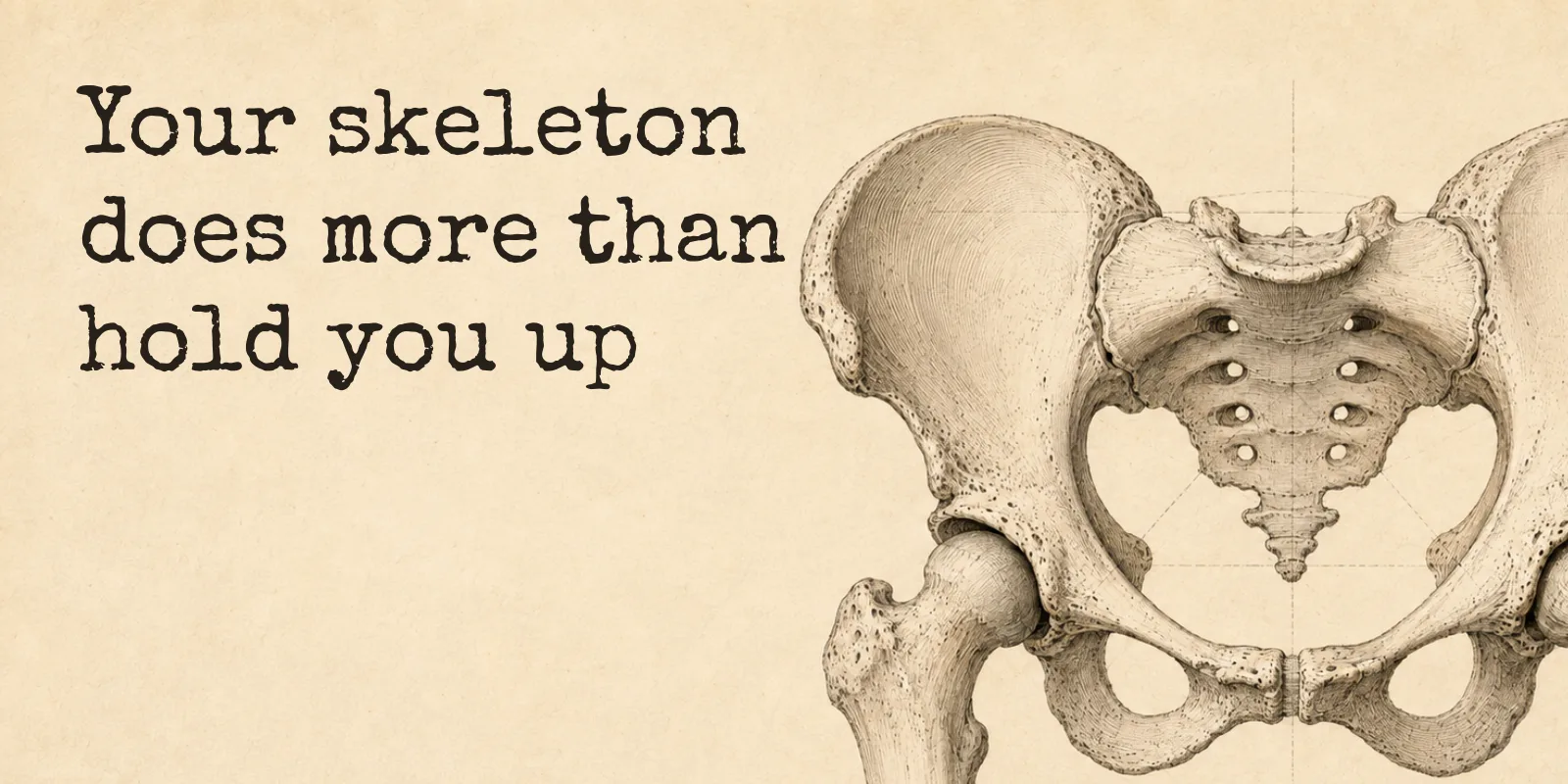
The skeleton holds you up, and it also moves you, shields the brain and heart, makes your blood cells and keeps most of your calcium in reserve. Most bones do several of those jobs at once. That is what makes the skeleton much more than a frame.
Your skeleton holds you up, and that is the job everyone knows. It also gives your muscles something to pull on so you can move, it shields the brain, the spinal cord, the heart and the lungs, it makes your blood cells, and it keeps most of the body’s calcium and phosphorus in reserve. Almost every bone does more than one of those things at the same time.
It is tempting to picture the skeleton as scaffolding, the frame you hang the interesting parts on. Then you reach the chapter in the anatomy textbook where it says, quite plainly, that bone is where blood cells are made, and the sentence is worth reading twice. A skeleton that manufactures blood is a very different thing from a coat rack.
The textbook’s list
The reference The Bone Room checks itself against, OpenStax Anatomy and Physiology, opens its chapter on bone with five jobs: the skeleton supports the body, facilitates movement, protects internal organs, produces blood cells, and stores and releases minerals and fat. Some books split that last one into two, so you will see the list given as six. A medical reference adds a quieter seventh, because the cells living inside bone release a hormone that helps regulate phosphate levels in the blood.
The list is a fine place to start. What it hides is that these are jobs, and one bone can hold several of them down. The pelvis carries your body weight from the spine into your legs, protects the organs sitting inside it, gives the muscles of the trunk and thigh their anchor points, and holds red marrow that is still making blood in adults. So when the lab shows you a hip bone, that plate is standing in for four of the jobs at once.
Support: a frame that bends
The central line of the body is the axial skeleton, which is the skull, the vertebral column and the rib cage, 80 bones in all. Everything else hangs off it.
The spine is the clearest case. It is a flexible column that supports the head, neck and body and still lets them move, and its curves increase its strength and its ability to absorb shock, so no single region takes all the load. The weight travels down through the vertebrae into the sacrum, and from there through the pelvis and hip joints into whichever leg happens to be bearing it, which is what keeps you upright on one foot mid-stride.
Support also means giving muscles a grip. Most of the ridges and bumps on a bone’s surface are attachment points for a tendon or a ligament, and the size of the bump is a rough guide to how hard something pulls on it. The smooth rounded ones are joint surfaces instead, and the holes and grooves are where nerves and vessels pass through. Seventeen different muscles attach to each shoulder blade, which is a lot of pulling for one flat bone.
Movement: bones as levers
Bones cannot move themselves. A muscle contracts, it pulls on a bone, and the joint between that bone and the next one acts as the pivot. The textbook puts it neatly: bones act as levers and joints serve as fulcrums.
The humerus is the clearest case, because one bone builds two completely different joints. At the shoulder its rounded head sits in a shallow socket, which gives the arm the widest range of motion of any joint you have. At the elbow the same bone meets the ulna as a hinge, which only bends and straightens along one line. Knee, ankle and the joints between the finger bones are hinges too, though the knuckles where the fingers meet the palm are not: those can spread sideways as well as bend.
The hip is the other ball-and-socket joint in the body, and it is built the opposite way from the shoulder. The socket is deep and the ligaments are strong, so the femur’s movements are more constrained, and in exchange the joint can carry your whole weight with every step.
Protection: heaviest where it matters most
The textbook’s own examples are the ones you would guess. The ribs protect the lungs and heart, the vertebrae protect the spinal cord, and the cranium protects the brain. The easily missed detail is how differently each of those three does it.
The skull is the most complete enclosure in the body. Twenty-one of its 22 bones are locked together into a single unit, and only the lower jaw moves. The floor of the braincase is crowded with openings so that cranial nerves, blood vessels and the spinal cord can get in and out, and the largest of them, at the back, is where the spinal cord leaves the skull.
The rib cage has to protect the heart and lungs and still let you breathe, so it compromises. The twelve pairs of ribs are anchored firmly at the back to the thoracic vertebrae, and at the front the bone stops short of the breastbone and continues as a strip of cartilage. When the muscles between the ribs contract they lift the ribs outward like a bucket handle and raise the sternum like a pump handle, which is what makes the chest bigger when you breathe in, and the cartilage springs back to help push the air out again.
The spine protects the cord by stacking. Each vertebra has a large opening between its body and its arch, and the spinal cord runs down through that chain of openings while the column bends and twists around it.
The arms and legs get almost none of this, and that is the trade. A limb wrapped in bone could not swing, so the skeleton spends its protection where the cost of damage is highest and movement can be given up.
Blood: the job you never see
Blood cells are made in red marrow, a soft tissue that fills the spaces inside spongy bone. The red cells that carry oxygen, the white cells of the immune system and the platelets that clot a cut all come out of it.
Where that marrow lives changes as you grow. In childhood the whole skeleton is filled with mostly red marrow, and it even occupies the hollow shafts of the long bones. Over the years it converts to yellow marrow, which is mostly fat, in a fixed order: the hands and feet first, then the limbs, then the trunk last, and the process is usually complete by about 25. By adulthood blood production is largely restricted to the skull, the pelvis, the vertebrae, the sternum and the upper ends of the femur and humerus. Some references add the ribs and shoulder blades.
The femur shows how much one bone can carry. It is the longest and strongest bone you have, roughly a quarter of your height, and its whole shaft works as the lever that swings your leg. Its hollow center stores fat, and only its upper end, near the hip, is still making blood.
Storage: a reservoir that gets rebuilt
Bone holds 99 percent of the body’s calcium and about 85 percent of its phosphorus, and calcium is needed for a longer list than you would expect: heart rhythm, the contraction of every muscle, the conduction of nerve impulses and the clotting of blood. The bones act as a store for it. When blood calcium gets too high the body deposits it into bone, and when it drops too low, a hormone from the parathyroid glands prompts bone to give some back.
What makes this possible is that bone is being taken apart and rebuilt all the time. One set of cells resorbs old or damaged bone on a surface, another set lays down new bone in its place, and about 5 to 10 percent of the skeleton is renewed this way every year. Bone also answers to how hard it is used. People who exercise regularly have thicker bones than people who sit, and astronauts on long missions lose around 1 to 2 percent of their bone mass a month because nothing is loading it.
The fat in yellow marrow is a separate store. It is ordinary fat tissue, and the triglycerides in it can serve as a source of energy.
Where each job lives
The axial skeleton leans toward support and protection, and the appendicular skeleton, the limbs and the girdles that hang them off the trunk, leans toward movement. Neither owns its jobs outright, which is why the table is best read across a row rather than down a column.
| Region | Support | Movement | Protection | Blood | Storage |
|---|---|---|---|---|---|
| Skull | Carries the head on top of the spine | Only the lower jaw moves | Encloses the brain | Red marrow in adults | Minerals, renewed by remodeling |
| Vertebral column | Bears the weight of head and trunk | Lets the trunk bend and turn | Surrounds the spinal cord | Red marrow in adults | Minerals, renewed by remodeling |
| Ribs and sternum | Frame the chest | Lift with every breath | Shield heart and lungs | Red marrow in adults, on some lists | Minerals, renewed by remodeling |
| Pelvis | Passes weight from spine to legs | Anchors trunk and thigh muscles | Protects the pelvic organs | Red marrow in adults | Minerals, renewed by remodeling |
| Femur and humerus | Carry the limb’s load | The main levers of leg and arm | Very little | Red marrow at the upper end only | Yellow marrow stores fat in the shaft |
Read down that table and the skeleton has already sorted itself into two halves, the column and the limbs hung on it, which is the split anatomy names and the one piece of vocabulary here that pays for itself on the first day.
It is never the same skeleton
An adult skeleton is counted as 206 bones, and the whole accounting explains why that number is a convention. Younger people have more, because some bones fuse during childhood and adolescence to make an adult bone, which is the story of how a baby gets to 206.
The marrow moves too, retreating from the hands and feet toward the trunk until about 25. And the remodeling never stops, so at 5 to 10 percent a year, much of the bone you had at fifteen has been taken down and rebuilt by forty. The shape from the outside stays the same while the material underneath keeps being swapped out.
Frequently asked questions
What is the skeleton for?
It supports the body, gives muscles the levers they pull on to move you, protects the brain, spinal cord, heart and lungs, makes blood cells in red marrow, and stores calcium, phosphorus and fat. Most individual bones do several of these at once.
What are the five functions of the skeletal system?
The standard textbook list is support, movement, protection, blood cell production, and the storage and release of minerals and fat. Some references count mineral and fat storage separately and give six, and a few add an endocrine role, since bone cells release a hormone that helps regulate blood phosphate.
Do bones make blood?
Yes. Red marrow inside spongy bone makes red blood cells, white blood cells and platelets. In adults it is largely confined to the skull, pelvis, vertebrae, sternum and the upper ends of the femur and humerus, while the shafts of the long bones hold yellow marrow, which is mostly fat.
How does the skeleton help with movement?
Muscles pull on bones, and the joints between bones act as the pivots. Bones work as levers, and the shape of the joint sets what is possible: a hinge like the elbow or knee only bends and straightens, while a ball and socket like the hip or shoulder can move in several directions.
Once you see the skeleton as a set of jobs, the bone names stop looking like a list of Latin words and start becoming labels for the work. The lab is free, and you can start with the big bones without knowing a single one; it introduces them a few specimens at a time.
Sources
Every anatomical claim above comes from one of these. Where two sources give different lists, the text says so.
- OpenStax, Anatomy and Physiology 2e, 6.1 The Functions of the Skeletal System: the five functions; bones as levers and joints as fulcrums; ribs, vertebrae and cranium as the examples of protection; the bone matrix as a reservoir for calcium and phosphorus; yellow marrow’s triglycerides as an energy source; red marrow as the site of blood cell production.
- OpenStax, 6.3 Bone Structure: projections as attachment points for tendons and ligaments, sized by the forces on them; red marrow in the spaces of spongy bone; yellow marrow in the medullary cavity.
- OpenStax, 6.4 Bone Formation and Development: remodeling as resorption and replacement on the same surface; about 5 to 10 percent of the skeleton renewed annually.
- OpenStax, 6.6 Exercise, Nutrition, Hormones, and Bone Tissue: bone changes structure as stress increases or decreases; people who exercise have thicker bones; astronauts lose about 1 to 2 percent of bone mass a month.
- OpenStax, 6.7 Calcium Homeostasis: bones deposit calcium when blood levels are high and release it when low; what calcium is needed for; parathyroid hormone and calcitonin.
- OpenStax, 7.1 Divisions of the Skeletal System: 206 bones, 80 axial and 126 appendicular; what each division contains; younger people have more bones because some fuse during childhood and adolescence.
- OpenStax, 7.2 The Skull: 22 bones, 21 immobile; the mandible as the only movable one; the base of the skull with numerous openings for cranial nerves, blood vessels and the spinal cord; the foramen magnum.
- OpenStax, 7.3 The Vertebral Column: a flexible column that supports the head, neck and body and allows their movements; curves increase strength, flexibility and shock absorption; the vertebral foramen contains the spinal cord.
- OpenStax, 7.4 The Thoracic Cage: protects the heart and lungs; 12 pairs of ribs anchored posteriorly to the thoracic vertebrae; each rib ends anteriorly in costal cartilage.
- StatPearls, Anatomy, Thorax, Wall Movements: the bucket-handle and pump-handle movements of the ribs and sternum; costal cartilage and elastic recoil in exhalation.
- OpenStax, 8.3 The Pelvic Girdle and Pelvis: the pelvis transfers body weight from the vertebral column into either lower limb; attachment for trunk and lower limb muscles; protects the pelvic organs; the deep acetabulum.
- OpenStax, 8.4 Bones of the Lower Limb: the femur as the longest and strongest bone, about a quarter of a person’s height.
- OpenStax, 9.4 Synovial Joints: hinge joints bend and straighten on a single axis (elbow, knee, ankle, finger joints); the hip and shoulder as the only ball-and-socket joints; the shoulder’s shallow socket and range versus the hip’s deep socket and strong ligaments.
- StatPearls, Anatomy, Shoulder and Upper Limb, Humerus: the humerus forms a ball-and-socket joint at the shoulder and a hinge at the elbow.
- StatPearls, Anatomy, Thorax, Scapula: seventeen muscles attach to each scapula.
- OpenStax, 18.2 Production of the Formed Elements: after birth most blood cell production is in red marrow; in children it can occur in the medullary cavity of long bones; in adults it is largely restricted to the cranial and pelvic bones, vertebrae, sternum and the proximal ends of the femur and humerus; the products include erythrocytes, platelets and the white cell lineages.
- Bone and blood interactions in human health and disease, Bone, 2018: in adults, hematopoietic cells are found in the vertebrae, pelvis, ribs, sternum, skull, proximal ends of long bones and scapulae; in childhood the skeleton is filled with mostly hematopoietic marrow, converting with age from the fingers and toes inward.
- Metabolic-Endocrine, in Musculoskeletal Diseases 2021 to 2024 (Springer, on the NCBI Bookshelf): at birth hematopoietic marrow is present throughout the skeleton; conversion begins in the hands and feet and then moves from the limbs to the trunk; typically complete by 25.
- StatPearls, Physiology, Bone: bone holds 99 percent of the body’s calcium and 85 percent of its phosphorus; osteocytes secrete FGF23, which regulates serum phosphate.