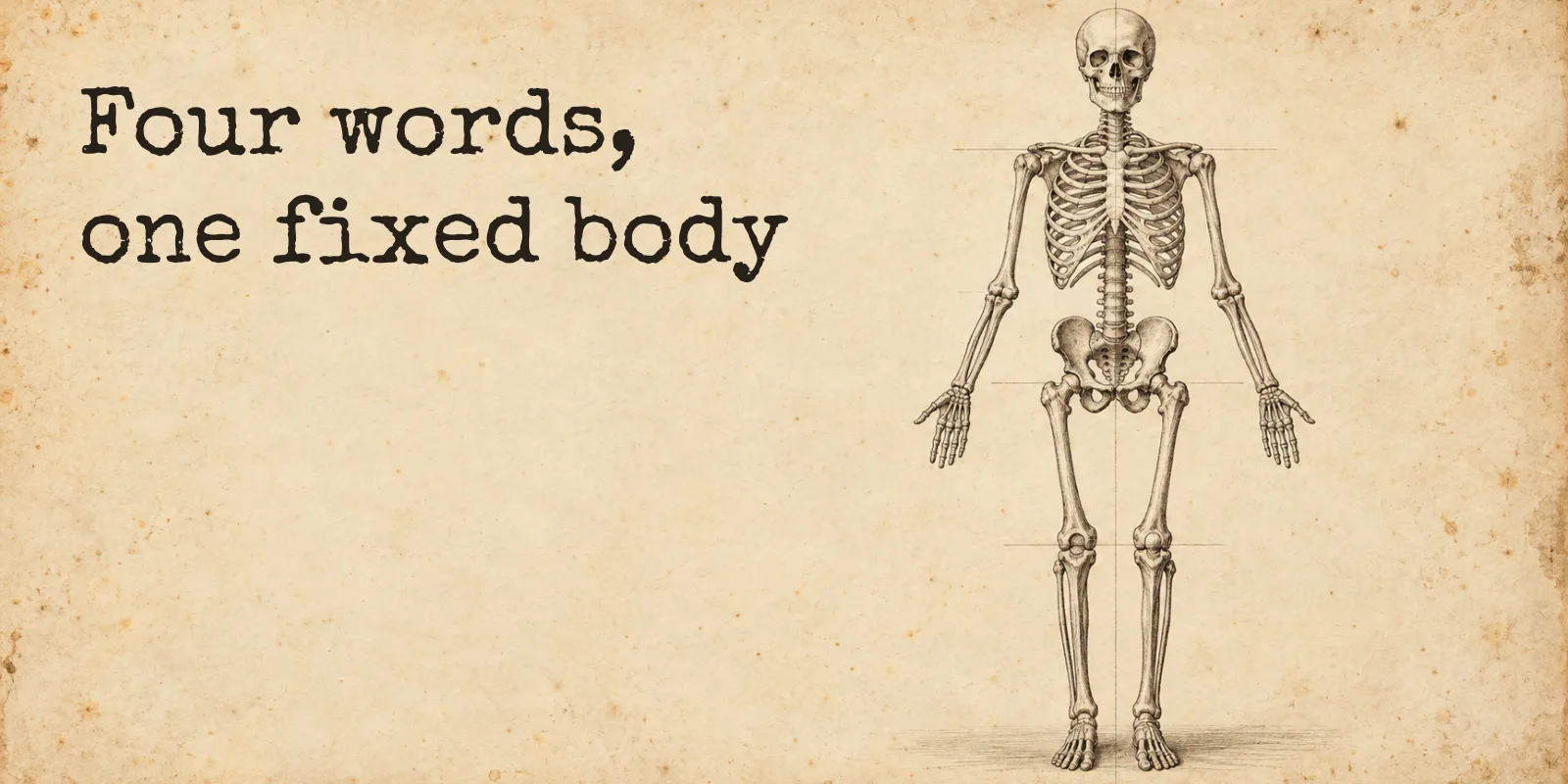
Medial means toward the middle of the body and lateral toward the side, superior means higher up and inferior lower down. What each word is measured from, why the radius counts as lateral when your thumb feels like it points inward, and why none of the four says anything on its own.
Medial means toward the middle of the body. Lateral means toward the side. Superior means a position higher than something else, and inferior means lower. Four words, two pairs, and not one of them means anything until you say what you are comparing.
So your sternum is medial to your shoulders, and your shoulders are lateral to your sternum. Your skull is superior to your pelvis, and your pelvis is inferior to your skull. Every one of those sentences has two structures in it, because that is the only shape these words work in.
I stepped over all four when I started, the same way I stepped over proximal and distal. I was after nouns, since nouns were what I kept hearing on the show that started this, and the directional words looked like scaffolding around the names I actually wanted. Then I read enough about any one bone to notice that most of what was being said about it was location, and the location was written in the words I had been skipping.
What the four words are measured from
All four are read off a standard pose called anatomical position, and the textbooks are specific about it: the body standing upright, feet at shoulder width and parallel with the toes forward, the upper limbs held out to each side, and the palms of the hands facing forward.
The pose is fixed, so the words are fixed with it. A clinical reference puts it about as bluntly as it can be put: it does not matter how the person being described is currently positioned, the terms are used as though the body were in this standard position. Somebody flat on their back in a scanner is still described as though they were standing up and facing you.
Medial and lateral run out from one line
Medial describes the middle, or the direction toward the middle of the body. Lateral describes the side, or the direction toward the side. The line they are measured from is the one running directly down the middle of you, which anatomy calls the midsagittal or median plane, and a cut along it would divide you vertically into equal right and left halves.
The sternum sits on that line. StatPearls calls it the partially T-shaped vertical bone forming the anterior portion of the chest wall centrally, which is a careful way of saying breastbone, front, middle. Your shoulders sit out to either side of it, so the sternum is medial to your shoulders and your shoulders are lateral to your sternum, and neither of them carries either word on its own.
Depth is a separate question with its own pair of words, superficial for closer to the surface of the body and deep for farther from it. Medial and lateral only ever travel left and right from that middle line, which is worth holding onto, because inner and outer are the words most people reach for first and they are answering something else entirely.
The word itself helps a little. Medial arrives through Late Latin medialis, of the middle, from medius, in the middle. Middle did not come from medius, though; it came up through Old English middel and the Germanic side of the family, and the two words only meet much further back at the Indo-European root medhyo-. So they are cousins, and the family resemblance is still enough to make the word point the right way.
Superior and inferior are comparatives, and it shows
Superior describes a position above or higher than another part of the body. Inferior describes a position below or lower.
Both are comparatives in the grammatical sense, and not by coincidence. Superior is the Latin comparative of superus, situated above, which sits on super, above or over. Inferior is the comparative of inferus, that is below or beneath. They are the Latin for higher and lower, and higher and lower are questions rather than statements until a second thing turns up in the sentence.
Your nose is superior to your chin, and your chin is inferior to your nose. Move the comparison and the word flips, because that same chin is superior to your sternum.
The forearm is where this goes wrong
Everything above holds until you get to the forearm.
OpenStax says it plainly: the ulna is the medial bone of the forearm, and it runs parallel to the radius, which is the lateral bone of the forearm. The radius is the one on the thumb side. The ulna is on the little finger side.
Now look at your arm hanging by your side, and that seems backwards. Your palm faces your thigh, your thumb points forward, and the thumb side of your forearm feels like the front of you rather than the outside. But anatomical position turns the palms forward, which rotates the whole forearm, and a radiology reference states the consequence in one line: the anatomic position is with the hands supinated, palms forward, and this places the thumbs lateral. Turn your palm up and look again. The thumb has swung out to the side of you, and the little finger has come in toward the middle.
The foot makes the same arrangement without the argument, because feet do not rotate the way forearms do. Your big toe sits on the inner edge, nearer that middle line, which is why OpenStax can simply say that the hallux is the medial toe and that the thumb, or pollex, is lateral to the other digits.
Clinicians have noticed the forearm problem too. A StatPearls chapter on radiographic positioning notes that to limit confusion when describing a location in the upper extremities, it is more common to use radial and ulnar in place of medial and lateral. The two bones get promoted into directions of their own, which tells you how often the rotation trips people up.
Eight comparisons to say out loud
Reading the definitions above will have left you feeling like you have them. That feeling is recognition, and it is a reliable liar, which is why you can point at a bone and still not be able to name it.
So here are eight comparisons. Cover the middle column, read the prompt, and say the word out loud before you look.
| Prompt | Answer | Why |
|---|---|---|
| The sternum is ___ to the shoulders. | Medial | It sits on the middle line at the front of the chest. |
| The shoulders are ___ to the sternum. | Lateral | They sit out to either side of that line. |
| The skull is ___ to the pelvis. | Superior | Higher up the body. |
| The pelvis is ___ to the skull. | Inferior | Lower down the body. |
| The radius is ___ to the ulna. | Lateral | It is the thumb-side bone, and palms forward puts the thumb on the outside. |
| The ulna is ___ to the radius. | Medial | It is the little-finger-side bone, nearer the middle. |
| The big toe is ___ to the little toe. | Medial | The hallux sits on the inner edge of the foot. |
| The thumb is ___ to the other fingers. | Lateral | The pollex is lateral to the digits in anatomical position. |
Come back to this in a few days rather than running it twice this afternoon. The gap between two attempts is doing more work than the second attempt is, and the anatomy studies on that are not subtle.
Where these four stop
Four words do not cover a body. Anterior means the front or the direction toward the front, and posterior means the back. Proximal and distal run along a limb rather than up and down the body, measured from the point where that limb attaches, which is how your elbow manages to be proximal to your wrist and distal to your shoulder in the same sentence.
Which leaves the names. That is the half I built the lab for, and it starts with the big bones you could already find on your own arm, a few specimens at a time, with the radius and the ulna among the early ones. A name is not cataloged until you have produced it on three separate days, the last of those typed from memory. It is free, and you can start without an account.
Frequently asked questions
What does medial mean in anatomy?
Medial means the middle, or the direction toward the middle of the body, measured from the line that runs vertically down your center. It is always a comparison, so the sternum is medial to the shoulders rather than medial on its own.
What does lateral mean in anatomy?
Lateral means the side, or the direction toward the side of the body, away from that middle line. Your shoulders are lateral to your sternum, and in anatomical position your thumb is lateral to your other fingers.
What is the difference between superior and inferior?
Superior describes a position above or higher than another part of the body, and inferior describes a position below or lower. Both are Latin comparatives, which is why each one needs a second structure in the sentence before it says anything.
Is the radius medial or lateral to the ulna?
Lateral. The ulna is the medial bone of the forearm and the radius is the lateral one, because anatomical position holds the palms facing forward, which places the thumb side on the outside. In practice, radiology often sidesteps the whole question by saying radial and ulnar instead.
Why does anatomical position matter for these words?
It fixes the reference pose so the terms mean one thing. Whatever position a person is actually in, they are described as though standing upright with the palms facing forward, which is what keeps the radius lateral even when the arm is turned.
Sources
Every anatomical claim above is checked against OpenStax Anatomy and Physiology 2e or StatPearls on the NCBI Bookshelf, the same references the lab uses. Two entries sit outside that pair and carry no anatomical claim: a dictionary, for where the words came from, and an open medical terminology textbook, for the wording on describing a patient in any position.
Show all 9 sources
- OpenStax, Anatomy and Physiology 2e, 1.6 Anatomical Terminology: anatomical position, with the feet at shoulder width and parallel, toes forward, the upper limbs held out to each side and the palms facing forward; the definitions of medial, lateral, superior, inferior, anterior, posterior, proximal, distal, superficial and deep; the midsagittal or median plane dividing the body vertically down the middle; the hallux as the medial toe and the thumb, or pollex, as lateral to the digits.
- OpenStax, 8.2 Bones of the Upper Limb: the ulna as the medial bone of the forearm running parallel to the radius, which is the lateral bone, and the radius as the lateral or thumb side of the forearm.
- StatPearls, Anatomy, Shoulder and Upper Limb, Arm Structure and Function: the upper extremity pictured in standard anatomical position with the palm facing forward, putting the radius laterally and the ulna medially.
- StatPearls, Anatomy, Thorax, Sternum: the sternum as the partially T-shaped vertical bone forming the anterior portion of the chest wall centrally.
- StatPearls, X-ray Radiographic Patient Positioning: the anatomic position as hands supinated with the palms forward, which places the thumbs lateral; radial and ulnar being used in place of medial and lateral in the upper extremities to limit confusion.
- Medical Terminology, Chapter 2, Medical Language Related to the Whole Body, NCBI Bookshelf: the same description of anatomical position, and the statement that it does not matter how the person being described is currently positioned, the terms are used as though the body were in the standard position.
- Online Etymology Dictionary, medial and middle: medialis, of the middle, from medius, in the middle, from PIE medhyo-; middle from Old English middel and Proto-Germanic, from the same PIE root.
- Online Etymology Dictionary, superior and inferior: superior as the comparative of superus, situated above, from super; inferior as the comparative of inferus, that is below or beneath.
- Dobson, Perez and Linderholm, Distributed retrieval practice promotes superior recall of anatomy information, Anatomical Sciences Education, 2017: one-week recall after studying and retrieving across three days against the same total time in a single sitting.