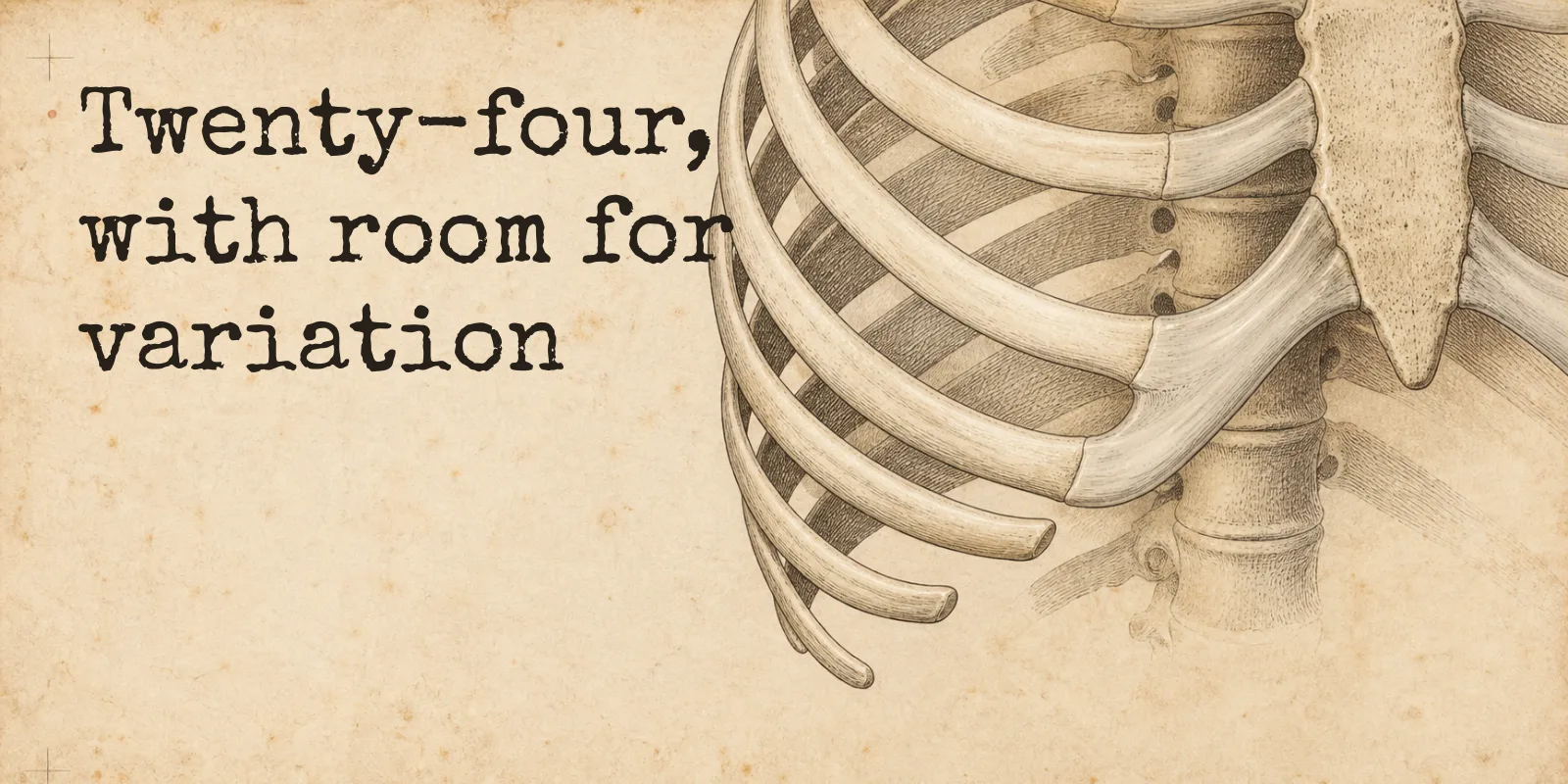
Most people have 24 ribs in 12 pairs, and a small number are born with an extra one or one fewer. The bigger surprise is at the front of the chest, where cadaver studies keep finding that the standard textbook picture does not match most people.
Most people have 24 ribs, arranged in 12 pairs, and that is the count in the anatomy textbook. Not everyone matches it. Some people are born with an extra rib, some with one missing or underdeveloped, and those variations are more common than the phrasing “extra rib” suggests.
The part I did not expect is that the count turns out to be the stable bit. Where real skeletons actually diverge from the diagram is at the front of the chest, in how the lower ribs connect, and there the standard picture is wrong for more than half of us.
How the 12 pairs are meant to be arranged
The thoracic cage is the sternum at the front, the 12 thoracic vertebrae at the back, and 12 pairs of ribs curving between them, with each rib ending in a strip of costal cartilage. OpenStax, the textbook The Bone Room checks itself against, puts the job of the whole assembly in five words: the thoracic cage protects the heart and lungs.
Ribs are then grouped by how they reach the sternum, or fail to. Ribs 1 to 7 are true ribs, and each one has its own costal cartilage running directly to the breastbone. After that the naming gets contested, which is worth knowing before you read anything else about ribs.
OpenStax calls ribs 8 to 12 false ribs, because their cartilage does not attach directly to the sternum, and then says the last two of those, ribs 11 and 12, “are also called floating ribs” because they do not attach to the sternum at all. On that reading there are two classes, and floating ribs are a subset of the false ones.
StatPearls sets the same ribs out as three classes instead: true ribs 1 to 7, false ribs 8 to 10 joining the seventh costal cartilage indirectly, and floating ribs 11 to 12 on their own. Plenty of teaching materials follow this version, and if you were taught “true, false, floating” as three separate groups, this is why.
Both descriptions cover the same 24 bones and disagree only about where to draw a line around the words. The Bone Room follows the OpenStax version, so the lab teaches 14 true ribs and 10 false ribs with the floating pair named inside them, but a source using the other split is not making a mistake.
The front of the chest is where skeletons actually differ
Here is the finding that changed how I read the diagram.
The costal margin is the curved lower edge of the rib cage you can feel under your fingers, and classical teaching says it is a continuous arch of joined cartilage formed by ribs 7 to 10. Two cadaver studies from the Medical University of South Carolina went looking for that arch and largely did not find it.
The first dissected the costal margins of 40 cadavers, both sides. The ninth rib was attached to the eighth every single time, in all 80 evaluations. The tenth rib was attached to the ninth in only 18 percent of them, and in 59 percent it was floating, with no attachment to the ninth rib at all. The follow-up study, 30 cadavers evaluated by chest wall surgeons, found the tenth rib floating 52 percent of the time and put the ninth rib’s tip free in 60 percent.
So in most of the people examined, the tenth rib behaves like a floating rib, in someone with a perfectly ordinary 24. The textbook arch is a real arrangement, it is just not the majority one, and the authors say so plainly: significant variability exists in the chest wall and costal margin compared with traditional teaching.
That matters clinically, because a mobile tenth rib tip that slips inward is the suspected mechanism behind slipped rib syndrome, and the same study found subluxation in a third of the tenth ribs it looked at. It also means the honest answer to “do we all have the same rib cage” is no, well before you get anywhere near the count.
Two questions are hiding inside the one people usually ask:
| The question | The usual answer | What the evidence shows |
|---|---|---|
| How many ribs are there? | 24, in 12 pairs | An extra or absent rib changes the total, in a small percentage of people |
| How do the lower ones attach? | Ribs 7 to 10 join into one costal margin | The tenth rib is unattached in roughly half to three fifths of people |
A scan report can describe a variation in the second without saying anything unusual about the first.
Can someone have an extra rib?
Yes, and there are two kinds, one of which gets almost all of the attention.
The famous one is the cervical rib, a supernumerary rib arising from the seventh cervical vertebra, the lowest bone in the neck, so it sits above the usual first rib. A 2018 meta-analysis pooling 141 studies and nearly 78,000 people put its prevalence at 1.1 percent in healthy individuals, which is where the familiar “about 1 in 100” comes from. StatPearls gives 0.5 to 1 percent, and individual studies have reported anywhere from 0.58 to 6.2 percent depending on the population and the imaging, so the rough figure is more trustworthy than any precise one. More than half of the people who have one have it on a single side.
The less famous one is more common. Lumbar ribs grow from the lumbar spine instead of the neck, and a 2024 meta-analysis of nine studies put them at 2.1 percent, roughly twice the cervical rib figure, usually on both sides. The authors note that lumbar ribs are “a rare and relatively unknown anatomical abnormality” in the literature while being nothing of the sort in bodies, and that mistaking one can lead a surgeon to operate at the wrong spinal level.
Around 90 percent of cervical ribs cause no symptoms and are found by accident on an X-ray taken for something else. In the rest, the extra bone narrows the space where nerves and vessels leave the neck and can contribute to thoracic outlet syndrome: numbness and tingling in the little and ring fingers if the brachial plexus is compressed, or a weaker pulse and a change in color and temperature in the arm if the subclavian artery is. Among people who do have thoracic outlet syndrome, cervical ribs turn up in 29.5 percent, against that 1.1 percent baseline.
Having a cervical rib is not the same as having thoracic outlet syndrome. The rib becomes medically relevant only when it compresses something enough to account for a person’s symptoms.
Can someone be born with fewer ribs?
Yes. Rib agenesis is the congenital absence of one or more ribs, and a rib can also be hypoplastic, meaning it formed but stayed small. Both are different from having a rib taken out surgically later on.
It is often said that the 12th rib is the one most commonly missing, and the numbers only half agree. Among congenital rib anomalies, absence of the 12th rib accounts for about 26 percent, while supernumerary ribs, cervical or lumbar, account for about 30 percent. So the absent 12th is indeed the classic missing rib and a large share of all rib anomalies, but extra ribs are the slightly bigger group overall. Underdevelopment is also more common than outright absence: the developmental arrest that produces hypoplasia happens more often than the one that produces aplasia.
A missing or small rib can be an isolated finding with no wider meaning, and it can also sit alongside a congenital condition of the spine or chest wall, since rib defects may be associated with maldevelopment of the vertebral column or the thoracic muscles. Either way these are usually spotted by chance, because they have no specific symptoms of their own.
The wording on an imaging report tends to sound more serious than the finding, because radiologists are describing structure precisely rather than making a prediction about your life.
Does the number change as you grow?
No. Ribs get longer and change shape, but a person does not gain or shed one on the way to adulthood.
The spine does something quite different, and it is the reason the adult count differs from a child’s at all. The five sacral vertebrae fuse into a single sacrum, and OpenStax is specific about the timing: sacral and coccygeal fusion does not start until age 20 and is not complete until middle age. The post on why babies have more bones than adults follows that thread. The ribs sit out that whole process.
Do men and women have the same number of ribs?
Yes. Twelve pairs, regardless of sex. A 2026 paper tracing how the chest has been named and described over the centuries states the anatomy in passing, as settled background: male and female thoracic frameworks remain homologous.
The idea that men are a rib short comes from the account in Genesis of Eve being made from Adam’s rib, and it has been attached to the human body ever since without ever having been true of one. A paper in Clinical Anatomy even argues that Michelangelo hid the outline of a rib in Adam’s own body in the Sistine Chapel fresco, which is an argument about a painting and not about a skeleton, though it does say something about how firmly the image stuck.
What does differ between the sexes is shape. StatPearls gives the female rib cage about 10 percent less volume and a greater cranio-caudal inclination to the ribs. Some surveys also report cervical ribs somewhat more often in women, though at least one study found the reverse, and that is a difference in how often one variation shows up, not in anyone’s baseline count.
How ribs fit into the 206
OpenStax gives the adult skeleton 206 bones: 80 axial and 126 appendicular. The ribs belong to the axial skeleton, the central column that also takes in the skull, the vertebral column and the sternum, and all 24 are inside that 80. Those two numbers are the two halves of the skeleton, and the ribs are one of the places the division is least argued over.
So a person born with a cervical rib carries 207, a person born without a twelfth carries 205, and someone who has had one removed has a different total again. The 206 keeps working as a reference because it describes the common adult pattern and is honest about being a pattern. The Bone Room teaches 48 individual bone names and brings in the rest as numbered or grouped sets, and the ribs are one of those sets for exactly this reason: 24 is the number to learn, and the twenty-four bones behind it are not identical to each other or reliably identical between people.
What a rib variation usually means day to day
For most people, nothing they would ever notice. The majority of these findings are asymptomatic and arrive by accident, on a scan ordered for an unrelated reason, and a person can carry a cervical rib or a small twelfth rib for eighty years without it coming up.
A report that mentions an extra or missing rib is worth raising with whoever ordered the scan, particularly alongside pain, numbness, tingling, weakness, or changes in circulation in an arm or hand. The finding on its own is not a diagnosis, and an extra rib does not by itself need treating.
Does everyone have the same number of ribs?
No. Most people have 12 pairs, or 24 ribs, but a small percentage are born with an extra rib or with one absent or underdeveloped. Cervical ribs occur in about 1 percent of people and lumbar ribs in about 2 percent.
Can a person have 13 pairs of ribs?
Yes. An extra rib can grow from the seventh cervical vertebra in the neck or from the lumbar spine, though it often appears on one side only instead of as a full pair. Most cause no symptoms and are found by chance on imaging.
Can you be born without a rib?
Yes. Rib agenesis is the congenital absence of one or more ribs, and a rib can also form but stay underdeveloped, which is more common than complete absence. Neither is the same as surgical rib removal, and neither automatically indicates a health problem.
Do men and women have the same number of ribs?
Yes, 12 pairs for both. The belief that men have one fewer traces back to the story of Adam and Eve. Nobody arrived at it by counting. The female rib cage does average about 10 percent less volume, which is a difference in shape rather than in number.
Why do some sources say ribs 8 to 10 are the false ribs and others say 8 to 12?
Both are in current use. OpenStax treats ribs 8 to 12 as false ribs and calls 11 and 12 floating ribs within that group, while StatPearls lists true, false and floating as three separate classes. They describe the same 24 bones and differ only in how the categories are drawn.
If the answer to a question about ribs turns out to be another question about ribs, the lab is free and starts with the big bones. You can work through the rib cage a few specimens at a time and find out which of the names come back to you a week later.
Sources
Every anatomical claim above is checked against OpenStax Anatomy and Physiology 2e or StatPearls on the NCBI Bookshelf, the same references the lab uses. Where two sources give different figures, the text says so.
Show all 12 sources
- OpenStax, Anatomy and Physiology 2e, 7.4 The Thoracic Cage: the thoracic cage as 12 pairs of ribs with their costal cartilages and the sternum; it protects the heart and lungs; ribs 1 to 7 as true ribs attaching directly; ribs 8 to 12 as false ribs; ribs 11 and 12 as the last two false ribs, also called floating ribs; the sternum’s manubrium, body and xiphoid process.
- OpenStax, 7.1 Divisions of the Skeletal System: 206 bones in the adult skeleton, 80 axial and 126 appendicular; the axial skeleton as skull, vertebral column and thoracic cage; the thoracic cage as the 12 pairs of ribs and the sternum.
- OpenStax, 7.3 The Vertebral Column: the sacrum formed by the fusion of five sacral vertebrae, with sacral and coccygeal fusion not starting until age 20 and not complete until middle age; the costal facets on thoracic vertebrae that ribs articulate with.
- StatPearls, Anatomy, Thorax, Ribs: the three-class split of true ribs 1 to 7, false ribs 8 to 10 connecting via the seventh costal cartilage, and floating ribs 11 to 12; the female rib cage about 10 percent smaller in volume with a greater cranio-caudal inclination of the ribs.
- StatPearls, Anatomy, Thorax, Cervical Rib: cervical ribs in approximately 0.5 to 1 percent of the population, commonly attached to the seventh cervical vertebra; unilateral more frequent than bilateral; most go unnoticed and are clinically irrelevant; the neurological, arterial and venous symptom patterns of thoracic outlet syndrome.
- Henry et al., World Neurosurgery, 2018, Cervical Rib Prevalence and its Association with Thoracic Outlet Syndrome: A Meta-Analysis of 141 Studies: 141 studies and 77,924 participants; pooled prevalence 1.1 percent in healthy individuals and 29.5 percent in patients with thoracic outlet syndrome; more than half of cases unilateral; cervical ribs arise from the seventh cervical vertebra.
- Laswi et al., Journal of Trauma and Acute Care Surgery, 2022, Redefining the costal margin: A pilot study: 40 cadavers evaluated bilaterally; the ninth rib attached to the eighth 100 percent of the time; the tenth rib attached to the ninth in 18 percent and floating in 59 percent; subluxation in 33 percent; classical teaching holds that ribs 7 to 10 fuse to form the costal margin.
- Patel et al., Journal of Trauma and Acute Care Surgery, 2023, Anatomy of the anterior ribs and the composition of the costal margin: A cadaver study: 30 cadavers; the tenth rib floating without attachment to the ninth 52 percent of the time and hooked in 25 percent; the ninth rib tip free in 60 percent; significant variability in the chest wall and costal margin compared with traditional teaching.
- Osiowski et al., Surgical and Radiologic Anatomy, 2024, Prevalence and characteristics of lumbar ribs: a meta-analysis: nine studies, pooled prevalence of lumbar ribs 2.1 percent, bilateral in 65.4 percent; lumbar ribs described as rare and relatively unknown in the literature while being a common variation; the risk of wrong-level spine surgery.
- Chauhan et al., Journal of Ultrasound, 2025, Unilateral rib agenesis: congenital rib anomalies split into anomalies of number and of morphology; absence of the 12th rib about 26 percent of anomalies and supernumerary cervical or lumbar ribs about 30 percent; hypoplasia more common than aplasia; rib defects may be associated with maldevelopment of the vertebral column or thoracic musculature; anomalies mostly asymptomatic and identified incidentally.
- de Campos, Clinical Anatomy, 2019, A hidden rib found in Michelangelo Buonarroti’s fresco The Creation of Adam: the traditional Biblical account associating a rib with the origin of Eve, and the argument that Michelangelo concealed a rib in the figure of Adam.
- Kim, Hwang and Han, Anatomy & Cell Biology, 2026, From pectus to breast: anatomical and semantic gendering of the thorax: male and female thoracic frameworks remain homologous.